October 2, 2026
 Categories: In Print / Headline / Halacha & Hashkafa
Why don't many in the U.S. sleep in sukkahs? Should we encourage more to do so? How?
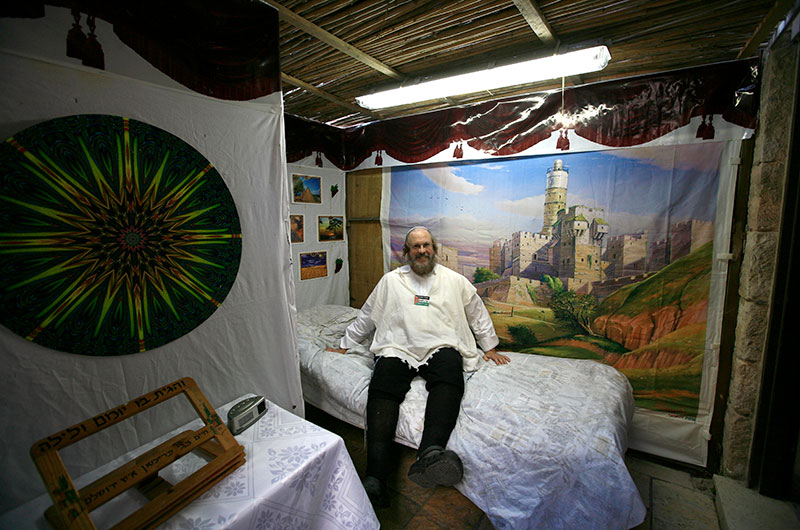


 The Torah states that we should dwell in a sukkah during the Sukkot holiday. The Talmud explains that we should use our sukkahs in the same manner and to the same degree as we live in our permanent addresses. Growing up, we would bring a TV into the sukkah to watch the Major League Baseball playoffs and World Series. (The playoffs were shorter back then. We only had a Mr. October; there was no such thing as a Mr. November.)
While many people are careful to eat everything in the sukkah over Sukkot, far fewer people are as careful when it comes to sleeping in the sukkah. The Talmud raises the possibility that we should be stricter about sleeping outside the sukkah than we are about eating in the sukkah. The halacha is that whereas a small amount of food does not require eating in the sukkah according to the letter of the law, there is no such thing as a small amount of sleep that would not require doing so in a sukkah. If that is the case, why are so many otherwise observant Jews not careful when it comes to sleeping in the sukkah?
One of the central themes of Sukkot is the importance of Jewish unity. Jews spanning different customs seem united in the common practice of not sleeping in a sukkah. The practice of sleeping in the sukkah is one that unites large swaths of Ashkenazic, Sephardic and chassidic communities – in its non-observance. The Rema suggests that men don’t sleep in the sukkah because couples belong together on Yom Tov and it would be difficult for women to sleep in the sukkah. If that would be the only reason, then nowadays people should be encouraged to build sukkahs that would be comfortable and accessible for wives. And hotels that host Sukkot programs should be offering private sukkahs – just as many offer private rooms for the Pesach Seder.
I believe the more compelling reason why sleeping in the sukkah has always been a tough sell is because whereas people may enjoy a picnic meal outside, very few enjoy a night’s sleep outside. In Europe and the Northeast, it’s too cold. In Florida it’s too hot. And buggy. And often rainy. Where the weather is conducive, one should explore the feasibility of sleeping in the sukkah. In Israel you see more people sleeping in the sukkah. Some suggest it’s because that was the practice of the Vilna Gaon, and his students established Ashkenazic minhag Eretz Yisrael. I believe that climate plays an important factor. The climate in Israel is beautiful on Sukkot. The rule of sleeping in the sukkah seems to be the Torah’s ways of telling us that Israel is the ideal location in which to celebrate the holiday.
Rabbi Yosef Weinstock is Senior Rabbi at Young Israel of Hollywood – Fort Lauderdale, Florida.
* * * * *
 Sleeping in the sukkah is a beautiful mitzvah that allows a Jew to fully immerse themselves in the sanctity of the sukkah, which is described in chassidus as being suffused with the “Or makif” – the transcendent Divine light that surrounds us during this festival.
Yet in practice, many observant Jews, particularly in the United States, do not sleep in the sukkah. This isn’t due to apathy or disregard for halacha, but often stems from halachically valid reasons: cold weather, lack of comfort, security concerns, or the inability to sleep properly due to distractions. The Alter Rebbe (Shulchan Aruch HaRav, Orach Chaim 639:8) rules that one who experiences discomfort (“mitzta’er”) is exempt from sleeping in the sukkah – so much so that doing so despite the discomfort would not be a mitzvah at all.
But there’s a deeper reason rooted in Chabad thought. The rebbeim of Chabad, including the Rebbe Rashab and the Frierdiker Rebbe, did not sleep in the sukkah, despite having the means and ability to do so comfortably. The Rebbe once explained (Sichos, Sukkos 5714 and other occasions) that the kedusha of the sukkah is so great and encompassing that sleeping in it – an act of total unconsciousness – could be considered inappropriate or even spiritually insensitive in certain contexts. The Rebbe emphasized the value of consciously experiencing the holiness of the sukkah, which is primarily expressed through eating, learning Torah, and rejoicing inside it.
So, should we encourage more people to sleep in the sukkah? If it can be done comfortably, safely, and in accordance with halacha, it’s a beautiful and meaningful mitzvah. But we must do so without judgment. Not sleeping in the sukkah doesn’t imply laxity or lack of observance – sometimes, it’s a reflection of deeper spiritual sensitivity or halachic adherence.
Instead, we should inspire deeper awareness of the sukkah’s holiness: encourage people to eat all their meals inside it, to learn Torah there, to sing, to farbreng, and to feel the embrace of the sukkah as the “hug” of Hashem. The more we infuse the sukkah with joy and light, the more Jews – whether sleeping in it or not – will internalize its message of Divine protection and unity.
Rabbi Eliyahu Raskin is a devoted community leader, educator, and advocate for Jewish life in Brooklyn Heights. He serves as the rabbi of Chabad of City Tech College and runs Chabad of Brooklyn Law School. Rabbi Raskin also offers weekly Torah classes at Long Island University, and is the founder and director of the Jewish Conversion Academy
* * * * *
 Although sleeping in the sukkah is clearly an integral part of the mitzvah to “reside” (leishev) in the sukkah throughout the holiday, many Jews around the world, and in the U.S. especially, do not do so. There are a number of reasons for this.
First, it must be noted that only Jewish males are obligated to sleep (and reside) in the sukkah. It is a time-bound positive commandment, from which women are exempt. So, the answer for why the female half of the Jewish population does not sleep in the sukkah may very well be that they have no such obligation.
Second, the obligation to reside in the sukkah is limited by the principle of "teshvu – ke'ein taduru." One must live in the sukkah as one would live in their year-round residence. Rema (639:2) states that based on this principle, any married man whose sukkah would not provide him and his wife with the privacy that their bedroom affords would be exempt from sleeping in the sukkah, as in normal, year-round life, husband and wife sleep in the privacy of their bedroom. (Rema adds that optimally a couple would have a private sukkah so that they can reside in the sukkah with the requisite privacy.)
Third, there is a blanket exemption of “mitzta'er” (one who experiences pain) from residing in the sukkah. Historically, Ashkenazim lived in cold, European climates that offer ample reasons to exempt one from sleeping in the sukkah (Rema, 639:2). Bugs and safety concerns are also grounds for the exemption.
Fourth, today we are like the proverbial Princess and the Pea. We sleep on extremely comfortable mattresses in safe, climate-controlled, bug-free environments with a minimum of ambient noise and light coming in from outside. Take these conditions away, and many people have a hard time falling asleep – and sleeplessness constitutes grounds for exemption. True, some people love camping and can sleep just fine on a thin mattress in the great outdoors; by its very nature, the notions of mitzta'er and teshvu – ke'ein taduru have subjective elements.
Finally, Chabad has a custom to sleep in the home, but I do not fully understand the rationale offered.
Thus, there are many reasons why a Jew in the U.S. – or anywhere else – would be exempt from sleeping in the sukkah.
Of course, that does not mean that we should avail ourselves of these exemptions. In most cases (rain being an exception), it is still a mitzvah to sleep in the sukkah, even if one experiences some discomfort.
I therefore think that we need to try to sleep in the sukkah. We should do what we can to make the sukkah a comfortable environment, conducive to sleep. If it's still uncomfortable, we can move back inside. I don't think one would need to try to sleep in the sukkah every night of the holiday once it becomes clear that one will have trouble sleeping in the sukkah. But I think we should try on the first night and if it works out, keep going until it doesn't.
Rabbi Elli Fischer is a translator, writer, and historian. He edits Rav Eliezer Melamed's Peninei Halakha in English, cofounded HaMapah, a project to quantify and map rabbinic literature, and is a founding editor of Lehrhaus. Follow him @adderabbi on Twitter or listen to his podcast, "Down the Rabbi Hole."
* * * * *
 Our sukkahs today are much more comfortable than our grandparents' sukkahs were. In most cases, we have much more space and considerably more comfort than they had. Quite honestly, the weather in Florida and even in New York is much more pleasant than the weather our grandparents in Russia and Poland had over Sukkot. Even so, it seems to me that fewer men sleep in the sukkah today than in our grandparents' generation.
I can't be sure why this is so. However, perhaps part of the problem may be that we have a greater need for physical comfort than our grandparents had. We are unwilling, perhaps even unable, to sacrifice at all, for anything. Our parents and grandparents spent their summers with the windows open, or they went to the Catskills for slightly cooler air. We feel that without air conditioning, we may actually die. Even bunks in summer camp are now air conditioned. We are so accustomed to fine food that we can eat in a single Shabbos the amount of food that our grandparents would eat in an entire month.
I am not valorizing poverty and deprivation. Our lives are, baruch Hashem, better. That is wonderful. However, when our need for creature comforts negatively impacts on ideal shmiras hamitzvos, it may be time to rethink if we are guilty of Devarim 32:15: when Klal Yisrael got too fat they rebelled against Hashem.
Rabbi Ezra Schwartz is a Rosh Yeshiva at Rabbi Issac Elchanan Theological Seminary, where he holds the Harry Rabin Chair in Talmud and Jewish Law. He also serves as the Associate Director of the Semicha Program and teaches halacha at GPATS.