October 2, 2026
 Categories: Torah / Halacha & Hashkafa
Willing Confinement


American youth are familiar with Oscar the Grouch. Oscar, a green monster who resides in a garbage can, is an iconic character on Sesame Street. Oscar is perpetually grumpy and impatient with others and seems to enjoy everything everyone else doesn’t.
There is great depth in the fact that Oscar lives in a garbage can. Resentments, nastiness, and obnoxiousness greatly limit our world, confining us to the doldrums of our negativity. When we are unable to traverse our negativity, we are doomed to living with the smelly rubbish of the refuse that surrounds us. It’s often not easy to pull ourselves out of those garbage cans but doing so expands our world and allows us to enjoy the sunshine around us, even when the sun isn’t shining.
To be honest, Oscar’s trash can is actually bigger on the inside than it seems. In various episodes, Oscar has noted that his trash can boasts such amenities as a farm, swimming pool, ice rink, bowling alley, and piano. Other items include Slimey, Oscar’s pet worm and Fluffy, Oscar’s pet elephant. The trash can also has a back door. In addition, on occasion, Oscar walks while still inside his trash can, with his feet visible below. Nevertheless, at the end of the day, his life is still confined to a trash can.
But is living in a confined area always a bad thing? Is living a metaphorically confined existence always restricting?
The beautiful Yom Tov of Shavuos celebrates the anniversary of our original acceptance of the Torah. Perhaps the most intriguing and well-known question regarding the giving of the Torah has to do with a perplexing statement in the Gemara (Shabbos 88a). The Gemara states that when the nation stood in unity at Sinai to accept the Torah, G-d held the mountain above them like a barrel and said, “If you accept the Torah, all will be well. But if not, there will be your burial place.”
Everyone is familiar with the fact that the Jewish people had selflessly and devotedly accepted the Torah with love, declaring “na’ase v’nishma – we will do, and we will hear.” Why was it necessary for there to be any modicum of coercion after they demonstrated perfect willingness to accept it with all its laws and restrictions? There are numerous answers to this enigma.
Over Yom Tov, I had a novel thought that explains why it is not perplexing at all. In fact, the complete acceptance is not at all at odds with what occurred with the mountain being held menacingly above them like a barrel.
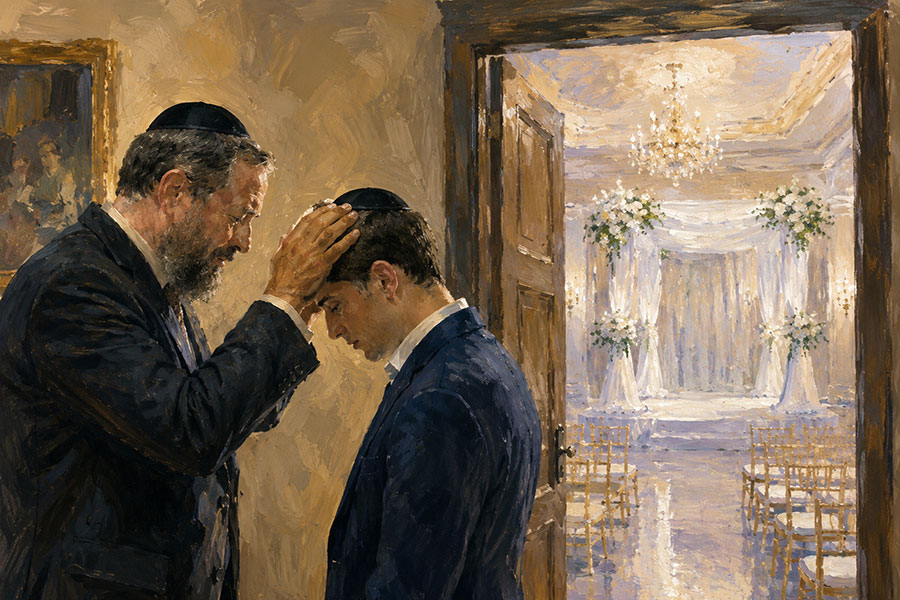
A young man is about to walk down to his chuppah. He has waited a long time for this moment. From the time he excitedly but nervously proposed, and she tearfully smiled and said yes, through all the wedding preparations, including finding an apartment and everything in between, it was all surreal. He dreamed of the opportunity to carve a life for himself with his kallah and now the moment has arrived.
Now, in a private room, the chassan’s father placed his hands gently and lovingly upon his head and blessed him. Then he looked into his son’s eyes and said, “I want to remind you that you have committed yourself to a most wonderful yet serious undertaking. For the past few years, you loved to disappear at night for a few hours, often to go learn. You came back at all hours of the night, and we never knew in advance when that would be. You also would go off with your friends for a few days for fun trips. You would also call us from a restaurant to tell us you weren’t coming home for supper or even for Shabbos. We told you we were okay with that, and it was great. But all that ends now! When you place that ring upon her finger you are committing to be her protective wall, to circle her like that ring, prioritizing her above all else, and to always be thinking about her. She in turn will circle you under the chuppah seven times and pledge to do the same for you.
“You have willingly and lovingly accepted the marriage. In doing so, you have limited yourself in that your world will always be intertwined with hers. In marrying her you have the formidable task of ensuring all your decisions include what’s best for her.”
(Similarly, this week’s “Marriage Minute” email from Gottman Institute emphasized that healthy relationships mean “being there for your partner when they need you” and “putting them first.” It urged couples to “put everything down and turn toward your partner.”)
When Klal Yisrael stood at Sinai and were offered the Torah they accepted it with alacrity and excitement. But in so doing they also committed themselves to ensuring that they would forevermore live their lives according to, and within, the dictates and confines of the Torah. Perhaps G-d never actually held the mountain above them at all, but symbolically they saw their acceptance at Sinai as if that was the case. A barrel has limitations and the Jews now had to live within the Torah’s limitations. (This idea has been proposed by other commentaries as well. In a sefer called “V’haish Moshe,” Rav Moshe Soloveitchik of Switzerland said a similar idea with a different twist.)
Interestingly, the Gemara does not say that if they failed to accept the Torah “here would be your burial place.” Rather, it says “there.” At whatever point later on they would forget the responsibilities of their commitment, there would be their burial place. It’s analogous to a marriage in which, somewhere down the line, one of the spouses no longer prioritizes the other and begins to make decisions selfishly. “There” – when that happens, will be the beginning of the burial place and undoing of the marriage.
Not all limitations are constricting. In building a marriage, we willingly constrict ourselves because we recognize that through the marriage and its limitations, we can accomplish far greater things and become far greater people than we could have without those limitations.
It is no less regarding our relationship with the Divine. In accepting the Torah, we willingly and lovingly accepted the limitations that doing so would entail.