 September 25, 2026
 Categories: Op-Eds
Israel’s Energy Market and the War in Ukraine


In the wake of Russia’s invasion of Ukraine in February 2022, Europe’s energy markets have experienced high electricity prices and multiple gas supply disruptions that have prompted a dramatic rethinking of European energy security strategy. While Europe has been able to withstand the brunt of the energy crisis so far thanks to a relatively mild winter and ample reserves of Russian gas, it is gearing up for a more difficult winter season next year.
Depending on how the war develops in 2023 and how committed European countries prove to be to their sanctions against Russian oil and gas imports, this year may provide several opportunities to develop Israel’s gas export potential, oil transit and storage capabilities, and renewable energy sales. While these opportunities could be rewarding, they entail economic, security, and environmental risks that need to be taken into consideration.
Source: Delek Group Ltd, Presentation for Investors, October 2017. Additional graphics: Elai Rettig
The economic and political impasse surrounding the East-Med pipeline to Greece has reawakened the dormant Israel-Turkey option. Turkey is a large natural gas market with an existing infrastructure (the TANAP pipeline) that can transit gas to Europe, making it — at least in theory — a good candidate for Israeli gas exports. However, attempts in 2015 to promote an underwater pipeline between Israel and Turkey failed over price disagreements and political tensions. Turkey demanded a lower price for the gas than the private gas companies could offer due to Israeli regulations. Israeli officials are also wary of Israel’s becoming too dependent on Turkey as its primary gas customer due to fears that Turkey will use the pipeline as a political tool.
Before signing such a deal, Israel would need to protect itself from deliberate disruption by securing assurances supported by third-party guarantees from either the US or the EU. For its part, the European Union has not been keen on the idea of bolstering Turkey’s position as Europe’s main gas transit country (in addition to its role in transiting gas from the Caspian region, Russia, Iraq, and potentially Iran), as doing so would grant Ankara economic and geopolitical advantages in its dealings with Europe.
The dramatic rise in European gas prices following Russia’s invasion of Ukraine has changed some of the EU’s calculations, but not enough to justify a major pipeline deal to either Greece or Turkey. As prices have reached $25 per mmBTU in some European gas hubs, it may seem that expensive gas pipelines from the Eastern Mediterranean make much more sense than they did two years ago. However, it is not clear how long these high prices will hold. In some places, they have already dropped to pre-war levels.
A major infrastructure project from the Eastern Mediterranean to Europe can be completed by the end of 2025 at the earliest. But will the war in Ukraine still be going on in 2025? Will there still be sanctions against Russian gas? Will Putin still rule Russia? Until European investors know the answers to these questions, it is still a very risky prospect for the private sector to invest in multi-billion-dollar infrastructure. Unless the European Union provides guarantees that private investors won’t lose their investments once prices go down, Israeli gas companies are unlikely to be able to lock down a 10–15-year binding contract with a European customer.
The culmination of these political, economic, and technical limitations has pushed European customers to bet on the LNG option. For Europe, LNG imports offer more flexibility to search for non-Russian suppliers, freedom from transit states, and a quicker solution to the gas crisis than pipelines. While most efforts to build LNG intake terminals (i.e., regasification facilities) in Europe over the past decade have focused on Western Europe, the current crisis is pushing towards more terminals in central and southeastern Europe (including Greece, Italy, Poland, Germany, and Estonia).
Assuming the EU goes through with building these new LNG terminals and increases LNG demand over the next two to four years, it will still need to compete with Asia for demand. Europe has been lucky so far in that it did not need to compete with East Asia for LNG during 2022 due to a mild winter and COVID restrictions in China. But 2023 may see a surge in East Asian demand for LNG as China recovers from lockdowns, and the price may increase substantially. This will require much more LNG supply to come online in the next few years.
Israeli and regional investors are hopeful that LNG will be the next chapter for the East-Med gas export market, ridding it of the geopolitics of pipelines. The cheapest and most immediate option for Israel to export LNG to Europe would be to do it through Egypt’s two existing LNG terminals at Idku and Damietta. However, this does not represent an ideal solution. There is not much spare capacity left at those terminals to increase exports, they do not have the most efficient technology (a considerable amount of gas is lost during liquification), and they offer more geopolitical advantages to Egypt than to Israel. In addition, Israel needs to overcome infrastructure bottlenecks that are preventing it from exporting more gas to the LNG plants in Egypt. A new direct underwater pipeline will need to be built from its gas fields directly to the terminals.
Other LNG export options may exclude Egypt but contain challenges of their own. Israel can lease or purchase a floating LNG (FLNG) facility, which is cheaper and creates much less political pushback (i.e., NIMBY opposition over the shoreline in Israel). However, most FLNG ships generate only small amounts of gas (0.5-2 BCM annually), and even the biggest FLNG offers much less capacity to export compared to a regular land-based LNG terminal (4-6 BCM annually vs. 12 BCM).
Another option would be to construct a land-based LNG terminal in Cyprus. However, this might anger Egypt, which aspires to become the “LNG hub” of the Eastern Mediterranean. It could also create problems with Turkey over contested political waters around Cyprus.
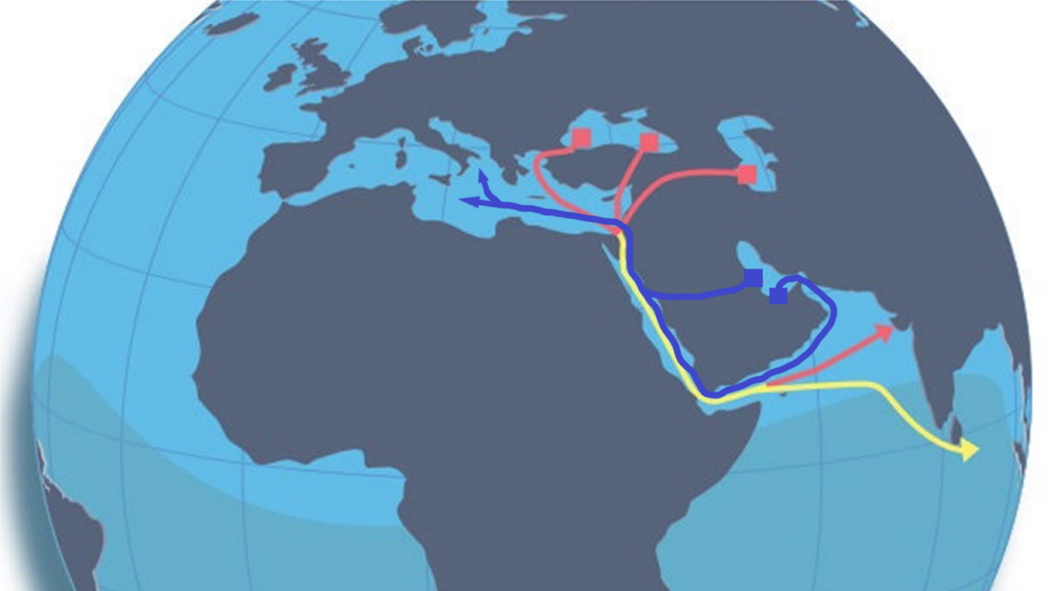 Source: Europe Asia Pipeline Company Website, Digital Magazine. Additional graphics: Elai Rettig
More oil flowing to Europe through Israel and Egypt entails considerable environmental and security risks for both the Red Sea and the Eastern Mediterranean Sea. Potential for oil leaks and accidents will inevitably rise along with increased movement of oil tankers, requiring more cooperation among the countries of the region in standardizing monitoring and quick-response measures. The movement of Israel-bound oil tankers in the Red Sea may also increase potential for Iranian sabotage, especially near the Bab-el-Mandeb Straits, where they could be vulnerable to Iran-backed Houthi rebels in Yemen. Operations of this kind may be more appealing to Iran than operations in the Persian/Arabian Gulf and the Straits of Hormuz, which could block Iran’s oil shipments as well. Increased Iranian maritime threats require deeper cooperation among the region’s naval forces, a process that is already underway.
Source: Europe Asia Pipeline Company Website, Digital Magazine. Additional graphics: Elai Rettig
More oil flowing to Europe through Israel and Egypt entails considerable environmental and security risks for both the Red Sea and the Eastern Mediterranean Sea. Potential for oil leaks and accidents will inevitably rise along with increased movement of oil tankers, requiring more cooperation among the countries of the region in standardizing monitoring and quick-response measures. The movement of Israel-bound oil tankers in the Red Sea may also increase potential for Iranian sabotage, especially near the Bab-el-Mandeb Straits, where they could be vulnerable to Iran-backed Houthi rebels in Yemen. Operations of this kind may be more appealing to Iran than operations in the Persian/Arabian Gulf and the Straits of Hormuz, which could block Iran’s oil shipments as well. Increased Iranian maritime threats require deeper cooperation among the region’s naval forces, a process that is already underway.
- Increased Potential for Israeli Gas Exports
Source: Delek Group Ltd, Presentation for Investors, October 2017. Additional graphics: Elai Rettig
The economic and political impasse surrounding the East-Med pipeline to Greece has reawakened the dormant Israel-Turkey option. Turkey is a large natural gas market with an existing infrastructure (the TANAP pipeline) that can transit gas to Europe, making it — at least in theory — a good candidate for Israeli gas exports. However, attempts in 2015 to promote an underwater pipeline between Israel and Turkey failed over price disagreements and political tensions. Turkey demanded a lower price for the gas than the private gas companies could offer due to Israeli regulations. Israeli officials are also wary of Israel’s becoming too dependent on Turkey as its primary gas customer due to fears that Turkey will use the pipeline as a political tool.
Before signing such a deal, Israel would need to protect itself from deliberate disruption by securing assurances supported by third-party guarantees from either the US or the EU. For its part, the European Union has not been keen on the idea of bolstering Turkey’s position as Europe’s main gas transit country (in addition to its role in transiting gas from the Caspian region, Russia, Iraq, and potentially Iran), as doing so would grant Ankara economic and geopolitical advantages in its dealings with Europe.
The dramatic rise in European gas prices following Russia’s invasion of Ukraine has changed some of the EU’s calculations, but not enough to justify a major pipeline deal to either Greece or Turkey. As prices have reached $25 per mmBTU in some European gas hubs, it may seem that expensive gas pipelines from the Eastern Mediterranean make much more sense than they did two years ago. However, it is not clear how long these high prices will hold. In some places, they have already dropped to pre-war levels.
A major infrastructure project from the Eastern Mediterranean to Europe can be completed by the end of 2025 at the earliest. But will the war in Ukraine still be going on in 2025? Will there still be sanctions against Russian gas? Will Putin still rule Russia? Until European investors know the answers to these questions, it is still a very risky prospect for the private sector to invest in multi-billion-dollar infrastructure. Unless the European Union provides guarantees that private investors won’t lose their investments once prices go down, Israeli gas companies are unlikely to be able to lock down a 10–15-year binding contract with a European customer.
The culmination of these political, economic, and technical limitations has pushed European customers to bet on the LNG option. For Europe, LNG imports offer more flexibility to search for non-Russian suppliers, freedom from transit states, and a quicker solution to the gas crisis than pipelines. While most efforts to build LNG intake terminals (i.e., regasification facilities) in Europe over the past decade have focused on Western Europe, the current crisis is pushing towards more terminals in central and southeastern Europe (including Greece, Italy, Poland, Germany, and Estonia).
Assuming the EU goes through with building these new LNG terminals and increases LNG demand over the next two to four years, it will still need to compete with Asia for demand. Europe has been lucky so far in that it did not need to compete with East Asia for LNG during 2022 due to a mild winter and COVID restrictions in China. But 2023 may see a surge in East Asian demand for LNG as China recovers from lockdowns, and the price may increase substantially. This will require much more LNG supply to come online in the next few years.
Israeli and regional investors are hopeful that LNG will be the next chapter for the East-Med gas export market, ridding it of the geopolitics of pipelines. The cheapest and most immediate option for Israel to export LNG to Europe would be to do it through Egypt’s two existing LNG terminals at Idku and Damietta. However, this does not represent an ideal solution. There is not much spare capacity left at those terminals to increase exports, they do not have the most efficient technology (a considerable amount of gas is lost during liquification), and they offer more geopolitical advantages to Egypt than to Israel. In addition, Israel needs to overcome infrastructure bottlenecks that are preventing it from exporting more gas to the LNG plants in Egypt. A new direct underwater pipeline will need to be built from its gas fields directly to the terminals.
Other LNG export options may exclude Egypt but contain challenges of their own. Israel can lease or purchase a floating LNG (FLNG) facility, which is cheaper and creates much less political pushback (i.e., NIMBY opposition over the shoreline in Israel). However, most FLNG ships generate only small amounts of gas (0.5-2 BCM annually), and even the biggest FLNG offers much less capacity to export compared to a regular land-based LNG terminal (4-6 BCM annually vs. 12 BCM).
Another option would be to construct a land-based LNG terminal in Cyprus. However, this might anger Egypt, which aspires to become the “LNG hub” of the Eastern Mediterranean. It could also create problems with Turkey over contested political waters around Cyprus.
- Turning Israel into an Oil Transit Route to Europe
Source: Europe Asia Pipeline Company Website, Digital Magazine. Additional graphics: Elai Rettig
More oil flowing to Europe through Israel and Egypt entails considerable environmental and security risks for both the Red Sea and the Eastern Mediterranean Sea. Potential for oil leaks and accidents will inevitably rise along with increased movement of oil tankers, requiring more cooperation among the countries of the region in standardizing monitoring and quick-response measures. The movement of Israel-bound oil tankers in the Red Sea may also increase potential for Iranian sabotage, especially near the Bab-el-Mandeb Straits, where they could be vulnerable to Iran-backed Houthi rebels in Yemen. Operations of this kind may be more appealing to Iran than operations in the Persian/Arabian Gulf and the Straits of Hormuz, which could block Iran’s oil shipments as well. Increased Iranian maritime threats require deeper cooperation among the region’s naval forces, a process that is already underway.
- A Brighter Future for Israeli Renewable Energy Technology