 September 18, 2026
 Categories: Headline / Columns
What Nechama Is


Someone from our team set the poster board on the easel, then stepped back and straightened it. It was covered with photographs of children. On the other side of the door, their parents were waiting to come in.
I was at a bereavement Shabbaton, a weekend run by the Ohel trauma team for parents who have lost children. Those of us who sit with bereaved parents learn to stop offering the usual reassurances. It gets different; it doesn't get better. Many parents hear the word "closure" as an insult, and they are right to. Their child is a person who is still in their lives, but missing, and the missing has worked its way into their marriage, their davening, their very sense of who they are.
Standing outside that door, with the emptiness sitting in my chest like a crater, I felt what comes over nearly everyone at the entrance to a shiva house. We arrive wanting to help and find we have nothing to say, because nothing we could say would be equal to what happened. Therapists feel a professional version of it, a pull to do something with a grief that size, to reframe it or move it somewhere gentler. The pull is worth distrusting. The only thing that would help cannot be done, and a helper who cannot bear his own helplessness will begin working on the mourner instead, quietly pressing a grieving person to feel less, sooner, so that the helper can stop feeling so useless.
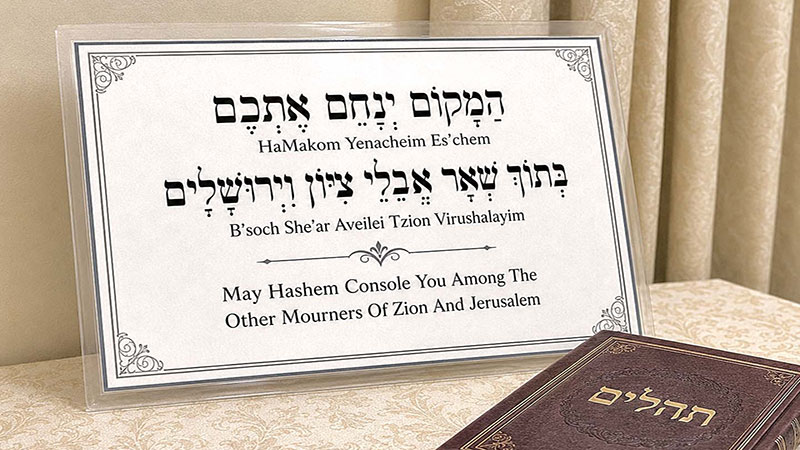
Chazal understood that we would be standing at that door with empty hands, and they put words in our mouths for the moment we have none of our own. HaMakom yenacheim eschem b'soch she'ar aveilei Tzion v'Yerushalayim. May HaMakom comfort you among the remnant of the mourners of Zion and Jerusalem.
Of all the names available to them, they chose HaMakom, the Place. A mourner is someone whose place is gone. The world he lived inside has been taken apart, and he is scattered away from everyone who is still all right. He is alone in a room full of people. “Eicha yashvah vadad ha'ir rabasi am”: how she sits alone, the city once great with people. Five times in that first perek, the megillah says “ein menachem lah,” she has nobody to comfort her. The walls came down, and the wound it will not stop naming is that nobody is sitting with her in it.
Then the beracha does something we say so often that we have stopped hearing it. It places him b'soch she'ar aveilei Tzion, among the remnant of those who mourn for Tzion. Said quickly, that can sound like a correction, as though we were letting him know there are older and larger griefs than his. It is the opposite. The mourning of Tzion belongs to all of us, and naming it sets his pain down among ours. We are telling him that we are in this together. And not only in the grief we all carry in common, but also in his own personal churban (destruction). Your pain is my pain. You are not crying by yourself. Eicha said she had no menachem. Every time we say those words, we are offering ourselves as one.
And what waits at the end of all of it is a gathering. Kibbutz galuyos: everyone who was scattered and isolated brought back together again, held by the makom of the land. Gathering is what the geulah is made of.
So, the beracha promises nothing about the pain lifting. It offers a Place and it offers company, and it stops there. Nechama (comfort) has little to do with feeling better. It means being gathered, having someone keep space open around a pain that cannot be fixed, long enough that the person inside it can begin to live again without being asked to leave his dead behind. The gaping hole stays central. Around it, slowly, among people who understand, a life becomes possible.
Then the door opened, and that is what the weekend turned out to be. Parents cried in the middle of meals and laughed in the middle of stories, and no one flinched, because nobody there needed protecting from any of it. They were seen, witnessed, embraced. Nobody carried the crater alone.
Very little separates that weekend from what happens in my office every week. Most of the people I sit with have nowhere else to put the thing; everyone in their lives needs them to be all right, and so they have learned to arrive everywhere slightly edited. An hour in which nothing has to be managed, where the worst of it can be said out loud and the person hearing it neither flinches nor leaves, does something no technique accounts for. None of it is a professional skill.
Chazal did not hand those words to therapists. They handed them to every Jew with no idea what to do, and the person in front of you does not have to be a mourner. We were given words for the loss everyone can see, the one with a doorway and a week and neighbors who bring food. Most of what people carry has none of that. The man three seats over at davening is somewhere inside his own churban, and there is no minyan for it and nobody is coming, because nobody knows. Which leaves the reaching out to us. We call, we ask a second time, we offer to hold whatever it is and stay long enough to actually hold it. Ram Dass said that we are all just walking each other home.
This week we read the words that give the Shabbos its name. “Nachamu nachamu ami.” Be comforted, be comforted, My people. They are spoken in the plural, to a people standing together, because comfort has never been offered to us any other way. Shabbos Nachamu arrives days after Tisha B'Av, when nothing has been rebuilt and nothing is finished, because nechama was never meant to wait until the grief was over.
What happens when we gather around each other is made of the same substance the geulah will be made of, in the small measure this world can hold, a spark of the thing itself. Yeshayahu says that Hashem will wipe the tears from every face, “umacha Hashem Elokim dimah me'al kol panim.” That day has not come and the tears are not wiped. And still, in a hotel over one Shabbos, in a therapy office on a Tuesday, at a doorway where somebody sits down and stays, in the text message that says I’m here for you, the gathering has already begun.