 September 25, 2026
 Categories: Headline / Perspectives
Why Mamdani Matters – Now


When Zohran Mamdani won the mayoralty, many New Yorkers who had not voted for him responded with a shrug. He had won – but how much difference could one mayor really make?
More than a half-year into his administration, the answer is clear: a great deal. Far from an ideological curiosity confined to City Hall, Mamdani has become one of the country’s most consequential political figures. His tenure is the first real test of what happens when a politician whose worldview is rooted in radical left-wing ideology gains executive power over America’s largest city – and its significance reaches well beyond New York, into the Democratic Party’s future, the place of Israel in American politics, and the nation’s schools and universities.
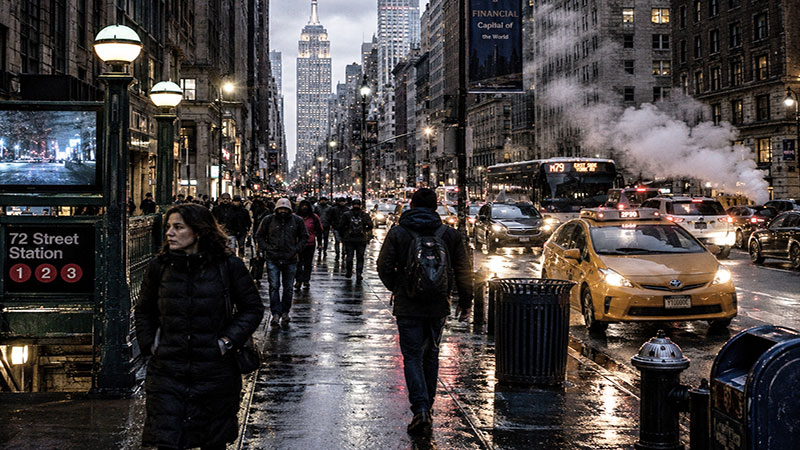
Two recent episodes show what is at stake. On the Upper West Side, a Jewish man walking home from synagogue was stabbed in what prosecutors have charged as a hate crime. According to police and witnesses, the attacker shouted “Allahu Akbar” as he assaulted a visibly Jewish victim. No reasonable person blames the mayor for this crime. But political leaders shape the atmosphere in which people live – what a society condemns, what it debates, and what eventually hardens into just another legitimate point of view. That’s why words matter most when they come from those who govern.
Around the same time, Mamdani repeated a campaign promise by declaring that Israeli Prime Minister Benjamin Netanyahu should be arrested if he came to New York for the United Nations General Assembly. The mayor conceded that he had no legal authority to order any such arrest – and then called for demonstrations against the democratically elected leader of the Jewish State. It was an extraordinary spectacle. The mayor of America’s largest city branding the leader of one of America’s most important allies – the only democracy in the Middle East – a war criminal.
Neither episode, by itself, explains why Mamdani matters. Together they suggest something larger than the conduct of one official. A movement that spent decades reshaping university campuses has crossed a new threshold – into executive government. That is his real significance.
Consider the world that produced him. American universities have long been the incubators of what is called postcolonial theory – a framework that reads global politics through power, oppression, and grievance. As analysis, it is a method; as politics, it becomes a moral narrative in which Western institutions are structurally suspect and Israel is recast as a colonizer.
Mamdani didn’t invent this worldview, but he is one of its most fluent interpreters. As a student activist and then a public figure, he framed housing, policing, and foreign policy within that framework, softening its academic vocabulary while keeping its assumptions.
This matters because governing is not the same as debating a syllabus. A mayor does not merely interpret the world. He allocates resources and sets priorities. In New York, the shift has surfaced already. City Hall increasingly stresses structural explanations for violent crime over individual responsibility and frames enforcement as harm reduction rather than deterrence.
Nowhere is the resulting unease sharper than among Jewish New Yorkers – members of the largest Jewish community outside Israel – who sense it not only in isolated acts of violence but in the broader tone of public life.
The clearest evidence of Mamdani’s significance is electoral. For years, anti-Israel activists worked to move their ideas from the margins to the mainstream, succeeding on campuses and in the culture. Electoral politics stayed different. Most candidates understood that supporting Israel – or at least accepting its legitimacy as the nation-state of the Jewish people – was the safer position. Mamdani has begun to change that calculation, and the June 23 primaries proved it.
He personally endorsed three House candidates. All three won – two by toppling sitting incumbents – in a sweep that ran directly against the choices of Gov. Kathy Hochul, Sen. Chuck Schumer, and House Minority Leader Hakeem Jeffries.
In NY-13, Darializa Avila Chevalier, a 32-year-old doctoral student and former Columbia encampment organizer who had worked as a field lead on Mamdani’s own campaign, unseated five-term Rep. Adriano Espaillat, chair of the Congressional Hispanic Caucus, roughly 49 to 46 percent – after Mamdani switched his backing from Espaillat to Chevalier. Her platform centered on halting U.S. military aid to Israel and full divestment. Her social media history shows support for Marxism and Lenin.
In NY-7, Claire Valdez, a DSA state assembly member who campaigns on an arms embargo against Israel and backs Jewish Voice for Peace’s “Break the Bonds” drive, beat Brooklyn Borough President Antonio Reynoso – Rep. Nydia Velázquez’s handpicked successor – by some 25 points. The New Republic said she almost certainly could not have won without Mamdani’s endorsement.
And in NY-10, former city comptroller Brad Lander – himself Jewish, and a former DSA member who has called Israel’s conduct in Gaza genocide – defeated two-term, AIPAC-aligned Rep. Dan Goldman by about 30 points. The same night, seven more DSA candidates won primaries for the state legislature.
What the sweep demonstrated was not merely momentum, but a cause. New York State Democratic chairman Jay Jacobs claimed voters’ feelings about Israel, not affordability, drove the results. The Anti-Defamation League declared flatly that “a movement built on antisemitic rhetoric won three congressional primaries,” and Mother Jones magazine cast the night as Gaza costing incumbents their seats, with Mamdani the new kingmaker alongside the Justice Democrats and the DSA. ABC quoted him arguing that democratic socialists “can get elected anywhere across this country.”
At Valdez’s victory party, supporters chanted “You’re next!” at footage of Hakeem Jeffries – and allied socialists are already exporting the New York playbook, with a win in Washington and a Los Angeles runoff following.
If ever-harsher attacks on Israel become the way to survive primaries and build progressive credentials, many will adjust – some growing louder, others deciding silence is safest. Either way the center moves.
The politicians who reshape history are rarely those who invent new ideas. More often, they prove that ideas once thought politically dangerous have become politically profitable. Mamdani may come to occupy that place in the evolution of anti-Israel politics. He didn’t create the campaign to delegitimize Israel. It has been building for decades, drawing on left-wing theories that cast Israel as an oppressor, on Islamist movements committed to its elimination, and on older antisemitic traditions – strands that converge, for all their differences, in treating Israel as uniquely illegitimate.
That campaign traveled from the United Nations’ 1975 “Zionism is racism” resolution to Durban, from BDS to the campus encampments – and now into electoral power in the nation’s financial and cultural capital, home to the largest Jewish community outside Israel and to the U.N. itself. Ideas that gain legitimacy in New York seldom stay there.
Two further facts sharpen the point. Exit polling found that roughly a third of Jewish Democratic primary voters backed Mamdani. This validates nothing about his views but hands his allies something long sought – namely, the ability to present denial of Israel’s right to exist as an acceptable Jewish opinion. And he appeals to the young, schooled in the very assumptions he voices. As a result, to many, his positions no longer sound radical but self-evident.
So the pressing question is no longer what Zohran Mamdani believes, but what other politicians are learning from him. Will candidates across the country decide that distancing themselves from Israel – even questioning its legitimacy – has become an asset, and support for Israel a liability in Democratic primaries? These are no longer theoretical questions but questions every friend of Israel, every American Jew, and every serious political observer should be asking.
History rarely turns because one controversial politician wins an office. It turns because hundreds of ambitious politicians study the returns, recognize a new path to power, and take it. That’s why Zohran Mamdani matters – now.
Last November, many New Yorkers greeted his victory with a shrug. If any are still shrugging, they shouldn’t be.