 September 18, 2026
 Categories: Halacha & Hashkafa / Torah
Watch Out for the Weed Whacker
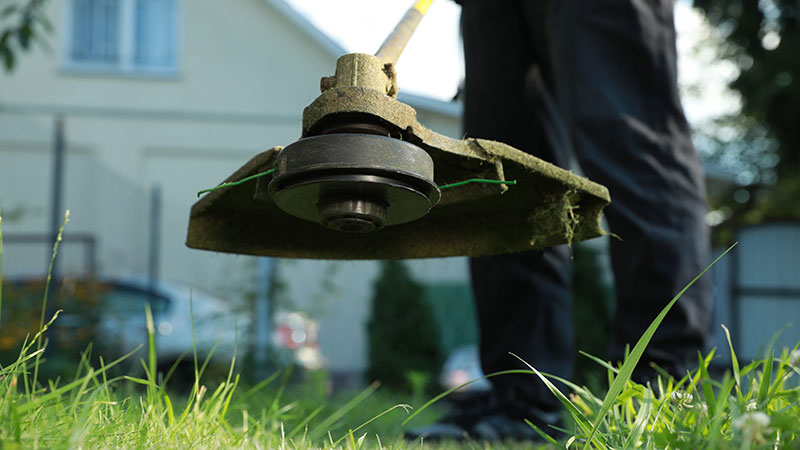


“These weeds are getting out of hand,” Mrs. Mazer said to her husband. “We’ve got to call a gardener to cut them!”
“I’m doing some jobs in your neighborhood this afternoon,” Moish, the gardener, told Mr. Mazer. “I’ll stop by your house afterwards.”
Late in the afternoon, Moish arrived. He unloaded his professional weed whacker – a long pipe with a rotating wire filament at the end.
He revved the engine and the machine roared to life. Moish walked around the yard, cutting the weeds. Occasionally, the filament would hit a rock and send it flying.
Moish turned his attention to the brush near the house – the thick weeds obscured the side of the house completely. He moved over the weeds with his weed whacker. Clump by clump, the thick green weeds yielded to the force of the whirling wire.
As Moish rounded the corner of the house, the “chut, chut” of the weed whacker suddenly became “crack!”
“What was that?” exclaimed Moish with alarm. He put down the weed whacker and pushed aside the clump of weeds he was working on.
“I don’t believe it!” he moaned. Affixed to the side of the house, covered by the weeds, was an electric wire leading to an outside outlet. It had been slashed by the weed whacker.
Moish knocked on the door. “I apologize,” he said to Mr. Mazer, “but under the brush was an electric wire that got sliced by the weed whacker. It was completely concealed by the weeds, so I didn’t see it.”
“I’ll have to get an electrician to fix the wire,” said Mr. Mazer. “Has this ever happened to you before?”
“Nope, first time it ever happened,” said Moish. “I’m generally careful, but this wire was completely covered.”
“You still have to watch what you’re doing, especially when working near the house,” said Mr. Mazer. “You damaged my property, so you should pay for the repair.”
“It’s not like I just came and damaged,” argued Moish. “You asked me to cut the weeds, and I can’t be expected to look under every clump before I cut. I’d be here all afternoon!”
“But you do have to be more careful near the house,” replied Mr. Mazer. “I’ll see what the electrician charges and then we’ll talk.”
Mr. Mazer asked his electrician to fix the wire. “That will be $75,” said the electrician.
Mr. Mazer called Moish. “The electrician charged $75 for the repair,” he said.
“That’s my whole fee!” said Moish. “If you want me to pay that, I won’t have earned anything on this job. It’s simply not fair!”
“Nor is it fair that I should pay double,” responded Mr. Mazer.
The two approached Rabbi Dayan and asked:
“Is Moish liable for the damage to the electric wire?”
“The Mishna (B.K. 26a) teaches that a person is generally liable for any damage that he does, even if unintended and not his fault,” replied Rabbi Dayan (C.M. 421:3).
“However, Tosfos (B.K. 27b s.v. U’shmuel) explains that the person is only liable if he carries some element of blame, even if not negligent (oness k’ein aveidai). A paid worker carries additional liability, so long as he could have prevented the loss (oness k’ein geneiva). Even a paid worker, though, is not liable for damage beyond his control (oness gamur) (C.M. 306:4, 378:1).
Ramban (B.M. 82b) maintains that one who damages is liable regardless of the circumstances, unless the owner was remiss in allowing the damage. However, even he concedes that a worker who acted upon instruction is not liable for circumstances beyond his control.
Similarly, the Mishna (B.K. 98b) teaches that if a construction worker was hired to dismantle – not demolish – a stone wall, and while dismantling one end of the wall, the other end collapsed and usable stones shattered or caused damage, he is exempt. One explanation is that this was an accident beyond his control (C.M. 384:3; MeiriB.K. 98b).
In our case, Moish damaged the electric line, albeit unintentionally. Since he was being paid, he is liable, so long as it was feasible for him to notice the electric wire, even if he bears only minimal blame. He is exempt only if the accident was beyond his control or if the owner was negligent in not alerting him (see Pischei Choshen, Sechirus, 7:24[56-57]).
“Since circumstances are variable,” concluded Rabbi Dayan, “and it is difficult to ascertain whether it was feasible for the gardener to have noticed the wire, and whether the owner should have warned him, it is best to compromise.”
Verdict: The gardener is liable unless it was not feasible for him to notice the electric wire or the homeowner was remiss in not alerting him to its existence. Since this is difficult to ascertain, it is best to compromise and share responsibility for the damage.