 August 21, 2026
 Categories: Collecting / Arts
Dr. Simone Schimdt, A Little-Known Holocaust Hero


Dr. Simone Schmidt occupies a morally powerful place in the history of the rescue of Jews during the Holocaust and, although her name is not among the most widely known figures of the resistance, the surviving documentation – much of which is exhibited here – reveals a life of profound courage, quiet conviction, and decisive action during one of the darkest moments in European history.
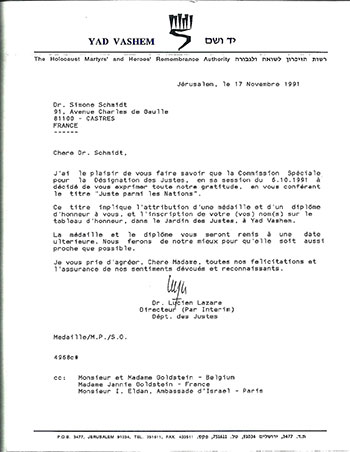
Exhibited here is the official notice from Yad Vashem to Schmidt advising that she had been selected as a Righteous among the Nations:
Yad Vashem
The Holocaust Martyrs' and Heroes' Remembrance Authority
Jerusalem, November 17, 1991
Dr. Simone Schmidt
91, Avenue Charles de Gaulle
81100 – Castres
FRANCE
Dear Dr. Schmidt,
I have the pleasure of informing you that the Special Commission for the Designation of the Righteous, at its session of October 6, 1991, decided to express its profound gratitude to you by conferring upon you the title of “Righteous Among the Nations.”
This title entails the awarding to you of a medal and an honorary diploma, as well as the inscription of your name(s) on the Roll of Honor in the Garden of the Righteous at Yad Vashem.
The medal and diploma will be presented to you at a later date. We will do our utmost to ensure that this takes place as soon as possible.
Please accept, dear Madam, our warmest congratulations and the assurance of our devoted and grateful sentiments.
(signature)
Dr. Lucien Lazare
Director Department of the Righteous (Acting)
Copies to:
Mr. and Mrs. Goldstein – Belgium
Mrs. Jannie Goldstein – France
Mr. I. Eldan, Embassy of Israel – Paris
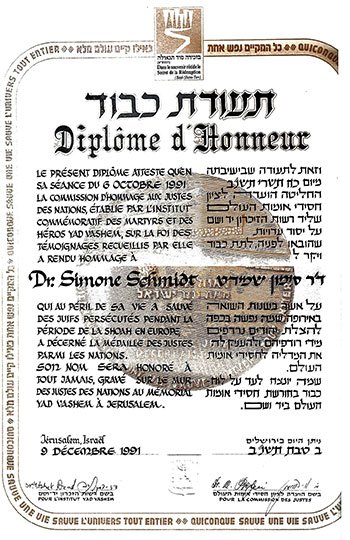
A physician by profession and a member of the French Resistance by conviction, Schmidt used her position in wartime France to save Jews from arrest and deportation, most notably in the dramatic rescue of the Goldstein family. In recognition of these actions, she was honored in 1991 by Yad Vashem with the title Righteous Among the Nations, perhaps the most meaningful distinction bestowed upon non-Jews who risked their lives to save Jews during the Holocaust. Her story illustrates how moral courage can manifest in practical ways through medical expertise, personal networks, and steadfast refusal to cooperate with injustice and how individuals embedded in ordinary professional roles could become lifesavers when confronted with the moral collapse of their society.
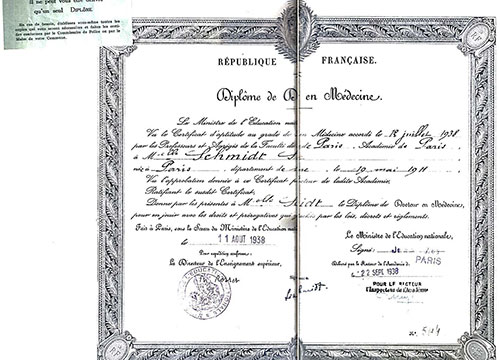
Schmidt was born in Paris at a time when France was emerging from the political and social tensions of the early twentieth century. Growing up in the French capital, she belonged to a generation whose childhood coincided with the trauma of the First World War and whose adulthood would be defined by the cataclysm of the Second. She pursued higher education in medicine, entering the demanding environment of French medical training in the interwar period, and, by August 11, 1938, just months before the outbreak of the Second World War, she had successfully completed her studies and received her Doctor of Medicine diploma from the Faculty of Medicine in Paris. This achievement, which represented years of discipline and intellectual dedication, placed her within a respected professional class whose members often held influential positions in local communities.
At the time she earned her degree, Europe was already sliding toward catastrophe: The rise of Nazi Germany, the intensification of antisemitic legislation in Germany and elsewhere, and the looming prospect of war formed the backdrop against which Schmidt began her medical career. As a result, what had initially seemed like a path toward a conventional life of clinical practice would soon become the framework for acts of resistance and rescue.
After completing her medical education, Schmidt eventually settled in the southwestern French town of Montauban in the department of Tarn-et-Garonne, a historically significant city notable for its Protestant heritage and long tradition of religious dissent dating back to the French Wars of Religion. This background of Protestant independence would prove important to her own world view, and sources describe her as a committed Protestant who maintained connections with prominent Protestant leaders in France. Among those with whom she had ideological or personal affinity was the influential pastor Marc Boegner (1881-1970), a leading French Protestant theologian and ecumenical figure who became one of the most influential voices in French Protestantism in the first half of the 20th century. During World War II, he became especially prominent for his opposition to antisemitic policies under the Vichy regime; he used his position to protest discriminatory legislation against Jews and advocated for protection of persecuted Jews in France. (After the war, he was widely recognized for his moral stance and interfaith solidarity and was later honored by Yad Vashem as a Righteous Among the Nations.)
When France fell to Germany in 1940 and the collaborationist regime of Vichy France was established, the situation for Jews in France rapidly deteriorated, as anti-Jewish laws excluded Jews from public life, confiscated their property, and ultimately facilitated their deportation to Nazi extermination camps. In southern France, where Montauban was located, the presence of refugees, political exiles, and Jewish families fleeing German-occupied areas created a fragile environment in which survival depended on secrecy, mobility, and the willingness of sympathetic non-Jews to provide assistance, and it was within this environment that she began to transform her professional identity as a physician into a tool of resistance.
During the war, Schmidt worked at the Montauban hospital which, in ordinary circumstances, would have meant treating illness and injury among the civilian population. Under occupation, however, the hospital also became a crossroads for fugitives, refugees, resistance members, and victims of the regime’s repression, and she quickly became involved in the French Resistance, a loosely organized network of individuals and groups committed to undermining German authority and aiding those persecuted by the Nazis. Her later documentation included “Carte de Combattant Volontaire de la Résistance,” confirming her participation as a voluntary combatant in the resistance movement, a status that was not merely symbolic but reflected real participation in clandestine activities that exposed her to the risk of arrest, imprisonment, or execution.
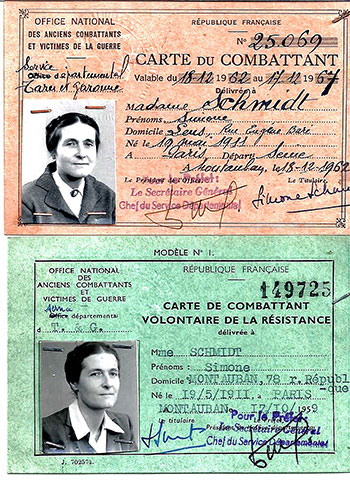
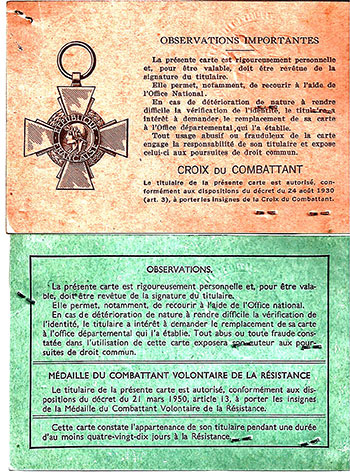
Exhibited here are two original Veteran’s Combatant Cards issued to Schmidt, one of them issued in recognition of her actions as a volunteer in the Resistance. The verso of the first card reads:
IMPORTANT OBSERVATIONS
This card is strictly personal and, to be valid, must bear the holder's signature.
It enables one, in particular, to seek assistance from the National Office.
In the event of damage of such nature as to render identity verification difficult, the holder is advised to request a replacement card from the Departmental Office that issued it.
Any abusive or fraudulent use of the card renders the cardholder liable and exposes them to ordinary legal proceedings.
COMBATANT’S CROSS
The holder of this card is authorized, in accordance with the provisions of the Decree of August 24, 1930 (Art. 3), to wear the insignia of the Combatant's Cross.
The Combatant’s Cross is a French recognition created after World War I to honor soldiers who had served under actual combat conditions. It was not awarded simply for military service, but specifically for having been exposed to enemy fire or having served in designated combat zones, and it is closely tied to the Combatant’s Card, which was the official administrative proof that a veteran had been recognized by the French state as a combatant. The cross itself was the visible insignia corresponding to that recognized legal status.
Eligibility generally required documented service in units exposed to combat, often including a minimum period in a combat zone (commonly around ninety days in World War I recognition systems), though exceptions existed, including being wounded in action, receiving an official combat citation, or being taken prisoner under combat circumstances. The determination was administrative and based on military records and supporting documentation.
Socially, the status of “combatant” carried considerable prestige in interwar France. World War I had a profound national impact, and recognized combat veterans were widely regarded as having performed a central civic sacrifice; this status became a key element of veterans’ identity, supported by major associations and reflected in public honors, pensions, and various administrative advantages. The insignia itself functioned not only as a decoration but also as a visible marker of a legally recognized category of veteran.
The decree of August 24, 1930, part of the French state’s effort to standardize and formalize the recognition of combat veterans and their rights, helped to define the legal framework for issuing the Combatant’s Card and clarified the conditions under which individuals could be officially recognized as combatants. It also regulated the right to wear the insignia associated with that status, ensuring that only those formally recognized by the state could display it. Article 3 of that decree specifically provided the legal authorization for holders of the Combatant’s Card to wear the insignia of the Combattant’s Cross. This was significant in France at the time because the wearing of medals and insignia was strictly regulated, and Article 3 served as the legal bridge between administrative recognition and the right to display the symbol publicly.
Schmidt’s medical profession gave her several advantages that could be used for rescue operations. Physicians possessed authority in matters of health and could issue official certificates regarding the condition of patients, which often carried legal weight and could delay transfers, prevent imprisonment, or create opportunities for escape. Exploiting these possibilities with remarkable ingenuity, she issued false medical certificates that declared individuals unfit for transport or detention, thereby preventing their immediate deportation or arrest. In other cases, she used her access to medical facilities to conceal fugitives or to provide treatment that allowed them to recover before escaping to safer locations. Her role as a doctor also allowed her to move relatively freely within the region, and she possessed a vehicle and travel permits that facilitated her ability to transport individuals discreetly to hiding places such as remote farms or religious institutions.
The networks that supported these activities were extensive and often involved cooperation between Protestant and Catholic figures in the region, and Schmidt worked closely with religious leaders and members of the local resistance. These individuals formed part of what historians sometimes call the “spiritual resistance,” a movement within the churches that rejected antisemitic policies and sought to protect Jewish refugees. Schmidt played a practical and indispensable role within this network because she was able to retrieve Jewish children arriving by train, provide them with medical cover stories, and escort them to convents or rural refuges where they would remain hidden.
One of Schmidt’s most renowned and well-documented acts of rescue involved a Jewish refugee named Maurice Goldstein, who had fled Belgium with his wife and young daughter after the German invasion of 1940. Like many refugees, he eventually found temporary shelter in rural southern France, settling near Montauban, and the family lived quietly under the protection of sympathetic local farmers, attempting to avoid the attention of the authorities. However, the environment remained extremely dangerous, as the collaborationist militia and German security forces frequently conducted searches for Jews and denunciations by neighbors or informants could lead to immediate arrest – and execution.
At one point, the Goldstein family received a warning that militiamen had arrived in their village and intended to arrest them. Such warnings were not uncommon; sympathetic gendarmes or local residents sometimes alerted Jewish fugitives to impending raids. Maurice Goldstein attempted to escape by jumping from a window and fleeing toward the nearby forest, a tactic he had used successfully in the past but, on this occasion, the militiamen, anticipating his escape, were waiting outside and opened fire, striking him with a bullet. Severely wounded, he was captured and transported under guard to the hospital in Montauban.
It was there that Schmidt’s intervention became decisive. She examined the wounded man and quickly recognized both the danger he faced and the opportunity presented by his medical condition. Goldstein’s wife sought assistance and was advised by local officials to contact Schmidt, who was already known for her sympathy toward those threatened by the regime, but Schmidt had come under suspicion by the German authorities because of her known connections with resistance figures. Notwithstanding the terrifying risk, she issued a medical certificate stating that Goldstein was in a condition that made him “intransportable,” meaning that he could not be moved without endangering his life, an official declaration that prevented the authorities from immediately transferring him to prison or deportation facilities.
The delay created by Schmidt’s certificate was crucial because it allowed time for Goldstein to recover sufficiently from his wound and to plan an escape. Eventually, he managed to flee from the hospital, disappearing once again into hiding and, after his escape, he was sheltered by members of the local rescue network, including the Meilhan family, who also hid his wife and daughter. Later, as the dangers intensified during the final years of the occupation, Goldstein joined the Maquis, the guerrilla forces of the French Resistance operating in rural areas and, when the war ended and France was liberated, the family was reunited.
Schmidt’s role in this episode did not go unnoticed by the authorities. By issuing a false medical certificate and facilitating the escape of a Jewish prisoner, she had openly defied the regulations of the occupation regime and she was arrested and accused of issuing fraudulent documents and aiding a fugitive. Under the conditions of wartime France, such accusations could easily lead to imprisonment, deportation, or execution; in fact, rumors circulated that she had been executed for her actions. She did survive the ordeal, although the exact details of her detention remain obscure. After the war, the Goldstein family undertook an investigation to learn what had happened to their rescuer and discovered, to their relief, that she had survived the Holocaust.
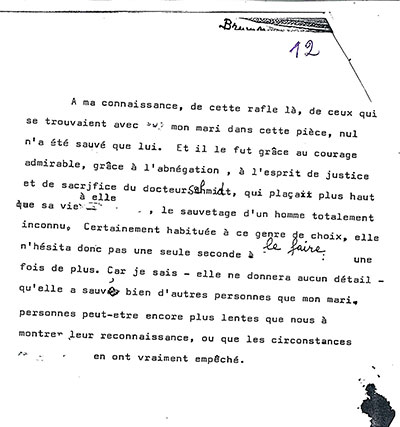
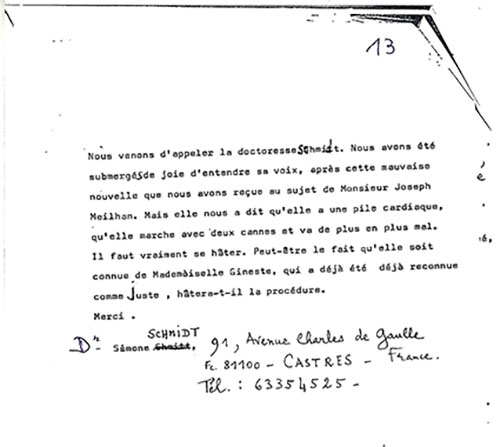
The Yad Vashem file on Schmidt is bolstered by dozens of pages of testimony regarding heroic and courageous acts. Exhibited here is the close of the long petition to Yad Vashem by the Goldsteins attesting to Schmidt’s heroism in saving Maurice Goldstein’s life:
…This is the story of my husband's arrest. Like all the unfortunate people arrested that same day in Montauban, he was to be sent to the death camps, and owed his survival to the admirable courage of a resistance fighter, Dr. Schmidt. Although already suspected by the Gestapo, she did not hesitate to forge a medical certificate, thanks to which my husband was taken to the hospital, from which he escaped. Dr. Schmidt was arrested shortly afterward by the Gestapo on October 13, 1943. One of her fellow resistance fighters was executed, and she herself owed her survival to a miraculous stroke of luck…
Although this delay of nearly half a century – before the woman who issued that life-saving certificate could be recognized as Righteous – is entirely our fault, I most earnestly implore you to act with haste. Dr. Schmidt is no longer young, and her health is delicate.
She displayed extraordinary courage. She knew she was under suspicion – on the verge of arrest. She was well aware of the atrocious methods employed against captured Resistance fighters. Yet, she did not hesitate for a single second to provide me with this certificate; I did not even have to insist. I explained the situation to her, and the moment I finished speaking, she began drafting the document – a document that could well have sealed her own doom . . . Without it, my husband would have been sent to the death camps. I know that among those confined with him in the prison were – among many others – a sixteen-year-old boy and an old man. Both prayed ceaselessly.
To the best of my knowledge – of that particular roundup, and of those who were with my husband in that room – no one was saved but him. And he was saved thanks to the admirable courage, the selflessness, and the spirit of justice and sacrifice of Doctor Shmidt, who placed the saving of a total stranger above her own life.
Undoubtedly accustomed to making such choices, she therefore did not hesitate for a single second to do so once again. For I know – though she will offer no details – that she has saved many other people besides my husband: people perhaps even slower than we were to show their gratitude, or who circumstances truly prevented from doing so.
We have just called Dr. Schmidt. We were overwhelmed with joy to hear her voice, following the bad news we received regarding Mr. Joseph Meilhan. However, she told us that she has a pacemaker, walks with two canes, and is in increasingly poor health. We really must act quickly. Perhaps the fact that she is known to Miss Gineste – who has already been recognized as a Righteous Among the Nations – will help expedite the process. Thank you.
(Marie-Rose Gineste was recognized as a Righteous Among the Nations for using her position and daily life in occupied France to help Jewish individuals and families evade arrest and deportation, providing them with shelter, concealment, and practical aid at great personal risk. She is also credited with helping arrange safer passage or contacts that allowed Jews to escape toward unoccupied zones or across borders.)
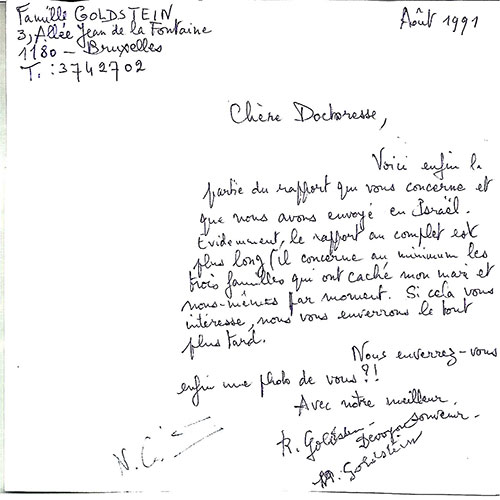
Exhibited here is an August 1991 correspondence from the Goldstein family to Schmidt regarding the testimony that they submitted to Yad Vashem:
Goldstein Family
3, Yeau de la Fontaine Alley
1180 -- Brussels
Dear Doctor:
Here is finally the part that concerns you and that we sent to Israel. Obviously, the reinforcement and completion is longer (it concerns at minimum the three families who have hidden my husband and ourselves for a while). If this interests you, we will send you the piece later.
Will you finally send us a photo of yourself?
With our best
R. Goldstein
Wishing you remembrance
M. Goldstein
The rescue of Maurice Goldstein was not the only instance of Schmidt’s assistance to Jews. Evidence suggests that she repeatedly used her professional authority to shield individuals from deportation, issued medical attestations to those threatened with arrest, arranged transportation to safe houses, and coordinated with clergy and farmers who provided long-term hiding places. One particular account recalls that she entrusted a Jewish girl to a Protestant pastor’s family for protection, later retrieving her when the situation became too dangerous.
It is always fascinating to study the motivation and character of the Righteous Among the Nations, and understanding why Schmidt chose to undertake such risks requires examining the moral and social influences that shaped her character. The first factor that appears particularly significant is her religious background; as a committed Protestant in a region with strong Protestant traditions, she belonged to a community that emphasized individual conscience and the duty to resist unjust authority, including particularly French Protestant leader Marc Boegner.
A second influence was Schmidt’s professional identity as a physician. Medical ethics emphasize the obligation to preserve life and alleviate suffering without discrimination but, under Nazi racial ideology, medicine was often perverted into an instrument of persecution, with doctors participating in forced sterilizations, euthanasia programs, and selections for extermination. For a physician committed to the traditional principles of medical ethics, such developments represented a profound betrayal of the profession’s values, and Schmidt’s actions can be interpreted as a defense of those values such that by using her medical authority to save lives rather than destroy them, she reaffirmed the humanitarian purpose of medicine.
Third, personal encounters with Jewish patients and refugees likely reinforced Schmidt’s convictions. In the hospital environment, she treated many Jews who had fled persecution or suffered injury during attempts to escape arrest, encounters that transformed abstract moral questions into personal relationships. Thus, when a wounded man like Maurice Goldstein arrived at the hospital, she did not see him as merely a statistic in the machinery of deportation but as a human being whose survival depended on the courage of those around him. Her response suggests that she recognized this humanity and refused to allow bureaucratic regulations to determine the fate of her patients.
Fourth, the broader context of the French Resistance also played an important role. By joining the resistance movement, Schmidt became part of a community that rejected collaboration and sought to restore France’s moral integrity, and Resistance members often – but by no means always, as history has proven – regarded the protection of Jews as inseparable from the struggle against Nazi domination. The rescue of persecuted individuals demonstrated that the values of liberty, equality, and fraternity, ideals deeply embedded in French political culture, had not been entirely extinguished by defeat and occupation.
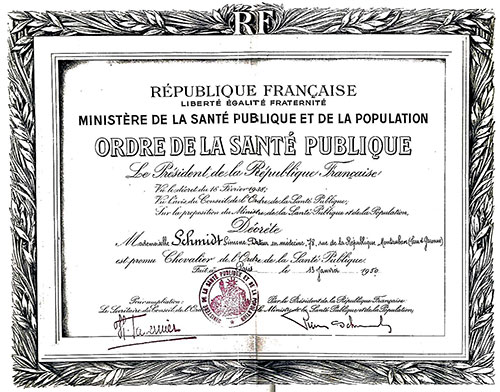
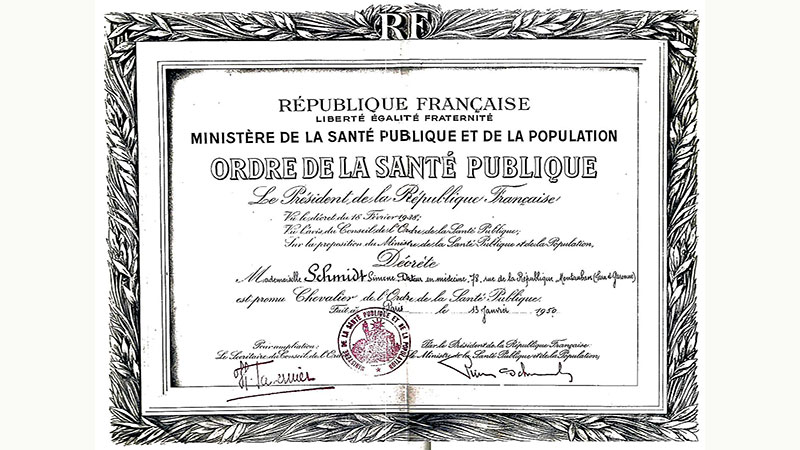
After the war, Schmidt continued her medical career and gradually received official recognition for her wartime contributions. In January 1950, the French Ministry of Public Health promoted her to the rank of Knight of the Order of Public Health (see exhibit), acknowledging her service both as a physician and as a public servant, and she was later awarded the “Carte du Combattant” (see exhibit above), a document recognizing her as a veteran of the conflict because of her participation in the resistance. These honors confirmed that her actions had been officially acknowledged within France although, like many resistance figures, she appears to have lived modestly and without seeking publicity.
In the years following the war, survivors often returned to the places where they had been hidden and sought out the individuals who had helped them, with these encounters forming the basis of many testimonies submitted to Yad Vashem. The Goldstein family’s investigation into Schmidt’s fate and their eventual confirmation that she had survived reveal the depth of gratitude felt by those she rescued, and their testimony ensured that her actions would be documented and recognized long after the events themselves had faded into history.
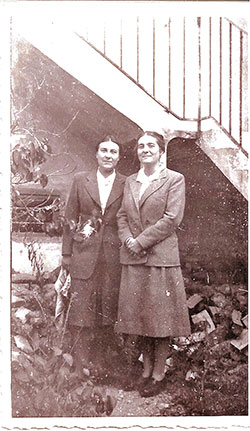
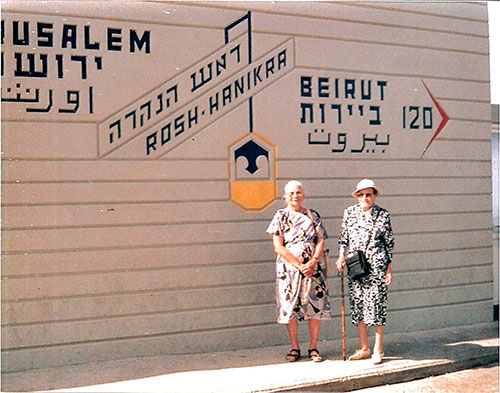
Newly surfaced photographic evidence places Schmidt in Israel, including at Rosh HaNikra, confirming that she did in fact visit the country. However, no archival documentation has yet been identified linking her visit to an official Yad Vashem ceremony or to meetings with Israeli leaders, so it appears most likely that, while honored as Righteous Among the Nations in 1991, she received her award outside Israel and visited the country at a later date, likely in a private or informal capacity.
Simone Schmidt’s life demonstrates that heroism during the Holocaust did not always involve dramatic confrontations or large-scale rescue operations and that it sometimes took the form of quiet decisions made within the ordinary routines of daily work. A doctor examining a wounded patient, a signature placed on a medical certificate, a discreet drive to a remote convent – these seemingly mundane actions could become acts of defiance against a system built on persecution and violence. By performing such acts repeatedly and with unwavering determination, Schmidt transformed her professional responsibilities into instruments of moral resistance. Even within societies subjected to intense propaganda and repression, individuals retained the capacity to choose compassion over indifference and courage over fear. Simone Schmidt stands among those who made that choice.
Schmidt’s story also highlights the importance of local networks in the rescue of Jews. The farmers who sheltered the Goldstein family, the clergy who provided moral support, and the resistance members who coordinated escapes all contributed to a collective effort that extended far beyond any single individual. Schmidt’s role as a physician allowed her to connect these networks, moving between hospital, countryside, and religious institutions while maintaining the secrecy necessary for their survival. Ultimately, her importance lies not only in the specific lives she saved, but also in the example she set, as she demonstrated that professional authority can be used either to enforce injustice or to oppose it and that individuals operating within oppressive systems still possess the capacity to act according to conscience. In a period when many institutions failed to protect the vulnerable, Schmidt chose to place her skills, reputation, and personal safety at the service of those targeted for destruction. Her recognition by Yad Vashem ensures that this legacy will endure, reminding future generations that even in times of overwhelming darkness, the actions of a single person can preserve life and dignity.