 August 21, 2026
 Categories: Features
The Many Streets Named For Rav Mordechai Eliyahu
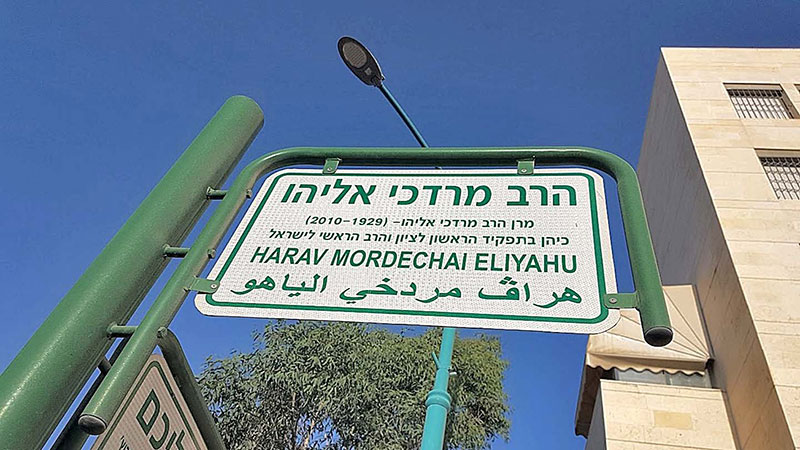


Driving through cities across Israel, you’ll often come across a familiar name: Mordechai Eliyahu.
It appears on street signs in Jerusalem, Beit Shemesh, Netanya, Lod, and beyond. The reason so many streets are named for someone who passed away as recently as 2010 is that Rav Eliyahu brought Torah into every aspect of life in the Jewish state and, through his halachic rulings, influenced countless people.
Rav Mordechai Eliyahu was born in Jerusalem in 1929, the son of a leading kabbalist. At just 28, he became the youngest member ever to serve as a judge in the Israeli rabbinical courts – an early recognition of his remarkable scholarship. He later served as the Sephardic Chief Rabbi of Israel from 1983 to 1993, becoming one of the most influential halachic authorities of his generation.
Rav Eliyahu was respected across a wide spectrum of religious communities in Israel – a rare figure whose authority transcended internal divisions. He did not remain confined to the beit midrash, though he spent countless hours there immersed in study. For Rav Eliyahu, Torah was not theoretical; it was meant to provide practical guidance.
Accordingly, he was deeply immersed in the realities of a modern Jewish state. He grappled with big-picture questions of public policy, security, and the challenges facing Israeli society. At the same time, he made himself available to individuals seeking guidance on their own challenges.
He visited IDF bases regularly, speaking with soldiers and addressing the complexities of observing halacha in the context of military service. He also received a steady stream of people who lined up outside his home each day, waiting for guidance on real-life issues, including medical decisions, financial dilemmas, and family challenges. He approached each question with seriousness and clarity.
That same care extended to the most vulnerable. Rav Eliyahu was known for his sensitivity to widows and orphans, making time for those often overlooked and ensuring that they were seen and cared for.
My business partner, Eliezer Goldberg, once shared an interaction that captures the essence of Rav Eliyahu. A client who deeply admired him hesitated to move forward on purchasing an apartment in Jerusalem’s Givat Mordechai neighborhood, where Rav Eliyahu lived, without first receiving his guidance and blessing. When asked whether it was a good deal, Rav Eliyahu refrained from offering a ruling. Instead, he directed the question to his wife, explaining that between them, she had the better understanding of the real estate market.
The story reflects Rav Eliyahu’s humility and his understanding that Torah leadership also means recognizing the expertise of others.
The streets named for Rav Mordechai Eliyahu honor a rabbi who applied Torah to address the practical challenges of building and living in a Jewish state. His life reminds us that building a Jewish state is one achievement; infusing that society with Torah and holiness is another.