 October 16, 2026
 Verboten Combos & Another Shot at Zachor


Parshat Ki Teitzei
Parshat Ki Teitzei has 74 mitzvot! That gets an exclamation point at the end of the sentence rather than a period. Those 74 mitzvot are 12.1% of the Torah’s 613. To put that into perspective, as one of the 54 sedras of the Torah, Ki Teitzei is 1.85% of the Torah, but with 12.1% of its mitzvot. Its slightly above average pasuk-count raises its share of the Torah to 1.88%. If mitzvot were evenly distributed in the Torah (which they are definitely not), Ki Teitzei would claim 11.5 mitzvot.
What does this number-one mitzva-count say to us? I would suggest two things (at least).
First, Moshe Rabbeinu realizes that his days are numbered and that he has so much more to do, and we can sense that in the text. R’ei, Sho-f’tim, and now Ki Teitzei show us that Moshe’s full-speed-ahead mitzva review and presentation reflects his knowledge of his short remaining timeframe.
Second, we read Ki Teitzei when Elul is well underway and the Yamim Nora’im are looming close. One of the questions each of us should be asking ourselves is: What is my agenda for Elul? The answer is: mitzvot! All flavors of mitzvot. That’s what we see in Parshat Ki Teitzei. I’ll give you a sampling of them a bit further down this column.
Size-wise, Ki Teitzei is rather average. In fact, its 110 p’sukim are the closest of any sedra to the average for the Torah of 108.26 p’sukim per sedra. Ki Teitzei is 28th of the 54 sedras in p’sukim. (Notice that 54 divided by 2 is 28.)
It goes up a few notches for words and letters and, most notably, for lines in a Sefer Torah. Its 212.8 lines earn it 21st place, reflecting the fact that Ki Teitzei has the most parshiyot in the Torah – 44. That includes a lot of blank space left by the sofer between one parsha and the next.
* * * * *
The mitzvot in Ki Teitzei encompass all categories of mitzvot – those between the Jew and Hashem, interpersonal mitzvot, those related to the Land of Israel, universal mitzvot, positive commands, prohibitions...
Let’s take a look at some of the mitzvot in Ki Teitzei that have a lesson and message beyond the details of the mitzva.
There is a prohibition not to leave a fellow’s beast of burden collapsed under its weight, and a positive mitzva to help unload a fellow’s animal.
Aside from the obvious image of a donkey overloaded with bundles of straw and the kindness shown to the animal when we help unload it, there is also the effect this mitzva has on us – increasing our sensitivity toward others.
And then there is the Sefer HaChinuch on this mitzva, which explains that if we are commanded to help unload an animal’s burden, how much more so are we commanded to help our fellow human being with his bundles and burdens. When you see a neighbor, whose fingers are becoming numb from the many plastic bags weighing down on his hand at the spot where the fingers meet the palm, ask him if you can help him carry his bags. It is a double mitzva and it’s a nice thing to do.
And if you are on the receiving side of “May I help you with that?”, resist the reflex to say, “No thanks, I got it.” Let the person help you. He gets a mitzva. You get an assist. It’s a win-win situation.
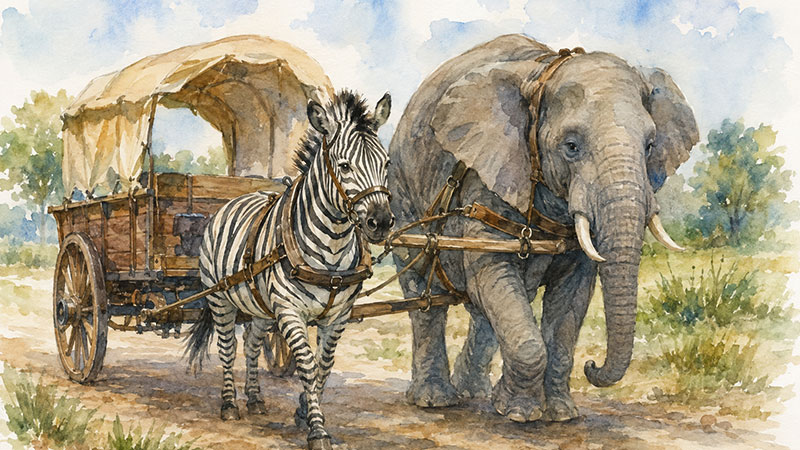
Here’s another mitzva from Ki Teitzei: not to harness to incompatible animals for any task (plowing is the Torah’s example). And another one: not to muzzle an animal when it is working with food.
Both of these seem to be teaching us kindness to animals. And the same principle would apply to putting two incompatible people on the same committee.
But here’s an interesting question. Who is the one who benefits from someone not violating either of these two prohibitions?
You might think it is the animals in question. Yes, they do benefit. But the main “target” of these mitzvot is the human being – the Jew. We become better people when we are more sensitive to animals. True, it’s good for the animals too. But it is we who stood at Sinai and committed ourselves to G-d and His Torah.
* * * * *
A word on the parshiyot in Ki Teitzei. There are 44 of them. All but seven parshiyot have mitzvot in them – one, two, or three, on all different topics. The parshiyot without mitzvot actually do have mitzvot, but they were already counted elsewhere in the Torah.
Thus, it came as a curiosity to me to find two seemingly different mitzvot sharing the same parsha. It isn’t as if Ki Teitzei is stingy with parshiyot.
I’m referring to the prohibition of plowing with an ox and a donkey together and the prohibition of shaatnez, wearing garments of wool and linen together. Two consecutive p’sukim in one parsha.
Strange bed-fellows, as the expression goes. But on closer examination, they have a common factor as well as two contrasting features that, when viewed side by side, make a statement.
The common factor is mixtures. You can’t mix two incompatible animals in the same harness. You cannot mix wool and linen in the same garment. Just to flesh out this point, let’s add a few other mitzvot to the mix (pun intended). Cross-breeding of animals is forbidden. That’s a mix. Planting grain, vegetables, or edible spices and herbs within a vineyard is forbidden. That’s called k’lai kerem. When planting different seeds, there has to be a noticeable separation between each type, to avoid k’lai z’rai’m. And let’s not forget basar b’chalav (meat in milk). So, we have prohibitions against certain animal-animal mixes and plant-plant mixes. And shaatnez completes the set with the token animal-plant mix prohibition.
But the contrasting features are just as significant. First, there is the difference in applicability of these two mitzvot. “Lo tacharosh” – do not plow – applies on a Torah level to an elephant and a giraffe pulling a bandwagon (as in Dr. Seuss’s And to Think That I Saw It on Mulberry Street). Shaatnez, on the other hand, applies only to wool and linen and only in a garment. You can weave the Parochet for the Aron Kodesh in a shul with wool and linen. No problem at all. You can mix cotton and wool in a garment. There isn’t a Rabbinic extension to cotton from linen, even though your logic might say that since cotton too comes from a plant, it should also be forbidden, at least by Rabbinic decree. Not so. Not even a chumra. The one mitzva is as totally inclusive as the other is totally exclusive. And the point? They are both mitzvot and their details are not subject to logic, but rather to the Oral Law which is an inseparable part of Torah.
The other contrast is between a mitzva that we seem able to understand on a logical and common-sense level and another mitzva that is very chok-like. And again, the point is that they are both mitzvot, both the commands of G-d, and they have equal status among the Torah’s mitzvot.
* * * * *
There is so much more to share about Ki Teitzei and its mitzvot, but let me conclude with what might be an obscure note.
The last of Ki Teitzei’s 44 parshiyot and the last mitzvot of the 74 that fill the sedra are about Amalek. This Shabbat, the three-pasuk portion will be read twice – once as the end of Sh’vii and then repeated for the Maftir. And of course, the other time we read it is on Shabbat Parshat Zachor, the Shabbat before Purim. Our Sages seem to agree (not all of them) that the prohibition of “Lo tishkach,”Do not forget, applies all the time. But they define “Zachor,” Remember what Amalek did, as the public reading of Parshat Zachor – specifically, once a year, and the designated day to read it is the Shabbat before Purim. Technically, the Torah just says to remember and does not pin it down to once a year on a specific Shabbat.
The once-a-year rule, though, is a little vague. Does a year mean a calendar year or does it mean twelve months? If it means a year regardless of how long or short the year is –Jewish years can be 353, 354, 355, 383, 384, or 385 days long (and a solar year averages 365-and-a-quarter – actually, a bit less than 365.25, but we won’t get into that now) – then there is no problem to raise now. But if a year means 12 Jewish months or even 12 general calendar months as the natural period of time after which forgetting sets in, then we might have a slight problem.
The last time we read or heard Zachor was February 28 of this year. The next Shabbat Zachor will be March 20, 2027. That would be 385 days from the most recent Zachor until the next. This is so because the coming year, 5787, is a shana m’uberet, a 13-month, 2-Adar year.
For your further information: There are seven 13-month years in every 19-year cycle. If you take the year’s number – let’s take 5787 as an example – and divide it by 19, you get a quotient and a remainder. So, 5787 divided by 19 is 304, with a remainder of 11. This means that 304 lunar cycles (19 years) have passed since Creation, and the coming year is the 11th year of the 305th cycle. Years 3, 6, 8, 11, 14, 17, and 19 of each 19-year cycle have an additional Adar. Years 1, 2, 4, 5, 7, 9, 10, 12, 13, 15, 16, and 18 are the 12 shana p’shut, plain years with one Adar, in each 19-year cycle. This applies unwaveringly in our fixed, non-Sanhedrin calendar; it will be slightly different when we have a Sanhedrin – may it happen speedily in our time.
I hope you are following; it’s not easy. Therefore, some sources suggest that this Shabbat, the Torah reader (baal korei or baal k’ri’a) should have in mind – and we, the congregation, should also have in mind – that if waiting until the next Shabbat Zachor is beyond the one-year rule, then the reading of the Zachor passage this Shabbat should be a fulfillment of the mitzva of Zachor. But if 385 days is also considered a year, then we should not have the fulfillment of the mitzva in mind, because our Sages designated that the mitzva be properly fulfilled on the Shabbat before Purim. Doing it this Shabbat, if not necessary, should be avoided. But, if necessary, then the conditional intention will kick in.
Bottom line: Most shuls will not do anything different for Zachor this week. But you might be in one of the less common minyanim where someone mentions this minor (but I think interesting) point. I thought I’d share it with you, my dear TBTN (Torah by the Numbers) column readers!
On that note, I wish you and yours, and all of K’lal Yisra’el, a Shabbat Shalom.