September 11, 2026
 Categories: Headline / Features / Jewish Community
Sephardic Rabbis Gather to Shape the Future of a Living Tradition
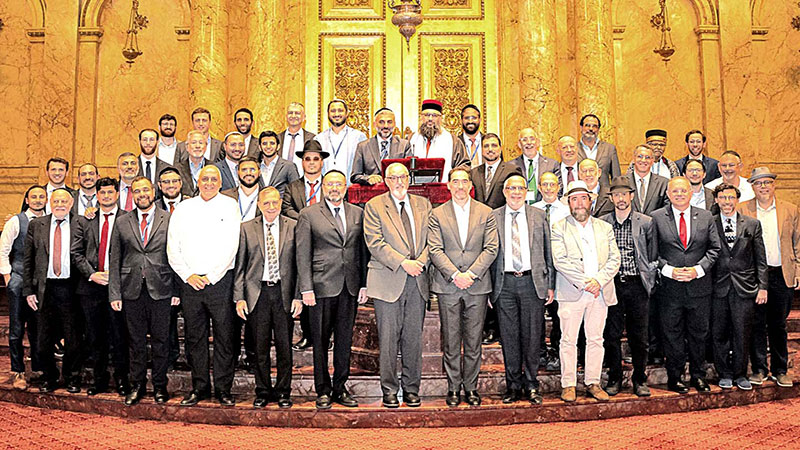


NEW YORK— More than 150 Sephardic rabbis, educators, rabbinic students, and lay leaders from across the United States and from Israel, Mexico, Canada, Spain, Portugal, Turkey, Germany, Sweden, England, Russia, South Africa, Amsterdam and Dubai gathered in New York for the second Sephardic Rabbinic Conference. More than a professional rabbinic convention, the two-day gathering became a frank discussion about the challenges of leading a Sephardic community today and how to preserve the Sephardic mesorah as a living tradition.
The conference was organized by Avi Garson, co-founder of The Habura, and Ethan Marcus, managing director of the Sephardic Brotherhood of America, with UJA-Federation of NY serving as host. It was supported by Jewish organizations including the Rabbinical Council of America (RCA) and the Orthodox Union (OU). Rabbi Etan Tokayer, president of the RCA, Rabbi Jacob J. Schachter and other prominent figures from the broader Orthodox world addressed the gathering, underscoring that the conference was not intended to create a separate Sephardic sphere, but to strengthen Sephardic leadership while remaining connected to the rest of the Orthodox community.
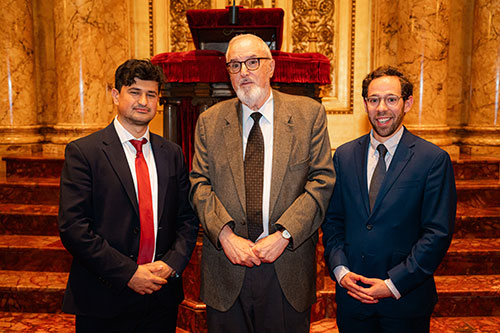
Eric Goldstein, CEO of UJA-Federation of NY, acknowledged that the UJA had “not focused enough on the Sephardic community.” Noting that the organization was founded more than a century ago with “roots that are deeply Ashkenaz,” he said, “I think both UJA and the broader Ashkenazi world didn’t feel a sense of a deep enough connection.”
Throughout the conference, the needs of Sephardic communities took center stage. The questions ranged from halacha and rabbinic authority to education, youth engagement and the practical realities of running a modern Jewish community. Rabbis discussed the reality of leading communities in which the rabbi is not only the spiritual and halachic leader, but also, in many cases, the CEO responsible for schools, staff, fundraising, pastoral care, family crises, programming and the countless practical matters involved in keeping a community functioning. Sephardic rebbetzins, too, were recognized as partners in communal leadership, addressing the particular needs of women and families.
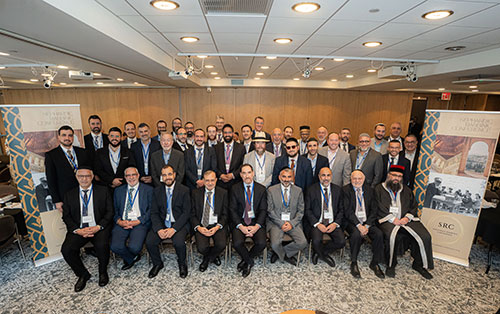
The conference opened with a video message from Rabbi Haim Sabato, rosh yeshiva of Birkat Moshe in Ma’aleh Adumim, who highlighted the rich intellectual legacy of Sephardic Torah scholarship. Sabato identified several foundations of the Sephardic tradition the conference sought to carry forward.
“First is the Sephardi engagement with mikra, following in the footsteps of the Ramban, Ibn Ezra, Rabbi David Kimhi and the Ralbag. Then comes halacha, represented by the Rambam, the Rashba and the Beit Yosef, and continued by later sages such as the Peri Chadash, the Chida and the Ben Ish Chai.” R. Sabato emphasized that Sephardic sages also distinguished themselves through deep, analytical Talmud study, citing the Lechem Mishneh of Rabbi Abraham de Boton, the Mishneh LaMelech of Rabbi Yehuda Rosales, the Machaneh Ephraim of Rabbi Ephraim Navon, and Rabbi Eliyahu Mizrahi, whose meticulous analysis spanned the entire Shas. “This is the Sephardi tradition,” he said.
His message quickly moved from history to responsibility. Invoking the Navi’s account of Shechaniah’s charge to Ezra, “Arise, for this matter is upon you, and we are with you; be strong and do it,” Sabato urged the rabbis not to lament the generation’s challenges, but to rise and act, to consider how they will carry forward the mesorah they had inherited.
From that broad historical tradition, the conversation turned to the contemporary experiences of the rabbis in the room. Rabbi Abraham Tobal, Chief Rabbi of the Mount Sinai Community in Mexico City, spoke about loneliness of a community rabbi and saw an opportunity to turn the gathering into a lasting network. He suggested creating a WhatsApp group that would keep the rabbis connected and could develop into a broader organization of Sephardic rabbis.
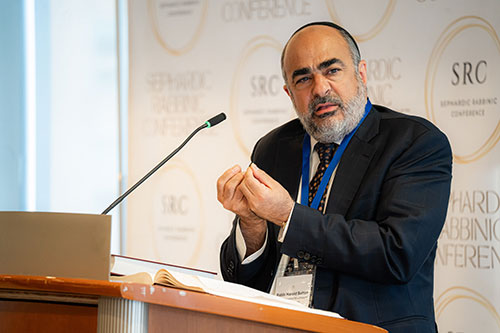
Rabbi Yogev Cohen of Har Bracha in Israel, founder of the Orot program in England, envisioned an expanding institutional infrastructure for Sephardic communities, including community development, rabbinic leadership, education and Torah scholarship. He raised the possibility of establishing a semicha program to strengthen rabbinic leadership and developing a professional journal where rabbis could publish teshuvot and halachic cases they had addressed over the years. He also raised the possibility of establishing a Sephardic Beit Din that could help communities world-wide address practical halachic matters. R. Cohen envisioned using the rabbinical network to create camps and retreats for children seeking kiruv and chizuk. “The future is in our hands,” he said.
The conference was deliberately held in New York. Several rabbis and participants expressed the view that although Israel is where the heart naturally turns, they did not want the conference moved to Israel and risk having the gathering become politicized. The goal was to maintain a forum focused on Sephardic rabbinic leadership and the needs of Sephardic communities in Israel and throughout the Diaspora.
The question of what it means to be Sephardic today was a recurring theme throughout the conference. Rabbi Moisés Chicurel of Madrid, Spain, said the Sephardic world needs to develop a sense of shared belonging across communities, “We have to think of making an international movement.” He rejected describing Sephardic identity as something of the past. “Stop calling it ‘heritage,’” he said. “It’s not dead. Yes, we are alive. It’s a way, it’s a way of living.”
Rabbi Marc Angel, Rabbi Emeritus of the Spanish and Portuguese Synagogue, posed a different question: “What will Sephardic Judaism mean 50 or 100 years from now?” He dismissed the ethnic label of “Sephardi Tahor” as being irrelevant, suggesting that Sephardim may increasingly blend into the broader Orthodox world. And while Sephardic sages have long shaped Jewish scholarship far beyond their own communities, Rabbi Angel asked whether their tradition alone could remain a unifying force for Sephardim as the ethnic boundaries that once set them apart fade.
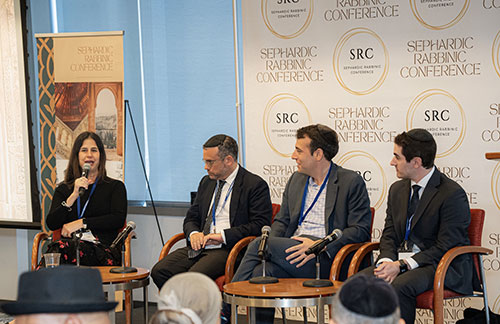
Rabbi Joseph Dweck, who most recently served as Senior Rabbi of the Spanish & Portuguese Sephardi Community of the UK, addressed the question more directly, identifying the “chareidization of the rabbanut and of our communities.” He described the challenge of maintaining a distinct Sephardic approach while the broader Orthodox world is moving increasingly to the right. Though he was careful not to declare that movement right or wrong, he said Sephardic leaders must understand why so many people are drawn toward it.
“Things are moving very strongly towards a very firm, rigid, binary system that multitudes are signing up to,” he said, adding that “there is a reason that that is happening.” The answer, he argued, requires looking inward rather than pointing outward. “What are we doing? What are we not doing? What are we accomplishing? What are we missing? And how did we get here?”
The details of Sephardic tradition, Dweck emphasized, matter precisely because they help preserve the distinct identity of each community. Singing “Ben Adam, Ma Lecha Nirdam” on the eve of Yom Kippur after Maariv, as well as singing “El Nora Alilah” during Ne’ilah with specific traditional melodies, are examples of practices specific to the Syrian community rather than universal Sephardic customs. Details, Dweck argued, help preserve the distinct identity of each Sephardic community.
Rabbi Dweck also questioned whether the Chareidi world has become the religious standard. He suggested that Sephardim may internalize a sense that their own way of religious life is somehow inadequate. He noted that “the vast majority of people think that the Chareidim are the gold standard, and that we’re lazy, or we’re just not living up to par,” and described “a feeling, maybe perhaps, on a certain level, that maybe we’re not okay,” and even “a shemetz [trace] of shame.” For Dweck, the challenge is how to “hold center” while articulating the distinct conceptual approach that comes from the Sephardic tradition.
That may ultimately be the significance of the second Sephardic Rabbinic Conference – not simply preserving the past, but building the connections, institutions and vision needed to carry the Sephardic mesorah forward. Across the many voices in the room, a common theme emerged: Sephardic Judaism is not a relic to be preserved, but a living tradition that must be strengthened, articulated, and passed to the next generation.