 October 23, 2026
Categories: Headline / Perspectives
Are Modern Orthodox Learners Merely Tourists in the Beit Midrash?
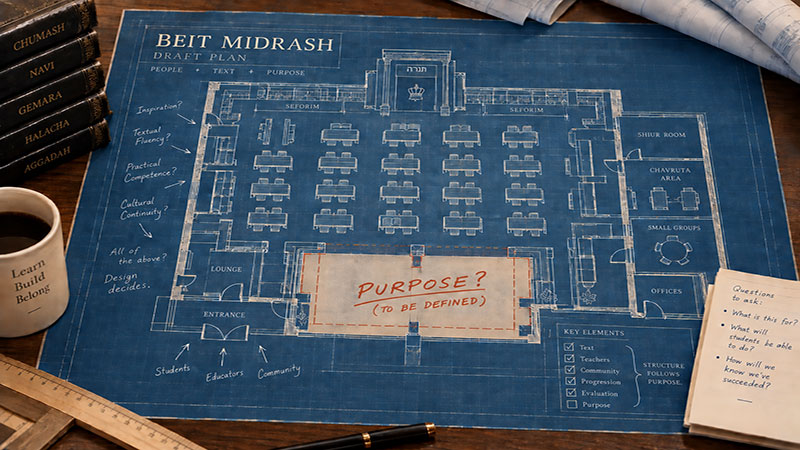


There's a question I keep hearing in different forms from rabbis, educators, and serious adult learners in the Modern Orthodox world, and I'm starting to think it's the same question underneath. The form changes – why don't our students retain what they learn? Why does the shiur feel flat? Why do our most motivated graduates stop learning within five years of leaving the beit midrash? – but the underlying question is simpler: what is this for?
I don't mean "what is Torah study for" in the abstract. I mean what is this particular hour of learning for? What is this curriculum for? What is the person sitting across from me supposed to be able to do when we're done that they couldn't do before?
The yeshiva world has a clear answer. The purpose is to become a posek. Not everyone gets there, obviously, but the structure points in one direction: you're learning to pasken, to render halachic judgment, to enter the conversation of Torah She'be'al Peh with enough depth that you can hold your own in a sugya and eventually produce your own chiddushim. The structure follows the telos. You learn in a specific order, with specific expectations, toward a specific competence.
The academic world has a clear answer, too. The purpose is to produce scholarship: new readings, careful arguments, contributions to the historical or literary understanding of a text. The structure follows that telos as well. You master languages, historiography, methods. You write papers that are reviewed by people who share your assumptions about what counts as a contribution.
Modern Orthodox Torah study, in too many of its institutional forms, has no clear telos, or purpose, at all. It tries to be both things at once – serious Torah learning and serious general education – and in the attempt it often becomes neither. The student in the MO high school beit midrash is not being trained to pasken; the curriculum doesn't point there. But he's also not being trained to produce scholarship; there are no languages, no methods, no expectation of original contribution. What is he being trained to do?
Here's the honest answer I think many institutions would give if pressed: to be an educated Jew. To know things. To have encountered the tradition. To be able to follow a daf or read a Rashi or participate in a shiur without feeling lost.
This sounds reasonable. It isn't. "Knowing things" is not a telos; it's a description of a state, not a direction. And because it's not a direction, the structure that builds toward it has no shape. You learn a perek of Gemara this year, a different masechta next year, some Chumash, some Navi, some halacha — a smorgasbord of exposure without any cumulative logic. The student who goes through twelve years of this knows more than the student who went through zero years, but he doesn't know more in a structured way. He has impressions but no map.
I want to be careful here, because the people running these institutions are not lazy or unserious. Most of them are working with impossible constraints: limited hours, heterogeneous student bodies, parental expectations that range from "my child should love Torah" to "my child should get into a good college." The problem isn't the educators. The problem is the design. When you don't know what you're building, you can't evaluate whether you've built it.
And the cost is real. I talk to MO high school graduates who can tell you they "learned" Kiddushin or Bava Metzia or whatever it was, but if you ask them what the Gemara's actual question was in any given sugya, they don't know. They remember that they were there. They don't remember what happened. They were tourists in the beit midrash, not cab drivers.
What would it look like to have a real telos?
I think there are at least three honest answers an MO institution could give, and the important thing is to pick one and let the structure follow.
First: the telos of practical competence. You're learning Torah so that you can live it. So that when a shayla comes up at your Shabbat table, or when you're raising children, or when you're serving on a chevra kadisha, you know what you're doing. This doesn't require semicha-level depth. It does require systematic coverage of the ground you're actually going to stand on, taught with the explicit goal of enabling independent judgment. The Tzurba M'Rabanan learning program, for example, actually does this well: it traces a topic from Torah through Shulchan Aruch so that you can see how the halacha got to where it is, and therefore how to apply it.
Second: the telos of textual fluency. You're learning Torah so that you can read a daf without ArtScroll or Koren, follow a teshuvah in its original language, understand the references in a rabbi’s derasha. This is a narrower, more achievable goal than full posek-training, and it's honorable. But it requires a different structure than most MO schools use. It requires focused language work, cumulative text exposure, and – this is the part nobody wants to hear – a willingness to spend long periods on material that doesn't feel "relevant" because the relevance is to the skill, not to the topic.
Third: the telos of cultural continuity. You're learning Torah so that you can sit in a beit midrash and feel at home, understand the allusions, participate in the conversation, pass something to your children that they couldn't get from a book. This is the most modest telos and in some ways the hardest, because it requires not just learning but belonging, and belonging can't be put into a curriculum. But even here, the structure matters. You don't produce belonging through occasional exposure. You produce it through sustained, shared engagement with the same texts over time.
One mistake would be trying to do all three at once without committing to any of them. The practical-competence track gets watered down by textual-fluency demands. The textual-fluency track gets derailed by relevance pressures. The cultural-continuity track gets reduced to Jewish identity programming because nobody has time for real sustained learning.
Pick one. Design the structure around it. Be honest with students and parents about what you're doing and why. The honesty itself is educational; it models the thing that Torah study is supposed to produce: clear thinking about what matters and why.
I think this is why so many of the most serious MO adult learners I know ended up in some kind of post-high-school yeshiva or seminary, or in a night-seder with a chavruta, or in a structured halacha program. They went looking for a telos. They found one outside the institutions they grew up in. Which means MO institutions have a design problem. And design problems are solvable.
What would it take for an MO high school or yeshiva to choose a telos and build the structure to match? Not more money. Not more hours, necessarily. A decision, made explicitly, defended publicly, and embodied in the curriculum down to the level of what happens in this room at this hour with these students.
The next time you walk into a beit midrash – your child's, your own, your shul's – ask the question I started with. Not "what are they learning?" but "what is this for?" If nobody can answer clearly, that's not a character flaw in the people present. It's a design flaw in the room itself. And design flaws, unlike character flaws, can be fixed.