 October 23, 2026
Categories: Headline / Parsha / Torah
No Tzaddik in the Land


Shlomo HaMelech said in Kohelet (7:20) that there is no person in the world who is such a tzaddik that he does only good and never transgresses. Rav Chaim Volozhin, in his classic rejoinder to emerging spiritual trends of the late eighteenth century, puts a fine point on this idea, asserting the literal interpretation of the verse (Nefesh HaChaim I:6-12). He explains that no matter how righteous an individual is or how fully he dedicates himself to the service of Hashem and separates himself from trivial distractions that take him away from Torah study, it is inconceivable that even the greatest person can go through an entire lifetime without erring in some small way.
Over a century earlier, the Shela HaKadosh developed this theme in more detail, explaining some of the flaws and shortcomings that are likely to trap the righteous and devout person in particular, and exhorting us to be wary of these faults in ourselves. He even discusses this in light of prophecy, where he explains why it’s necessary for every prophet to have a connection to the Divine that is inferior to what Moshe experienced. The Shela explained that one’s ability to draw close to Hashem and receive messages from Him is correlated to that person’s refinement of his own character to more closely resemble the Divine. Insofar as there is no tzaddik in the world who does only good, it is inconceivable that any prophet can be a perfectly pure vessel for receiving Divine inspiration. Of course, the defining voice in discussions of prophecy and human nature alike is Rambam, who cites our pasuk in the Shemoneh Perakim,where he also asserts that all humans are flawed and fallible, and that that there is truly no tzaddik who does only good and never transgresses.
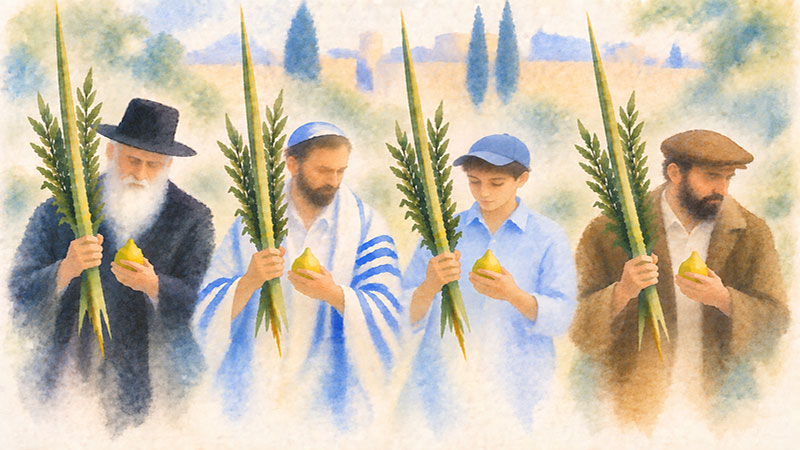
The Ben Ish Chai, in his commentary Ben Yehoyada on Menachot (27a), examines a well-known aggada about the four species that we bring on Sukkot in light of the aforementioned verse from Kohelet and this discussion of human nature. The Gemara teaches that one must take all four species together and cannot fulfill the mitzvah if any one is missing or incomplete. The Gemara further elaborates that two of the species bear fruit and two do not. It also compares the four species to four types of Jews – just as all the four species are necessary to fulfill the mitzvah, so too are all the Jews necessary to fulfill mitzvot.
The Ben Ish Chai teaches that the two species that bear fruit – the lulav and the etrog – correspond to Jews who learn much Torah and those who perform many mitzvot. Like these two species, such people in the world also bear “fruit” in the form of teachings and future generations of righteous and learned offspring. But the other two species, the hadas and the arava, are also necessary. The Ben Ish Chai explains that because a righteous person is still flawed, he needs to live in a generation full of those who are more deeply flawed – whether to appear good in comparison to them (such as Noach, for example) or to do good deeds for and among them and thereby lead them closer to Torah. Naturally, the wicked also require the righteous in their midst to advocate for them and help them to become better people.
Thus, according to the Ben Ish Chai, Shlomo HaMelech in Kohelet is describing a situation where there is no single tzaddik in the world to do all the good and none of the wickedness. Rather, as with the four species, the world comprises a variety of individuals of varying moral capacities – and it is the responsibility of each to complement and to complete the other so that together we can achieve what no one of us could possibly perform alone.