 November 13, 2026
Categories: Headline / Parsha / Torah
The Covenant of Levi
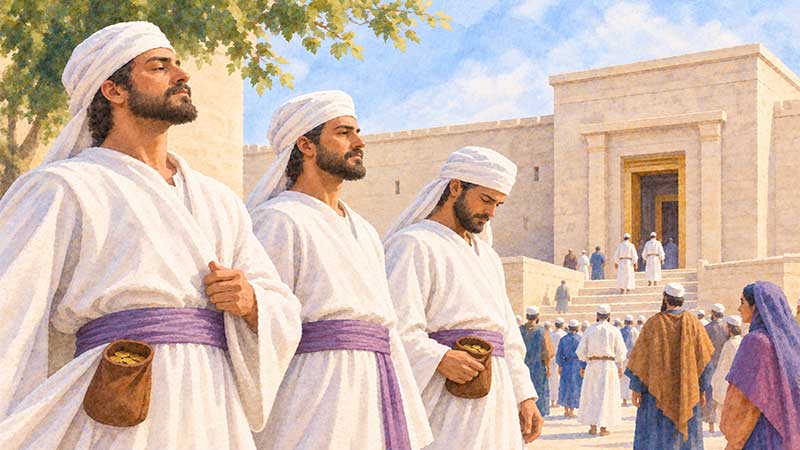


In this week’s parsha, we learn of the birth of Yaakov, who, as a man of truth, is associated with the essence of Torah (see especially Micha 7:20), as well as of his brother Esav, who exemplifies the opposite. In the haftara, in the waning days of the age of prophecy, the navi Malachi cautions Israel that we are becoming too much like Esav and not enough like Yaakov. The kohanim are reminded of the covenant Hashem made with the tribe of Levi and of how their own conduct is a repudiation of that covenant.
Radak points out that the covenant with the tribe of Levi was made with the spiritual leader of that tribe, Aharon, and his descendants were given the role of performing the service of Hashem in perpetuity. Pinchas was also given a unique covenant of perpetual priesthood, a “covenant of peace” (Bamidbar 25:12). Unfortunately, in our time, not unlike in the time of Malachi, there are those who claim the privileges of the priesthood – those of the tribe of Levi – without accepting the attendant responsibilities and required character traits. During the time of the second Beit HaMikdash, the corrupt kohanim could at least claim descent from Levi and from Aharon, whereas today those who seek to usurp this title don’t even have a credible claim to it. Still, given the extent of our deviation from the spiritual and moral standards of a nation of priests – or more to the point, the deviation of those who appoint themselves our leaders – it is instructive to examine the rebuke of Malachi to the priests and elders of his time.
Malachi repeatedly expresses that the conduct of the priests is repellent to Hashem, that they are disgracing Him before the people and are making a mockery of their sacred office. Twice in successive pesukim, he states that the priests have “lifted up their faces” (Malachi 1:8-9), referring to haughtiness. Following Metsuda and others, Malbim points out that even if the priests were worthy of the respect and deference they demanded, they would still – if they were truly righteous – be ashamed to conduct themselves in such a way. They would fear Divine retribution for their arrogance in holding themselves above the rest of Israel by virtue of the sanctity and humbling nature of the tasks they perform.
The navi states and restates that the one who is pure and true in his service (as Yaakov Avinu was) has no thought of himself whatsoever – he seeks to perform the Divine will and to be a faithful emissary of the people of Israel. The kohanim are meant to be servants of the people; the people are not their servants, and those who hold themselves to be superior to those they serve are only demonstrating the unfitness of their service. Hashem unequivocally rejects and repudiates this attitude, and He reviles such servants.
The greatness of the true descendants of Levi who are joined in a covenant with Hashem is reflected in the character of Aharon, whose qualities are praised in the opening verses of chapter 2 of Malachi which conclude our haftara. Of him we learn, chiefly from these verses but also explicitly in Pirkei Avot, that he was someone who “loved peace and pursued peace” (Avot 1:12). Rambam explains that Aharon always conducted himself in such a way that every Jewish person felt loved and admired by him. When the person was doing something wrong, Aharon would never attack or belittle him but instead would act even more lovingly toward him. As a result, the person would come to feel self-conscious about his shortcomings and work hard to do better so he could feel worthy of Aharon’s love for him.
Rav Kook, in an early sermon delivered before he immigrated to Israel, taught regarding the way the navi frames Aharon’s qualities here that he was as perfectly refined in profane matters as he was in the sacred. Again channeling the attribute of truth associated with Yaakov Avinu, the navi teaches that “the Torah of Truth was in his mouth” (Malachi 2:6). In what way is the “Torah of Truth” different from simply Torah? Is there Torah that isn’t truth? This shows us the greatness of Aharon and the purity of his heart. Unfortunately, it is possible for someone to be wise and learned in Torah and to represent himself as a great teacher or religious leader. Such a person might indeed partake of the grandeur of Torah and convey some of its light. But if their soul is not aligned with their religious exterior – if they, like the kohanim in the time of Malachi, accept remuneration and demand honor in return for their supposed Torah leadership – then their Torah is not the Torah of Truth and they are not partners in the covenant of Levi that was sealed with Aharon and with Pinchas.
That covenant encompassed “life and peace” (Malachi 2:5). Rav Kook explains that life means the eternal life of Torah, and peace is the ability Aharon demonstrated to get along with everyone and to earn – but not demand – their respect. Finally, Aharon is said to have “gone straight with Me, returning a multitude from their iniquity” (ibid. 6). Rav Kook connected this “going straight” with having good manners and proper behavior, thereby setting a positive example that others will want to follow. This was the way that Aharon inspired others.