 November 20, 2026
Parshas Vayetzei: When the Ladder Disappears
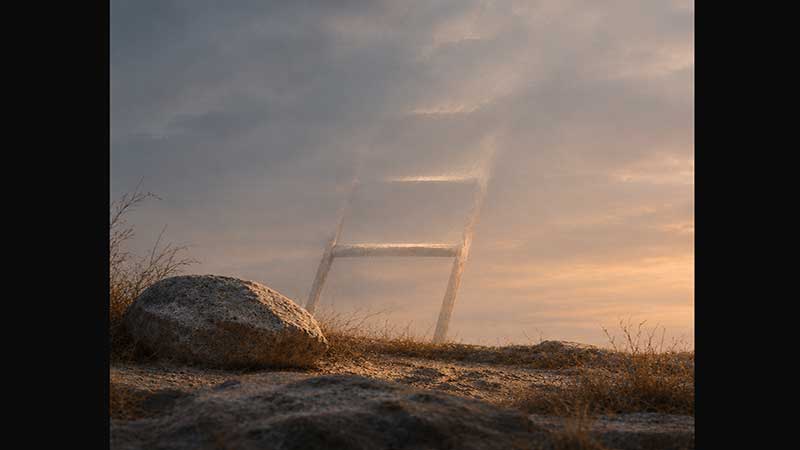


Some of the visuals in the Torah are so powerful that they consume everything around them. Yaakov’s ladder is one of them.
A man alone at night, fleeing the only home he has ever known, rests his head upon a stone and dreams. A ladder stretches from earth toward heaven. Angels ascend and descend. Hashem speaks. Yaakov awakens, astonished that holiness had been present all along: “Surely Hashem is in this place, and I did not know.”
It is magnificent.
And then Yaakov gets up. The ladder disappears.
For almost the entire remainder of Vayetzei, there are no ladders and no open heavens. Instead, there are marriages and children, infertility and jealousy, employment negotiations and changing wages. Sisters try to find their places in the same family. Women give birth and name children. A father manipulates his daughters and son-in-law. A worker realizes that no matter how faithfully he performs, the terms can always be changed.
There is love, certainly, but there is also disappointment. There is family, but family does not always mean safety. There is work, but work does not always mean fairness. And there are people – almost all of them, in one way or another, living inside circumstances they did not completely choose.
Perhaps that is where the real story of Vayetzei begins – not on the ladder, but in what happens after it.
When Someone Else Writes the First Paragraph
There have been seasons in my own life when I have looked around and realized that I was living inside circumstances I had not entirely chosen. That is quite an unsettling feeling. We want to imagine ourselves as the authors of our lives, carefully choosing the next chapter. Real life is rarely that cooperative. Sometimes, someone else has already written the first paragraph. The question then becomes whether we allow them to write the rest.
Leah knows something about having someone else write the first paragraph.
The Torah does not introduce her with a grand declaration of ambition or destiny. She is the older daughter of Lavan. Yaakov loves Rachel and agrees to work seven years to marry her. But when those years are completed, Lavan substitutes Leah.
It is an extraordinary scene, partly because of what the Torah does not give us. We are not told about a conversation in which Leah agrees to Lavan’s plan. We do not hear her reasoning. We do not know what she felt as she entered the marriage that night. We should resist the temptation to manufacture an interior life for her simply because the silence makes us uncomfortable.
But the silence itself is uncomfortable.
A marriage is arranged around her. Lavan makes the decision. Yaakov discovers the deception only afterward. Rachel is deprived of the wedding she expected. And Leah begins married life in a story in which the two people with the most obvious power are men negotiating with one another.
Yet Leah does not remain silent in the Torah for long. She begins to name.
And those names matter.
Leah Finds Her Voice
The names Leah gives her children allow us to hear something that the wedding narrative did not. With Reuven, she speaks of Hashem seeing her suffering and hopes that now her husband will love her. With Shimon, she speaks of Hashem hearing that she is unloved. With Levi, she hopes that now her husband will become attached to her.
The ache is difficult to miss. Again and again, the naming seems to look outward: see me, hear me, choose me, love me, attach yourself to me.
There is something painfully recognizable in that progression. Human beings can spend enormous amounts of energy trying to earn from someone what that person has shown themselves unwilling or unable to give. We tell ourselves that perhaps one more accomplishment will do it. One more sacrifice. One more demonstration of loyalty. One more attempt to become indispensable. Perhaps then we will be seen differently.
Then Yehuda is born. And Leah says, “This time I will thank Hashem.”
Something has shifted.
The Torah does not tell us that Yaakov suddenly loves Leah as he loves Rachel. There is no dramatic scene of reconciliation immediately preceding Yehuda’s birth. The external circumstances have not suddenly reorganized themselves around Leah’s hopes. But her language changes. For the first time, the name does not appear to ask Yaakov for anything.
That does not mean that Leah has stopped hurting. It does not mean that rejection no longer matters. And it certainly does not mean that people experiencing pain should simply become grateful and stop wanting something better.
It means something subtler. Leah begins to speak from somewhere that does not depend completely upon Yaakov’s response.
There is a difference between being rescued from a circumstance and refusing to let that circumstance remain the sole author of your identity.
That is not surrender – that is agency.
Sometimes agency is not the power to change the room. Sometimes it is the moment you stop allowing everyone else in the room to tell you who you are.
Rachel Is More Than the Woman Yaakov Loved
Rachel, too, can become trapped by the shorthand through which we remember her. She is beautiful. Yaakov loves her. He works seven years to marry her, and those years seem like only days because of his love.
Then comes the terrible inversion: The beloved woman cannot have children, while her sister can.
Rachel’s anguish is not hidden. Neither is the complicated relationship between the sisters. Vayetzei refuses to transform the mothers of Israel into uncomplicated symbols. They are human beings living painfully close to one another, each possessing different things the other desperately wants.
One has the love. One has the children. Neither experiences herself as having enough.
That may be one of the most profoundly human truths in the parsha. We are often remarkably poor judges of how fortunate another person’s life feels from inside it. From the outside, Rachel is the chosen one. From inside Rachel’s story, something essential is missing. From the outside, Leah is fruitful and surrounded by children. From inside Leah’s story, she longs to be loved.
Two women can stand beside each other, each imagining that the other possesses the thing that would finally make her whole.
And yet neither woman remains frozen in the place where we first meet her. Toward the end of the parsha, when Yaakov explains to Rachel and Leah that it is time to leave Lavan, the sisters answer together.
Together matters.
The rivalry has not erased their ability to recognize what has happened within their father’s household. The daughters who were once positioned against one another can now see something clearly from the same side. They are no longer merely Lavan’s daughters or Yaakov’s wives. They speak about the family they are leaving and the future they will enter.
Sometimes reclaiming agency begins not with knowing exactly where we are going, but with finally acknowledging that where we are is no longer home.
The Women We Barely Hear
Rachel and Leah are not the only women building this family.
The family that will become Israel is built through four women: Leah, Rachel, Bilhah, and Zilpah. Bilhah gives birth to Dan and Naftali; Zilpah gives birth to Gad and Asher. Yet after spending so much of Vayetzei hearing the pain, longing, jealousy, hope, and eventual resolve of Rachel and Leah, the relative silence surrounding Bilhah and Zilpah becomes even more striking.
The text tells us astonishingly little about their interior lives. Perhaps we should let that bother us.
We want to imagine what Bilhah thought. We want to give Zilpah a speech. We want to make them into precisely the kinds of women we would like them to have been.
Sometimes the most honest way to read Torah is not to fill a silence. It is to notice it.
We know that Bilhah and Zilpah are integral to the emergence of the people of Israel. We know the names of the sons they bear. But we are given far less access to their voices than to those of Rachel and Leah.
That absence asks something of us. Who builds our communities while receiving little of the recognition? Whose contribution is essential but whose voice is absent from the story we later tell? Who is remembered primarily in terms of what they produced for other people? And perhaps most uncomfortably, who is standing in the room right now whom we are treating as supporting cast in a story to which they are actually essential?
These are not only questions about Vayetzei. They are questions Vayetzei teaches us to ask.
Leadership is often described in terms of the people whose names appear at the top. Torah repeatedly forces us to look elsewhere. It makes us notice servants, younger siblings, outsiders, mothers, strangers, and people standing at the edge of the narrative.
Sometimes leadership means speaking. Sometimes it means noticing who has not been given the opportunity.
The Myth of the Perfect Choice
We tend to romanticize agency. We imagine it as the moment when someone stands up, draws a boundary, makes an announcement, and walks confidently into a better future.
Sometimes it looks like that. Usually, it does not.
Sometimes the choices available to us are constrained, imperfect, and unfair.
Vayetzei understands this. Its characters operate within family structures, economic realities, and obligations they did not invent. Their decisions are not made on blank pieces of paper.
Ours aren’t either.
There are responsibilities, children, parents, finances, and communities. There are promises we made when circumstances were different. There are people we love. People who depend upon us. Values we will not abandon simply because honoring them has become inconvenient.
That does not make us powerless. It makes agency more complicated than getting exactly what we want.
There is enormous power in identifying the decision that is actually ours.
Maybe I cannot control whether someone sees my value. I can decide whether their inability to see it becomes my own. Maybe I cannot undo the years already spent somewhere. I can decide what those years will teach me. Maybe I cannot change another person. I can decide what access that person has to my future.
Maybe I cannot rewrite the first paragraph. But I can notice when the pen has been handed back.
That kind of agency is quieter than the version we celebrate.
It may also be more useful.
Knowing When to Leave
Yaakov eventually leaves Lavan’s house.
That sentence sounds simple. The journey is not.
By then, his entire adult life has been constructed there. His wives are Lavan’s daughters. His children have been born there. His wealth has been built there. Whatever manipulation and conflict exist, so do history, attachment, and familiarity.
Leaving is rarely difficult solely because we may not realize that something is wrong.
It is difficult because the wrong thing may also be familiar.
We know the rules there. We know who we are there. Even disappointment can become predictable enough to feel almost secure. The unknown cannot offer that.
That is why leaving should not always be understood as running away. Sometimes leaving is an act of extraordinary clarity. There is a point at which perseverance ceases to mean remaining exactly where we are.
Judaism places enormous value on endurance, responsibility, and faithfulness. But endurance is not the same as permanent residence in every circumstance we have learned to survive.
Yaakov’s growth does not occur because he has found a life without complexity.
He hasn’t. He leaves one complicated chapter for another.
Perhaps maturity is not finally reaching a place where everything is under our control. Perhaps it is becoming more discerning about which responsibilities are ours and which stories no longer get to own us.
After the Ladder
Which brings us back to the beginning.
Yaakov has one of the most spectacular spiritual experiences in Torah before much of this happens. He sees the ladder. He encounters Hashem. He receives a promise.
And then he wakes up.
What follows are years of ordinary human complexity.
Maybe that order matters.
We sometimes imagine that spiritual clarity should remove confusion from our lives. If we pray enough, learn enough, listen carefully enough, perhaps the path will become obvious. Perhaps faith will produce certainty.
But Yaakov sees heaven and still has to negotiate life on earth.
The revelation does not prevent Lavan from deceiving him. It does not prevent Rachel’s pain. It does not make Leah feel loved. It does not give Bilhah and Zilpah larger voices in the text. It does not eliminate family conflict. It does not make Yaakov’s work simple. And it does not spare anyone from making difficult decisions.
The ladder never promised to do that.
Perhaps its promise is something else.
That heaven can touch earth without earth becoming heaven. That Hashem can be present in a life that remains complicated. That holiness does not require perfect circumstances.
Yaakov’s great realization when he awakens is that Hashem was present somewhere he had failed to recognize Him.
Vayetzei asks us to make a similar discovery.
We may not have chosen the place. We may not have written the circumstances that brought us there. We may have inherited expectations, obligations, disappointments, and dynamics that existed long before we understood them. We may even have spent years living inside decisions that somebody else made.
But that does not mean the story is no longer ours.
Leah teaches us that a person can discover a voice before circumstances change. Rachel reminds us that being chosen by someone else does not eliminate private pain. Bilhah and Zilpah remind us to pay attention to the people whose contributions are enormous even when the story gives them too little room. Rachel and Leah together remind us that people once positioned against each other can eventually recognize what they share. And Yaakov reminds us that there is a time for staying, striving, and building, and there can also be a time to leave.
We spend our lives looking for ladders. For the unmistakable sign. For the breakthrough. For the moment when heaven opens and tells us exactly what everything means.
Vayetzei gives us the ladder. Then it spends the rest of the parsha bringing us back to the ground.
To work and family. To love and disappointment. To unfairness. To people we cannot change. To circumstances we did not choose. And to the choices that somehow remain ours anyway.
Perhaps holiness is not found only in those extraordinary moments when heaven opens above us. Perhaps it is also found the morning afterward.
When the dream is over. When the ladder is gone. When nothing around us has magically rearranged itself.
And we look honestly at the life in front of us and realize that someone else may have written the first paragraph.
But they do not get to write the rest.
The pen is back in our hands.