 October 9, 2026
 Categories: Features On The Jewish World
A Bene Israel Siddur
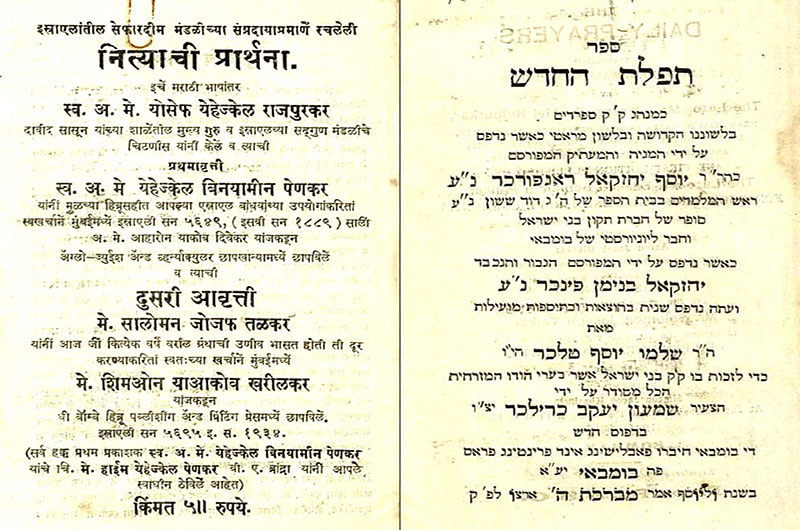


Every so often, a book arrives in the shop that reminds us just how far the Jewish story has traveled. Recently, I acquired a particularly unusual siddur: a fine copy of Daily Prayers Translated from Hebrew to Marathi by Joseph Ezechiel Rajpurkar. This was the second edition, published by Hymes Ezekiel Penkar and printed by Simeon Jecob Kharilker. At first glance, it is simply another translation of the Jewish prayer book. A closer look, however, opens a window into one of the most fascinating and least-known Jewish communities in the world, that of the Bene Israel of India.
(Marathi, the third most spoken language in India, is a major Indo-Aryan language spoken today by over 83 million people in the Indian state of Maharashtra.)
For centuries, the Bene Israel preserved a tradition that their ancestors descended from fourteen survivors of a shipwreck, a total of seven men and seven women off the Konkan coast near Navgaon, south of Bombay. Isolated from the larger Jewish world, they retained fragments of Jewish practice and identity while adopting the language and customs of their Indian surroundings.
According to Bene Israel tradition, a Jewish traveler and scholar named David Rahabi eventually encountered the community, either around the year 1000 C.E. or, according to another version, several centuries later. Recognizing traces of Jewish observance among them, he is said to have instructed them in the fundamentals of Judaism and trained young men to serve as religious leaders.
These leaders became known as Kajis, a hereditary office that carried both religious and judicial authority. For generations, they guided the community's spiritual life and were officially recognized as judges in disputes among Bene Israel families.
One of the most distinctive features of Bene Israel religious life is its special devotion to the Prophet Elijah. While Elijah occupies an honored place throughout the Jewish world, among the Bene Israel he became an especially beloved figure. His name is invoked at joyous occasions, and traditions surrounding him became woven into the fabric of community life.
This attachment is perhaps most clearly expressed through the unique Bene Israel ceremony known as Malida. The ritual centers on the preparation of a special food offering accompanied by the recitation of prayers, psalms, and biblical passages. A Malida may be held after childbirth, before a wedding, following the fulfillment of a vow, after a circumcision, during times of crisis, or simply as an expression of gratitude to G-d.
The ceremony also plays a prominent role on Tu B’Shevat, when the first fruits of the local region are celebrated. On such occasions, special honor is given to Elijah the Prophet, particularly in connection with Kandala, where Bene Israel tradition holds that Elijah once appeared to members of the community.
The siddur that arrived in our shop serves as a testament to the remarkable efforts made by Bene Israel scholars to preserve and strengthen Jewish learning. Chief among these figures was Joseph Ezechiel Rajpurkar (1834–1905), one of the most important intellectual leaders the community ever produced.
Rajpurkar received his education at Bombay's Free Assembly School and began teaching at the David Sassoon Benevolent Institution in 1856. Five years later he became headmaster, a position he would hold for an astonishing forty years. His scholarship earned wider recognition as well. In 1871 he was appointed Hebrew examiner at the University of Bombay, and in 1879 the university elected him a fellow.
What makes Rajpurkar particularly significant is his mastery of both Hebrew and Marathi, the vernacular language of western India. Recognizing the needs of his community, he devoted himself to making Jewish texts accessible to Marathi-speaking Jews. Over the course of his career, he translated more than twenty works from the Hebrew liturgy into Marathi, along with numerous English works of Jewish interest.
His Marathi siddur stands as one of the most tangible results of that labor. It reflects a community determined to remain faithful to its Jewish heritage while expressing that heritage through the language of its homeland. The volume is both distinctly Jewish and distinctly Indian, a reminder that Jewish civilization has flourished in places far beyond the centers most familiar to us.