September 11, 2026
 Categories: Headline / Perspectives / Op-Eds
A Bitachon-Minded Spin on Suffering


A friend of mine mentioned how her husband, a righteous man, ran to be the tenth guy for a minyan for someone who couldn’t get to shul, when suddenly he tripped and tore his ligaments, requiring surgery.
Because I’m the embodiment of all things bitachon, I instinctively yelled in frustration: “How could this happen? After all, he was doing a mitzvah – and last I checked, doesn’t it say that if you’re going to do a good deed, you are protected based on the concept of shliach mitzvah?”
Without missing a beat, she responded, “Avi, what are you talking about? How do you know it couldn’t have been much worse? We have to remember that when we experience a challenge, particularly when doing a mitzvah.”
Wow! No wonder she epitomizes the word aishes chayil and is a source of admiration to those lucky enough to know her.
She reinforced an important principle regarding bitachon: Our very existence, our relationship to everything around us – including life’s challenges – is never a linear experience. If we only look through life seeing the bad without bringing into account G-d’s infinite goodness, then our perception and understanding of life and of G-d – not to mention our ability to grow – is limited.
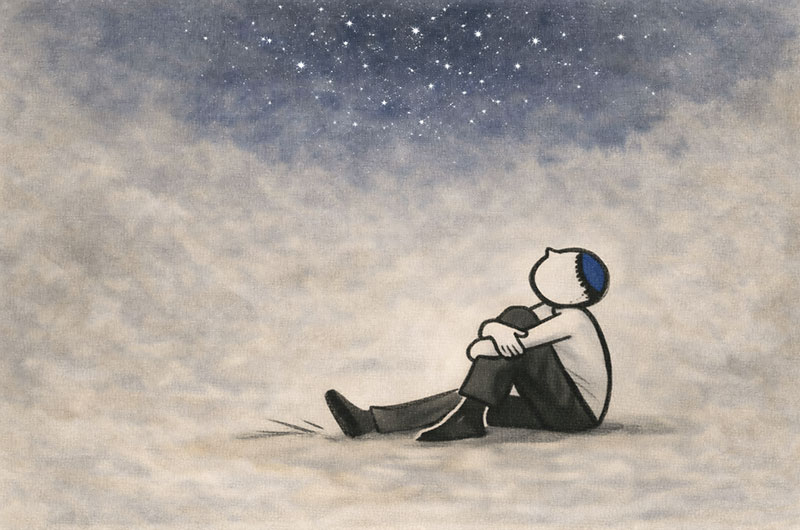
G-d told Avraham that he and his offspring would not be limited by the stars – that even though we are a tiny nation and appear weaker, because of our unique relationship with Hashem we can accomplish untold great things, precisely because we are not a one-dimension-thinking people. We know that when all else fails, teshuvah, tefillah, and tzedakah can move mountains.
I recently read that the Iron Dome was sent to be used in a European country and the success rate was 60 percent, as opposed to Israel’s success rate, which was closer to 90%. Puzzled, these Israeli scientists actually went to Europe to determine why there was such a discrepancy and came to the conclusion that they couldn’t.
Someone recently told me that when his child was given a 10% chance to live, one of the nurses told the father: “Don’t worry about the odds. I’ve been here long enough to know that G-d hears your prayers because I’ve seen actual miracles with you people.” (Baruch Hashem, he went on to tell me, his daughter made a complete recovery.)
G-d also told Avraham that his offspring would be more numerous than the stars. He promised that we will be an eternal people – hated, exiled, few in number, yet simultaneously a light unto the nations.
Our very existence is predicated on something beyond the norm. In order for G-d to take our hands and give us the Divine protection and blessing we so desperately need, we need to change our perspective.
My friend was right: How do we know what could’ve really happened to us when something bad occurs? I recently fell and broke a few ribs, and once I finished writhing in pain and crying “Why me?!” I recognized that it could have been a whole lot worse, chas v’shalom.
Most of the time, while there is gratitude, there is an equal amount of frustration as we lie healing in a hospital or suffering in our own respective ways. But we need to remind ourselves that sometimes it can take years before we can make sense of it all and “connect the dots,” as Steve Jobs put it.
Many years ago, a non-observant father of several children died prematurely, and his wife married an Orthodox Jew. One of the children decided to honor his mother and go to shul on Shabbos with his new stepfather. Within 30 years, he became frum and raised over 50 Orthodox grandchildren. In a moment of truth, he told me that if his father didn’t die, it is more than likely that no one in their family would’ve ever been observant, suggesting that what appeared as a setback, albeit tragic, was a setup for a greater destiny – one affecting his very own progeny.
Rabbi Dovid Orlofsky has spoken about how he broke his leg in high school and the only people who visited him and reached out to him were Orthodox Jews, which ultimately influenced him to become a world-famous lecturer and a rebbe to many.
My father had a particularly difficult time graduating college and law school, passing the bar, and even getting a job. But it was those very challenges which fortified him to try even harder, enabling him to become even more powerful and successful in all of his pursuits.
There’s no simple answer as to why things happen, because G-d’s ways are hidden. If all righteous people never got hurt, free will would be unnecessary, as everyone would know the secret elixir to life. Yet because we see bad things happen to good people while the evil prospers, doubt ferments, free will is preserved, and man can be tested.
Sure, when I initially heard that my friend hurt his leg, I was angry because I know he’s a righteous person, but then I reminded myself that many times, righteous people suffer for reasons unbeknownst to us. After Nadav and Avihu died, G-d said “Through those who are near to Me, I will be sanctified, and before all the people I will be honored.”
We know that we live in a world of confusion where things are not as they appear. The good news is that we have a Torah, Mesorah, and so many great Torah giants teaching us that each challenge is actually a tremendous opportunity to grow in our bitachon. And as my friend reminded me, it all comes down to how we choose to spin it. You can either fall down and complain about your horrible situation, or you can remind yourself that perhaps it could’ve been much worse. And believe me, it usually can…
May Hashem grant us the strength, wisdom, and proper bitachon as we endure all of life’s challenges.