 October 9, 2026
 Categories: Features On The Jewish World
A Book to Resist the Nazis in 1936
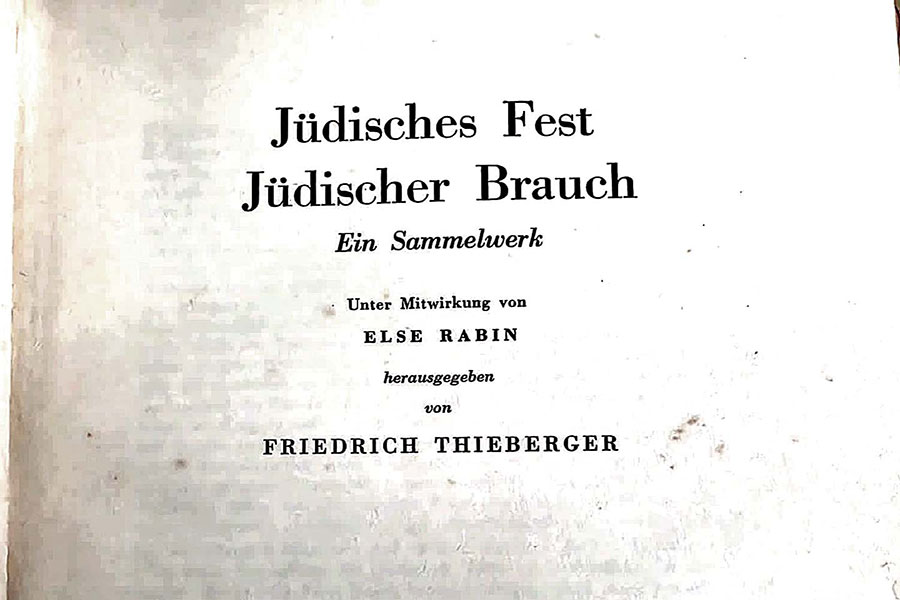


In those early, tightening years of Nazi rule, German Jewry lived in a state of profound contradiction, one eye fixed on the exits, the other turned inward, guarding a culture and religion under siege. There was the scramble to secure visas, affidavits, passage, anything that might pry open a door to safety. But alongside that urgency stood something quieter and no less defiant: a determination to preserve the inner spirit of Jewish life.
A remarkable volume I recently came across captures that tension with unusual clarity. Jüdisches Fest, jüdischer Brauch: ein Sammelwerk, published in Berlin in 1936 by Jüdischer Verlag, was far more than a book. It was, in essence, a cultural stand, what one might call a form of spiritual Zionism on German soil. At a time when the regime sought not only to marginalize Jews physically, but to erase them culturally, this work set out to gather, record, and dignify the lived texture of Jewish existence: Shabbat, the chagim, the customs of mourning, and the milestones that define a Jewish life.
Edited by Friedrich Thieberger, a Hebrew educator and associate of Franz Kafka, and with the assistance of Else Rabin, the volume brought together an impressive range of voices. Among them was Rabbi Leo Baeck, the towering leader of German Jewry in its final chapter, alongside other Jewish thinkers and even outside observers attempting to grapple with Jewish life from the periphery. The work blended scholarship with lived experience, creating not just an academic compendium, but a kind of spiritual archive.
And yet, the fate of this book underscores the nature of the enemy it faced. It did not fall victim to the infamous bonfires of 1933, the chaotic, student-driven spectacles that the world remembers. Its destruction came later, in 1937, when the Nazi campaign against Jewish culture had grown colder, more calculated, more efficient. By then, the regime had traded public theater for bureaucratic precision.
The publishing house itself – Jüdischer Verlag – was targeted. Warehouses were raided. Offices were cleared. Thousands of freshly printed copies of the 1936 edition were confiscated before they could circulate. This was not about spectacle; it was about eradication.
The books, in most cases, were not burned in public squares. They were pulped, reduced to raw material, as if the ideas they contained could be mechanically undone. Some copies were diverted into restricted archives, where Nazi “scholars” could dissect what they considered the intellectual output of an enemy people. The work was formally blacklisted, condemned as an expression of “un-German spirit,” a phrase that, in the moral vocabulary of the regime, marked it for disappearance.
The appearance of Jüdisches Fest, jüdischer Brauch in 1936 was not incidental; rather, it was urgent. Its editors and contributors understood, perhaps more clearly than many, that something irreversible was underway. While the machinery of persecution accelerated, they worked against the clock to ensure that the essence of Jewish life, its practices, its meanings, its inner coherence would be recorded.
The Nazis sought to make a people vanish not only from the streets, but from memory. This book was an answer to that effort. Its destruction, in turn, was an acknowledgment of its power. Today, the rarity of the original 1936 edition is not merely a bibliographic curiosity. It is a testament to both the ferocity of the attempt to erase and the quiet, stubborn insistence that there was something worth saving.