 October 16, 2026
A Female Composer Makes Music Behind the Scenes
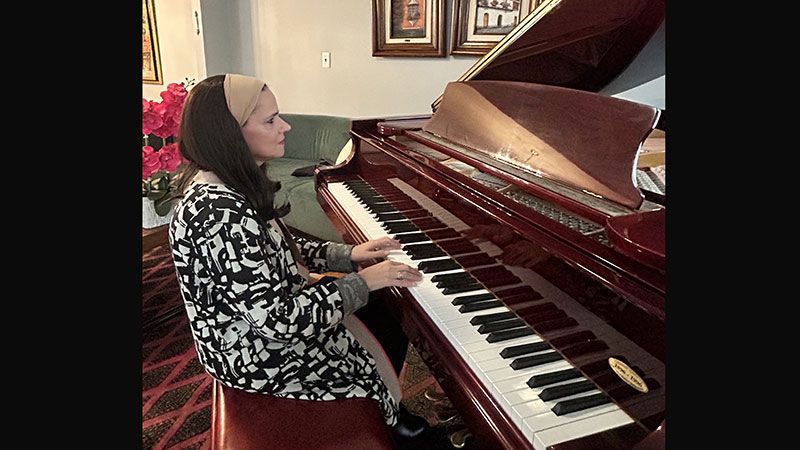


Miriam Cymet recently released her debut album, but she is not the singer. Cymet is the composer of all the songs on the album, Shaarei Shiros (Gates of Song), which are performed by male vocalists Naftali Blumenthal and Yehuda Zimberg – ensuring that there is no kol isha at all.
Although the songs are performed by male vocalists, you can easily sense that they were composed by a woman, even without being told. From the first song to the last, the album has a very calm and relaxing ambience. The beats are light and soft, making use of acoustic guitars, piano, and string instruments. The songs are soulful and full of yearning, with the potential to become kumzitz standards. One standout track is the second song, “Od Yishoma.” Cymet gives her own unique interpretation to the familiar, classic words of the song. I wouldn’t be surprised if I hear this tune during the chuppah at future weddings I attend.
Cymet’s connection to music began with her great-grandfather, Rav Boruch Dovid Weitzman, zt”l. In the early 1930s, as a wave of assimilation swept through the goldena medina, threatening traditional Yiddishkeit, he chose a unique way to fight back. Instead of using reprimands or harshness, he raised his children with joy and song.
Every Friday night after shul, he would gather his four children into a circle, dancing and singing songs about the beauty and laws of Shabbos. This approach had a tremendous, lifelong effect on them. Cymet’s grandmother, Rebbetzin Gittel Teitz, a”h, and her two sisters went to public school; there was no other option in New York at the time. But the foundation they received from their father was unshakable. She and her two sisters married talmidei chachamim, and her one brother became a rabbi.
Cymet was passionate about music from her earliest days. Her mother loves music and always sang to her children. Her father has a deep appreciation for chazzanus. There were always records (and later cassette tapes) playing in their home. She also went to Bais Yaakov of the Lower East Side, where music was an important part of the curriculum and where she had many opportunities to develop her musical talents in choirs and concerts.
Besides composing, Cymet also plays music. She took piano lessons and has been playing piano for many years. She plays by ear. During Covid, she also took guitar lessons on Zoom.
“How does it feel to compose the songs but then not be able to sing them for all audiences?” I asked her. “Does that bother you, or do you not care?”
“It did not bother me at all to compose music and then give it to someone else to sing,” she said. “I would like my music to reach as many people as possible; by releasing something in my own voice, I would be limiting the listener base significantly. Naftali and Yehuda have very beautiful voices and I was happy to have them as representatives.”
With all her enthusiasm for music and singing, Cymet did not realize she could compose music until after she turned 50! She was at a kumzitz (headed by Reyzl Shlafman) where Rebbetzin Shulamis Schreiber was sharing her original songs. Rebbetzin Schreiber noticed that Cymet was singing along with her as she was introducing the songs, and assumed she must be a composer if she could catch on to new songs with such ease. Cymet laughed out loud. But then, when they were discussing the concept of composing music, the Rebbetzin said it was not something she could take credit for at all – it comes straight from Hashem.
Cymet was intrigued. This was during the summer. A few weeks later, sitting in shul, she was struck by certain words in the machzor. She wondered if she could hold onto these words by coming up with an appropriate tune for them. So she sat down at the piano, started in C major, and within about 10 minutes, she had a tune. She had no idea whether the tune was good at all, so she shared it only with her husband, mother, children, one cousin who is exceptionally musical, and her son-in-law’s mother, who shares her passion for music.
Much to her surprise, they all thought it was very nice, so she gathered her courage and shared it at a kumzitz, where it was also well received. It did not take long for this to repeat itself. She would find words that resonated or that she liked – from the siddur, Navi, or Tehillim – sit at the piano, and compose melodies.
And then something strange started happening. Cymet could be peeling vegetables, stuck behind the wheel in traffic, grocery shopping, or waiting at the bus stop, when suddenly a new tune would form in her head – sometimes with specific words, other times with a concept but without fully developed lyrics, and often with no words or concept at all. There were times she woke up singing a new song, or when something going on in her life would trigger a new tune for specific words.
These tunes only found their way to the piano after they were already developed in her head. Included in this mix of tunes were several with ideas and a basic outline for lyrics, but no actual lyrics. She then began collaborating on songs with Barbara Bensoussan, whose articles she had been reading for years and who had moved in across the street from her about a year earlier.
The big question was what to do with all her songs. At one point, Cymet made some videos of herself at the piano and her son singing the songs and shared them with friends and family. She then reached out to two very talented musicians – Yisroel Appelbaum and Yosef Gestetner – who gave her great encouragement about her music as well as some ideas.
There was one song in particular, “Min Hameitzar,” which she really wanted to share with the public, as she felt that this song could inspire greater kavanah when reciting these timeless words in Tehillim and Hallel.
In 2019, Cymet was introduced to Naftali Blumenthal’s music and she was extremely drawn to it. Her definition of good Jewish music is that the tune conveys the meaning of the words of the pesukim. If the tune and words do not align, she will not connect to the song at all. For her to like an English song, she needs to feel drawn to the tune, but also has to connect to the message. Music influences her deeply.
Song lyrics get stuck in her brain long after she hears them, so it’s important for her to listen only to music that will have a positive impact, she told me.
Blumenthal’s Hebrew songs are very beautiful, and his English songs have powerful messages about topics like emunah, trusting yourself, and teshuvah. He is a composer, singer, and producer.
Cymet figured that since she really liked his original songs, his arrangements, and his voice, he might be the best person for her to call about “Min Hameitzar.” So she contacted him, and although he generally produces songs for singers who perform their own songs, he not only produced the music for “Min Hameitzar” but sang it as well.
Cymet was very impressed with the final product because it was a highly accurate version of the original demo she had sent him, greatly enhanced by stunning arrangements and beautiful vocals.
Although they got very positive feedback, she had no thoughts at that point of producing an entire album, even as new tunes kept coming. She sent a few of these songs to her brother, Rabbi Binyomin Gringras. He was blown away by Blumenthal’s production of “Min Hameitzar” and took a strong liking to the newer songs. Binyomin pushed the idea of an album very enthusiastically and became the driving force behind it.
Again, Blumenthal went beyond what he typically does; he arranged the music and did the vocals as well. He also asked his friend Yehuda Zimberg to do some of the singing on the album. Zimberg has an outstanding voice – powerful and clear, passionate without any whininess, and very pleasant to hear. Together, they created beautiful vocals accompanied by Blumenthal’s music.
The album, which is available on all music platforms, has ten songs. Two of the songs have English lyrics by Barbara Bensoussan. The opening track is “Shaarei Shiros,” with words of the Pele Yoetz about the gates of song remaining open even when the gates of tefillah are closed.
Jewish music has the power to uplift and inspire greater connection with Hashem and with one another. Cymet has been enjoying other people’s music her entire life and is very grateful for the privilege to share her own music, which is in itself a great gift from Hashem.