 September 18, 2026
 Categories: Features / Headline
A Journey Through Poland: Fire to Freedom


At nineteen, when most of my peers in Sha'alvim and other yeshivas and seminaries were making their trips to Poland on Heritage or the March of the Living, I couldn’t go. We couldn’t afford it. I was upset and embarrassed, and though I managed to have a wonderful Pesach break in Israel that year, I’ve felt that an important Jewish experience was missing ever since.
Twenty-one years later, at age forty, I finally made that journey.
Looking back, I realize that waiting was a blessing in disguise. Experiencing Poland as a husband and a father of three children completely changed how the history landed. At nineteen, still basically a child, I likely would have intellectualized the tragedy, processing it as "history" or a search for identity. I’m sure I would have felt deeply during the experience, but it would have been different. At forty, having built a life of my own, the distance of time contracts.
Standing near the barracks and staring at the displays of tiny children’s shoes, you inevitably ask yourself some horrible questions. At nineteen, I would have wondered, “Would I have survived?” At forty, I look at the heavy iron doors to the gas chambers and the narrow opening to the ovens and think of my own family – my wife, my daughter, my two sons. With nauseating certainty, I know that I could not have saved them. The tragedy stops being an astronomical statistic, impossible to really grasp, and becomes personal. Beautiful lives and beautiful futures were extinguished from millions of families just like my own.
A Millennium of Life
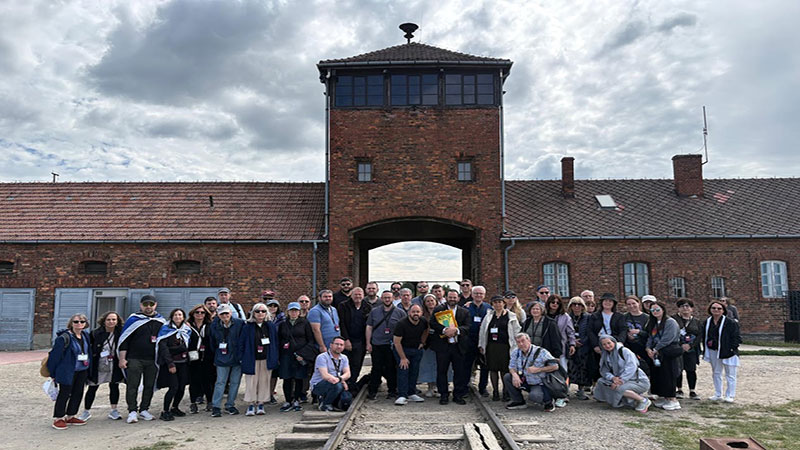
To comprehend the scale of destruction, our group had to first understand the richness of what had once been. We were privileged to go on this journey with JRoots, an incredible organization that has been conducting similar journeys across Europe, Morocco, and Israel for people of all ages, breathing life into our history. JRoots founder Tzvi Sperber was our guide. Tzvi had a mission to add a fourth dimension to our journey: to understand the Poland that was, and the people who thrived there, to tell their story.
Hearing from Tzvi and Rabbi Andrew Markowitz of Fair Lawn’s Congregation Shomrei Torah helped resurrect Poland’s Jewry. Poland is frequently described as a Jewish cemetery, but what we saw in Warsaw and Lublin was something vastly different: a vibrant and deeply creative culture that had flourished for a millennium.
At the Warsaw Jewish Cemetery, the sheer diversity of pre-war life is etched into its headstones. Writers, politicians, merchants, and rabbis rest side-by-side. The Netziv and the Brisker Rav are just a few steps away from the creator of Esperanto, Dr. L. L. Zamenhof. In Lublin, we stood inside Yeshivas Chachmei Lublin, once the premier centerpiece of Torah scholarship in the world, led by the dynamic Rav Meir Shapiro. Guided by Rabbi Markowitz, we sat and learned the Torah of Rav Shapiro in his very own yeshiva. These were not people waiting for a tragic fate; they were giants building a future.
The individuality of Poland and the bitterness of its destruction were further found in a little town called Brzesko. History became beautifully and painfully intimate as we traced the roots of the ancestors of our friend and trip organizer, Josh Lipschitz. Walking the same ground where Josh's family once lived, laughed, davened, and built a home brought the entire mission of the journey into focus. These were our grandfathers, our grandmothers, our cousins.
We saw this same enduring spirit in the beautiful 1761 synagogue of Łańcut, and at the grave of the chassidic master R’ Elimelech in Leżajsk. You begin to realize that every single unit of the six million had a home like the ones in Brzesko – a family, friends, love, and laughter.
Destruction
However, we all know where the vast majority of these stories end. This truth hits like a gut punch at Treblinka, where close to 900,000 Jews were murdered in a span of just over a year, and at Majdanek, with its gas chambers just a stone’s throw from the neighboring houses.
That feeling follows you into towns like Izbica, over 95% Jewish before the war, and today, completely ethnically cleansed of Jews. Walking through it today, you realize it is the very definition of a ghost town. The streets are there, the houses are there – but we are not.
To process a loss of this magnitude, to see beyond the statistic, you need to individualize the tragedy. It was not one crime of six million; it was six million individual, deliberate murders.
Nowhere did this become more devastatingly personal than outside Tarnów, at the mass graves in the Buczyna forest. Standing before the fenced-off plots where hundreds of children were brutally murdered and thrown into pits, the horror becomes personal. I can't help but imagine my own children in those pits. I ask myself how this was possible, how anyone could participate, and how they could have allowed this to occur.
Then we went to Auschwitz-Birkenau. We are told story after story from the testimony of survivors about the sadistic family separations on the train platforms. The sudden, chaotic moments where parents were ripped from children without the chance to even say a proper goodbye. You think of the agonizing weight of regretted last words, spoken in panic or confusion, that should never have been the final words shared between loved ones.
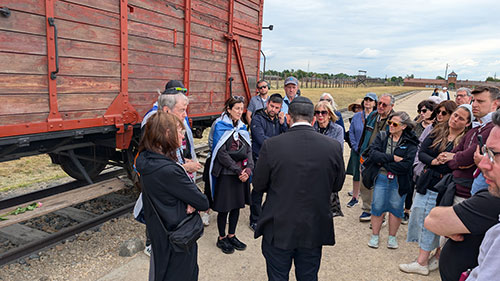
The cruelty was entirely intentional. The ultimate goal of the Nazis was to systematically humiliate and dehumanize us before they murdered us.
You feel this deeply when walking through the camp latrines at Birkenau. The physical reality of the overcrowding, the plague of dysentery, and the absolute squalor were meticulously designed to strip human beings of their dignity. I felt a visceral wave of horror standing inside the women's barracks, looking at the wooden tiers where ten women were forced to share a single bunk, a space barely the width of my own arm's length. The sheer mathematical impossibility of human survival in that calculated filth is overwhelming. This is what they did to our women, to our children, to our aged and infirm.
Eternity
How do we prevent a week like this from fading into a distant memory? How do we ensure that these echoes continue to reverberate without abating?
As we find ourselves having just emerged from the Three Weeks and Tisha B'Av, this question carries even more weight. For centuries, our people have utilized this period in the calendar to mourn the destruction of our Batei Mikdash, the exile of our people, and the countless calamities that have befallen us over the millennia of Jewish history, including the Holocaust. But standing on the blood-soaked ground of Poland, the lamentations of Yirmiyahu no longer feel historical. The tragedies of our ancient history, the catastrophes of the Holocaust, and the piercing devastation of October 7th are all inextricably linked together.
The answer came on Friday night in Kraków.
After days of walking through the ashes of ghost towns and death camps, our group gathered in the historic Jewish quarter of Kazimierz to bring in Shabbos. In an ancient shul we were suddenly joined by over a hundred Israeli yeshiva and midrasha students. They too had come to visit Poland. They were alive, electric, and energetic. As we sang and danced together, completely drowning out the chazzan, I realized that everything had come full circle. I was singing with the nineteen-year-old me that couldn’t come all those years ago.
The contrast was overwhelming. Just hours after standing in the suffocating fields of Birkenau, we were in a room filled with life and the defiant, beautiful euphony of Jewish youth.
The Nazis fought for total extermination, a reality they intended to leave evident only in a cold museum, with a little Sefer Torah decaying behind a pane of glass as the final marker of the end of Jewish history. They wanted to ensure that no descendants would remain to tell the story. Therefore, to honor and to remember, to love and nurture, to daven and learn Torah, and to celebrate with Am Yisrael in our very own Eretz Yisrael is the ultimate act of defiance.
We do not return home from Poland merely to mourn the dead. We return carrying their songs and their voices. We rebuild by taking with us the stories of the families who were silenced: from the bustling streets of Lublin, Warsaw, Kraków, Leżajsk, Tarnów, and Izbica; from the mud, blood, and ash of Treblinka, Buczyna, Majdanek, Auschwitz, and Birkenau; and from the ancestral homes of Brzesko. We share their lives with others and with our children, ensuring that they are never forgotten and will forever live on in our hearts.