 September 18, 2026
 Categories: Features / Book Reviews
A Landmark Edition of the Mishneh Torah
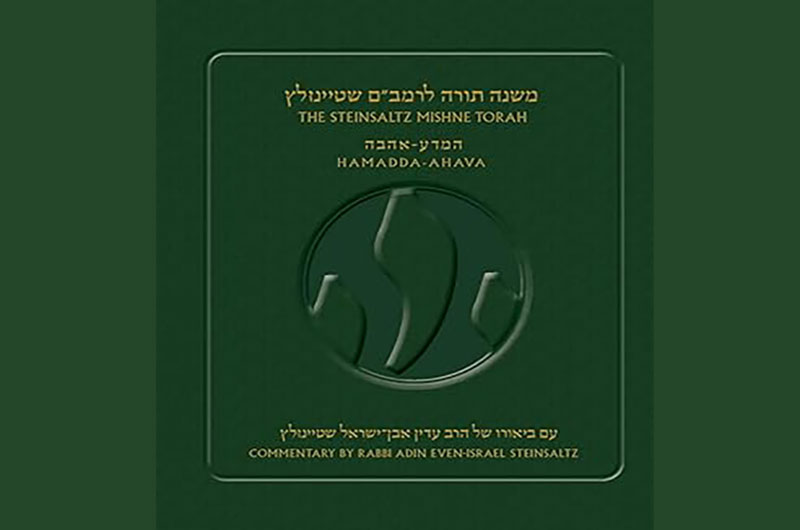


Title: Steinsaltz Rambam Mishne Torah, Volume 1: Sefer Hamadda and Sefer Ahava
By: Rabbi Adin Even-Israel Steinsaltz
Koren Publishers
Only every so often does a sefer appear that becomes the standard point of reference. It does not merely join the shelf of others of its type previously published, but instead becomes the sefer people will use in the present and future. That was my reaction when I first encountered Koren’s new translation and elucidation of the Steinsaltz Mishneh Torah. Only the first volume has been released so far, yet it already feels like one of the most important Torah publishing projects in recent years.
I still remember the first time I saw it, when someone in shul was recently learning from it. I immediately stopped to ask about this beautiful new sefer. Its physical quality is what one would expect from Koren: clear print, elegant design, and excellent binding. This first volume of the set contains the Rambam’s introduction to his magnum opus, the Mishneh Torah. It then continues with the Rambam’s listing of the 613 mitzvos and the first two books of Mishneh Torah itself: HaMada and Ahavah. As such, this volume is relevant to some of the most familiar and relevant areas of contemporary Jewish life, including the laws of teshuvah, tefillah, mezuzah, and many others.
One of the strengths of this edition is the care invested in the actual text itself. Many students of the Rambam do not realize that over the centuries, often due to unintended copyist and printing errors, mistakes crept into some editions of the Mishneh Torah. In response, Koren’s editorial team based this new edition on precise versions known for their accuracy. Even the diagrams and sketches are thoughtfully prepared, and the additional explanations are helpful without becoming overwhelming. You can tell this project was accomplished by experienced and skilled scholars. [Full disclosure: I was classmates with Rabbi Michael Siev, one of the leading translators on the project.]
Similar to what many readers will remember from the Koren Shas, another monumental work, many modern photographs and illustrations are included, making abstract discussions easier to visualize. For example, there are pictures clarifying the structure of tefillin knots, of plants and unusual fruits discussed by the Rambam, as well as those that offer a glimpse of what the Beis HaMikdash is understood to have looked like thousands of years ago. Helpful introductions and summaries, along with topic headings, and tables also appear throughout the work, allowing readers to better navigate what might (at over one thousand pages!) have otherwise seemed an overwhelmingly vast tome.
Looking beyond the many impressive facets of its presentation, at its core this sefer is, of course, a translation of Koren's Hebrew Steinsaltz edition of the Mishneh Torah, complete with notes based on those of the late Rabbi Adin Steinsaltz, zt”l, himself. Sometimes these helpful notes explain the background of biblical texts referenced by the Rambam, such as explaining the identity of Yehoyakhin mentioned in Hilchos Teshuvah (7:6), and later clarifying that he is the same as Konyahu cited later by the Rambam. Other times the notes serve to cross-reference pertinent texts elsewhere in the Mishneh Torah. Hilchos Teshuvah (3:5), for instance, states that “the pious of the nations” too have a share in the World to Come, and the note there points the reader to Hilchos Melachim (8:11), where the Rambam explains that these are “Gentiles who fulfill the seven Noahide mitzvot… because of G-d’s command.” Importantly, sometimes the notes include relevant explanations of Rabbi Steinsaltz found in his other works or even that he offered in lectures; the reader is treated to various additions of this type in the first chapter of Hilchos Yesodei HaTorah.
Another feature that makes the work stand out is that it does not present the Rambam in isolation. The comments of the Raavad, Rambam’s famous contemporary critic, are included as well, allowing the reader a window into the famous give-and-take between these two giants of Jewish thought and tradition. Other opinions, including of later halachic authorities, are also frequently referenced, such as those of the Shulchan Aruch, Rema, and more recent poskim. The reader is thus offered insight into development of the practical halacha in the centuries since the Mishneh Torah was first authored. At the end of each book are appendices further explicating the more complex halachic issues, which adds yet another layer of depth.
In the period since the Lubavitcher Rebbe famously encouraged daily Rambam study, many follow the one-year or three-year Mishneh Torah cycle popularized by the Lubavitch community. Very helpfully, the new Koren edition includes markers so readers know exactly where to stop each day. Comments from the Rebbe are included on the margins of some pages as well. Alongside the hardcover version whose beautiful design is detailed above, Koren very helpfully produced smaller and lighter softcover volumes ideal for commuters maintaining a daily learning schedule on the train, bus, or during a lunch break. (On a recent car trip, my teenage son eagerly delved into Sefer HaMada, and he cannot wait to learn more!)
This first volume makes clear that Koren has identified a genuine need and filled it exceptionally well. They have produced something that can serve beginners, experienced learners, daily Rambam students, and even people who simply want a clearer entry point into one of the foundational works of Jewish law and thought. We are left eagerly waiting for the next volume to appear.