

 November 27, 2026
Categories: Arts
A Mexican Spice (Tower) & A “Dreidel Menorah”


Dear Tsadik,
I got this besamim holder and this candelabra from my grandfather 50 years ago. He was originally from Berlin. I was wondering where they originated and their value.
Yakov
Brooklyn, N.Y.
Dear Yakov,
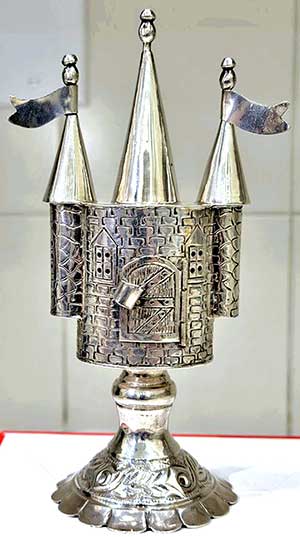
You inherited two interesting pieces, both of which are indeed related to your grandfather’s country of birth, Germany. The spice tower (besamim holder) is a very high-quality reproduction of a spice tower that was popular amongst German Jews during the first quarter of the 20th century. The reason I can state with certainty that it is a reproduction and not an original is the hallmark seen on the base, which states “Mexico Sterling.” During the late 1940s and early 1950s, there was an economic boom in the United States, and many Americans chose to spend their extra income on vacations in Mexico; subsequently, high-end silver gift shops sprang up to offer quality goods to be purchased by American tourists as souvenirs to take back home.
While I have seen a seemingly endless array of silver Chanukah menorahs made in Mexico during this era, this is the first time in 30 years that I can recall seeing a Mexican-made silver spice tower. That it imitates a pre-World War II-styled German spice tower is not surprising, as some of the aforementioned Mexican Chanukah menorahs I’ve come across are faithful imitations of pre-war German, Polish, and even American menorahs. If your spice tower were a pre-war German-made example, the hallmarks on the base would include the numeral “800,” which stands for 80% silver (your sterling-marked tower is of a higher silver content of 92.5%), and two symbols that look like a crescent moon and a crown.
Your grandfather may have remembered the original German-made spice tower of this form in his boyhood home in Berlin, and sometime after arriving in America, saw the Mexican copy for sale and purchased it, as it reminded him of the happy, safe times with his family before the war.
The German design of your spice tower is so popular that even today, in Judaica stores that sell ritual objects made of silver, you will find newly made examples offered for sale that are an identical match to your spice tower.
As to value, this is a bit tricky, because while it is not a new American reproduction, it is old – approximately 75 years old – and there is a collector base for silver objects made in Mexico during the decade following the end of the Second World War, since the heavy gauge of Mexican silver and high standard of manufacturing are appealing. I would say that in today’s market, your spice tower would sell for somewhere between $300 and $400, as unlike the readily available silver Chanukah menorahs that were made in Mexico, your spice tower is a curious rarity that would pique the interest of the advanced collector.
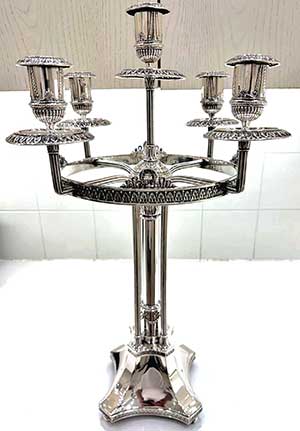
Now, to address your five-light candelabra, which technically is a secular piece made for the general marketplace, i.e., both Jews and non-Jews. On its face, it is not Judaica and therefore not relevant for this newspaper column. However, it bears the pre-war German hallmarks of “800” and the crescent moon and crown, indicating that it was made in pre-war Germany, and “L. Posen,” which was the manufacturer of your piece.
To explain: The silver firm Posen was founded by Lazarus Jacob Posen in 1834. Lazarus Posen manufactured secular silver goods for the general market. Upon his death in 1869, control of the business went to his widow, Bredina Wetzlar. Under her leadership and that of her son Jacob, Posen began producing Judaica. By the end of the 19th century, Posen had become the largest supplier of silver Judaica in Europe.
Because there are antique Judaica collectors of Chanukah menorahs, spice towers, kiddush cups, and other Jewish ritual objects made by the Posen silver company, and some of these collectors would be interested in acquiring a candelabra made by Posen as well, to incorporate into their collections for lighting Shabbos candles, it fits the parameters for me to evaluate this piece as “Judaica adjacent.”
Yakov, based on the information you gave me in our follow-up email correspondence – including the dimensions you gave me, the substantial weight of 66 ounces, and the stunning appearance of your candelabra, styled in neoclassical taste and made around the year 1900 – I estimate its value in today’s market to be between $3,500 and $4,500.
Best,
Tsadik
Dear Tsadik,
What is this gold-plated Agam menorah worth?
Howard Titen
Highland Park, N.J.
Dear Howard,
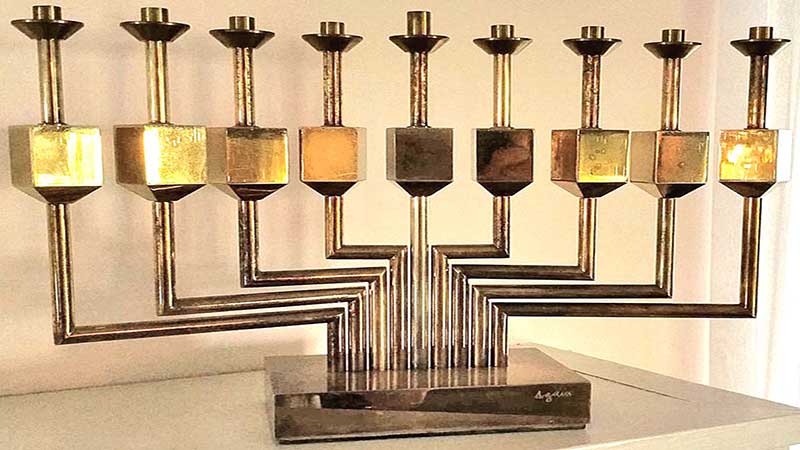
You have what is known as the “Dreidel Menorah”: Each arm can be disassembled, and their centers are each shaped like a dreidel and can theoretically function as one as well. This ingenious design concept was created by the Israeli sculptor and experimental artist Yaacov Agam (1928-2026). According to internet sources, this piece was originally designed in 1966 by Agam, and versions of his Dreidel Menorah were issued in numbered editions beginning in 1979. You have what appears to be a 24-karat gold-plated version. You replied to my follow-up correspondence that there is no number found on your example, but it is signed by Agam.
As to value, the only comparables that have appeared in the marketplace and actually sold were all numbered in limited editions of 225 pieces. If your example were numbered, the value would be $3,000-$4,000. I can only locate two or three examples of your “unknown edition,” offered by high-end retail sellers with asking prices in substantially larger amounts than the sold auction examples of $3,000-$4,000. If you have the original fitted blue wooden box that your menorah came in which states that it is 24-karat gold-plated, I believe that in today’s auction market it would sell for between $4,000 and $5,000.
Best,
Tsadik
Dear Tsadik,
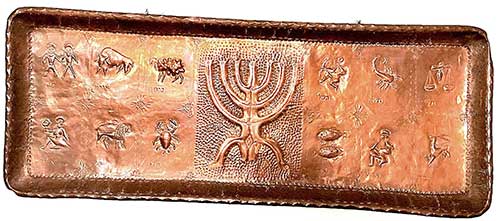
Decades ago, my parents traveled to Israel and purchased from an Israeli artist a beautiful tray, which I believe is made of copper. The dimensions are 39 inches wide and 15 inches tall. In the center is a seven-branched menorah. On each side of the menorah are the names in Hebrew of six months, along with a pictorial depiction of each month. I would greatly appreciate your review of this beautiful copper tray.
S.
Teaneck, N.J.
Dear S.,
What an attractive piece of tourist-ware your parents acquired on their trip to Israel! While rectangular copper trays were made in mass quantities in Israel beginning in the 1960s (which is the era your tray was created), most examples were die-stamped by machine; your tray was entirely made by hand. It is also substantially larger than the examples that appear in the marketplace. Copper trays with die-stamped decoration that are half the size of your tray tend to sell in the $20 to $40 range. By far, your tray is the most attractive type I have ever seen, as the repoussé and chasing work done by the artisan demonstrates his or her talent, and the details seen in the zodiac symbols flanking the menorah are very well-executed and quite charming.
As lovely as your tray is, unfortunately the collector audience for this type of ware is extremely limited and budget-conscious. Value: $150-$250.
Best,
Tsadik