 October 23, 2026
Categories: Headline / Parsha / Torah
A Rainy Request & Avra(ha)m’s Journey
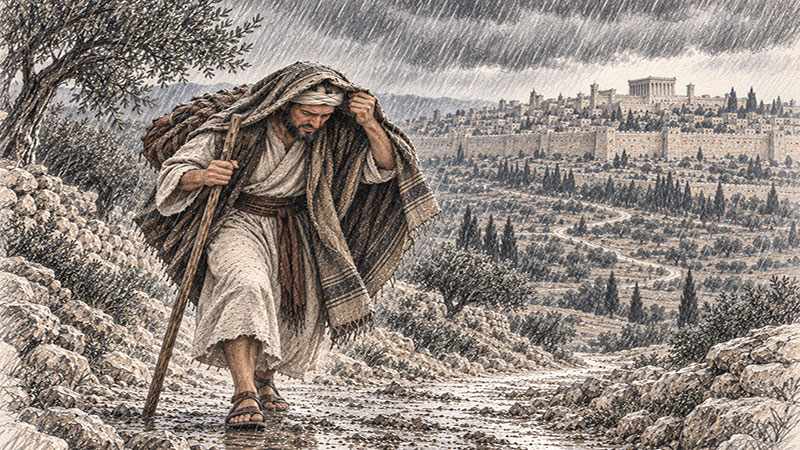


Parshat Lech L’cha
Let’s start with a riddle you can ask at your Shabbat table (assuming not everyone at your table has read this column):
There are 54 sedras in the Torah. Name the ones that have two-word names.
(Make them work for it – don’t give the answers too quickly.)
Here they are: Lech L’cha; Chayei Sara; Ki Tisa; Acharei Mot (unless you call it just Acharei); Ki Teitzei; Ki Tavo; and V’zot HaB’racha. That’s seven.
* * * * *
We in Israel began saying “V’tein tal umatar livracha” this past Motza’ei Shabbat, the eve of the 7th of Marcheshvan. I’ll save most of the details for the beginning of December when the rest of the world begins Tal uMatar, but I do want to say a few things about T&M now.
Why is there a different starting date for T&M in the Diaspora? Why is the date in Israel on the Jewish calendar and in Chutz LaAretz on the secular one? And what about travelers from and to Eretz Yisrael during the time when we are saying different things in our weekday Amida?
In Israel, the answer is simple: The Mishna in Taanit says to begin asking for rain on the 7th of Marcheshvan. And we do. As the Mishna explains, this is two weeks after Sukkot, which gives enough time for Jews who came to Yerushalayim for the chag (fulfilling the mitzva of aliya l’regel) to return home beyond the Euphrates River (N’har P’rat). We can say that this delay prevents the more distant travelers from having to ask for rain with their lips when their hearts don’t want it to rain before they get home. And the rest of us go along with the delay in asking for rain for their sake.
The Mishna in Taanit also teaches that we don’t ask for rain until it is close to the rainy season. In Bavel, the main center of Jewish life in the Diaspora in the time of the Gemara, that time was determined to be 60 days after the autumnal equinox, known to us as T’kufat Tishrei. That time ended up being in the beginning of December when the calendar changed from the Julian to the currently used Gregorian. The 60-days-after rule was fixed as the practice for all of Chutz LaAretz, regardless of the specific dates or local need for rain. The irony? The halachic date for beginning to say T&M is based on the timing in what today is Iraq. There are interesting details applicable in some parts of the Southern Hemisphere, but we won’t get into that now.
The bottom line for travelers to and from Israel: If the trips are short (less than a year), one says T&M according to the timing in his home country. It is more complicated for students in Israel for a gap year or otherwise. Guidelines are usually provided by the yeshivot and seminaries, as the case may be.
I want to finish this topic for now with a powerful point. If one does not say Tal uMatar during the period of the year when he or she is supposed to, the entire Amida is invalid and must be repeated. (Again, I’m leaving out many details for now.) Think about it: A person mistakenly said instead “V’tein B’racha…”– Hashem, please give a blessing to the land...” That doesn’t sound so negative. Yet 19 brachot are invalidated and the person repeats the Amida. Our Sages made the rules. They could have said, “If you forget Tal uMatar, let it go this time – just be more careful next time.” They did say something similar about other additions to the Amida. But not this one. And we should realize three things as a result of the T&M rules: Rain is important. Prayer is real. And the individual is significant, each and every one of us.
One more point about T & M – the numbers: In Israel, people who daven three times a day will be asking for blessed rain 480 times this year. That’s 160 weekdays in a year (such as this one, 5787) that has 385 days, 55 of which are Shabbat and another 15 days of which are Yom Tov days that do not fall on Shabbat. That means that we will have asked for rain on slightly more than half the days of the year. (Stats are different in Chutz LaAretz.)
May we receive beneficial, blessed, sufficient rain this year and every year.
* * * * *
Let’s get to Lech L’cha.
First, a fond (or not so fond) memory from quite a way back. I once had a rebbe who asked, “Why is Lech L’cha spelled with two chets? Why is Lech L’cha spelled with two chets?” He repeated the question until we interrupted and said, “But Rebbe, Lech L’cha is spelled with two chafs, not two chets.” To which he answered, “That’s one answer. I have a better answer.”
Now to the numbers: Lech L’cha (henceforth LL) is the third sedra of the Torah’s 54 sedras, the third of the 12 sedras in the Book of B’reishit.
It is written on 208 lines in a Sefer Torah, ranking 23rd, towards the bottom of the top half.
LL consists of 7 parshiyot – 3 open, 4 closed.
LL has 126 p’sukim, same as R’ei, but it is smaller than R’ei in other categories.
It contains 1,686 words (ranks 18th) and 6,336 letters (ranks 19th).
LL is ranked seventh of 12 in the Book of B’reishit for all categories. It has shorter than average p’sukim, which accounts for the drop in rank for words and letters.
LL has one mitzva of the Torah’s 613, one of only three in Sefer B’reishit – the mitzva of brit mila.
To put the distribution of mitzvot throughout the Torah into perspective: 17 sedras have no mitzvot; five have a single mitzva each; six have 2 or 3. This accounts for 28 sedras, just over half of the Torah’s 54, with between 0 and 3 mitzvot.
To continue with the numbers: One sedra has 5 mitzvot; three have 6; two have 7; one has 8; and two have 9. That’s 37 sedras with single-digit numbers of mitzvot.
We’re on a roll! Let’s keep going. One sedra has 11 mitzvot; two have 12; one has 16; two have 17; two have 18; and there are one each with 20, 24, 28, 41, 51, 53, 55, 63, and 74. That’s 17 sedras with more than double-digit mitzvot each.
Total: 54 sedras.
To sum it up, almost a third of the sedras have no mitzvot. A bit more than a third have 1-9 mitzvot each. And almost a third of the sedras have 11-74 mitzvot.
* * * * *
Avram and Sarai – who get their new and forever names towards the end of the sedra – leave Charan and go to the Land of Canaan at G-d’s command. Avram’s nephew Lot goes with them, as do people who were influenced by them to believe in one G-d. Sometime soon thereafter, a famine strikes and Avraham and Sara go down to Egypt (apparently with Lot). On the way, Avraham asks Sara to tell anyone who asks that they are brother and sister.
There are two halachic issues that we learn from this. One is that a person may leave Israel temporarily because of a famine (and other financial situations). The second is that a person may violate certain mitzvot in order to save someone else.
Let me clarify. A person can violate Shabbat to save his own life. This is based on “V’chai bahem” – And you shall live with them [the mitzvot] and not die because of them. (Much more complicated than presented here, but we won’t get into that here and now.) However, the argument that violating this one Shabbat will allow me to observe many Shabbatot in the future does not necessarily fit with the scenario of one person violating Shabbat to save another person. The principle that one may violate Shabbat to save someone else is learned from Avraham’s asking Sara to pose as his sister. She would be endangering herself and possibly violating certain prohibitions in order to save Avraham. Thus, the pasuk from Lech L’cha expanded the scope of piku’ach nefesh – what we may do in a life-threatening situation.
And here is a complication to the above. Ramban (Nachmanides) is of the opinion that Avraham “sinned a great sin, albeit inadvertently” when he went down to Egypt, leaving the land to which G-d had just sent him, and another sin by endangering Sara.
Without giving a satisfactory explanation, I will just say that this is the way of Torah learning and understanding. Each opinion has a certain validity. And if you say, “How can they both be right?” you’d be right too.
* * * * *
The sedra contains the account of the battle of the four kings versus the five kings. The people of S’dom were captured, including Avraham’s nephew Lot. Long story short, Avraham takes 318 men with him and frees the people of S’dom. Lot is saved. Rashi presents an interesting opinion: that Avraham took only his trusted servant Eliezer to fight with him to free Lot. Rashi backs his opinion with a gematria. We don’t find too many gematrias in Rashi. ELIEZER = 1+30+10+70+7+200 = 318. How could I leave this out of a Jewish Press column called Torah by the Numbers?
* * * * *
The mitzva of brit mila consists of two parts. The first takes less than a minute – the actual circumcision. The second part is the parents’ long-term mitzva to raise the child to be a good person and a good Jew. When the baby’s father appoints a professional mohel to perform the circumcision, it is the mohel who makes the b’racha “Al haMila.” But the second bracha – “L’hachniso b’vrito shel Avraham Avinu,” to enter the child into the Covenant of Avraham Avinu – is recited by the father. He does not give that brit part of the brit mila over to anyone. Well, he does send his son to school, but good parents retain the primary role of teachers of their children.
The command to circumcise a male baby at eight days old is found in Parshat Tazria. But the mitzva is not counted from that sedra. Rather it is counted in Parshat Lech L’cha. This is so because the mitzva is packaged with the covenant that G-d made with Avraham. This includes G-d’s promise that Avraham will have many descendants, that He will be our G-d, and that He will give the Land to Avraham in perpetuity. The word brit, in one grammatical form or another, occurs ten times in the portion of brit mila. Circumcision is so much more than a religious surgery; it represents a lifelong commitment to G-d, His Torah, and mitzvot.
Number-wise, brit mila is the eighth mitzva (following the Seven Noahide Laws) and is ideally performed on the baby’s eighth day. Eight is not stam a number – it represents mei-al lateva, above and beyond nature.
Here’s another short gematria about this special mitzva: BRIT = 2+200+10+400 = 612. Add MILA (which is one mitzva) and you get 613.
Shabbat Shalom.