 October 9, 2026
 A Singular Second Chance & the Omer’s Dual Overtones


Parshat Emor – Pesach Sheni – Lag BaOmer
A year ago – to be specific, 350 days ago – the first “Torah by the Numbers” column appeared in The Jewish Press. It was for Shabbat Parshat Emor, and that Friday was Lag BaOmer. This time around, the Friday of Parshat Emor is Pesach Sheni, so this column will feature both Pesach Sheni and Lag BaOmer, as well as Parshat Emor.
I hope you enjoy these columns as much as I enjoy writing them.
* * * * *
Let’s begin with Pesach Sheni. On the first of Nissan 2449, almost a year out of Egypt, G-d tells Moshe to tell the people to get ready to bring the Korban Pesach on the afternoon of the 14th of the month. Moshe transmits this to Bnei Yisrael, and they do as commanded and bring the first “Pesach L’dorot,” the annual Korban Pesach. Then the Torah tells us of people who approached Moshe and Aharon and said, basically, that it was not fair that they should miss out on the mitzvah of Korban Pesach just because they were tamei (ritually defiled) at the time the Korban was brought. G-d then sets down the mitzvot and laws of what we call Pesach Sheni and what the Mishna calls “Pesach Katan.” It is important to point out that Pesach Sheni was not a mitzvah that came into existence because of these men who were tamei. Pesach Sheni is part of the whole Torah that was given at Sinai and detailed to Moshe Rabbeinu during the 40 days and 40 nights following the day of Matan Torah. However, it was introduced and taught to the people as a response to the challenge presented by these individuals. It is also important to see how unique Pesach Sheni is. If someone misses Yom Kippur because of illness, there is no make-up for it. The person is exempted from fasting on Yom Kippur and it is a case of “better luck next year.” The same thing goes if it rains the entire seven days of Sukkot and one does not get the opportunity to fulfill the mitzvah to dwell in the sukkah. No make-up. Pesach Sheni is counterintuitive because the Korban Pesach is very much a time-related mitzvah. And actually, it is not considered a make-up for the Korban Pesach. That Korban is brought only in the afternoon of the 14th of Nissan. Pesach Sheni is its own mitzvah. A person who did not bring the Korban Pesach on the 14th of Nissan (though it’s not that simple; there are details as to who brings Pesach Sheni and who does not) is commanded to bring it on the afternoon of the 14th of Iyar and eat of it that night (the eve of the 15th of Iyar) with matzah and maror. It is significant to note that the Torah’s two official reasons for bumping the individual to Pesach Sheni are being tamei and being distant from the Beit HaMikdash. The Mishna adds to those two situations any other reason a person was not able to bring the Korban Pesach the first time – he was ill, he forgot it was to be done, he brought an animal that turned out to be invalid as a Korban, and so on. Rambam spells out that even one who intentionally refused to be part of the Korban Pesach the first time around has the mitzvah – the opportunity – to bring the Korban Pesach on 14 Iyar. Our takeaway from Pesach Sheni is the concept of (very narrow and specific to the Korban Pesach, but generalized to other situations) a second chance. T’shuva – repentance. The rule could have been, “Sorry, you missed it; it doesn’t matter why – that’s it. You have a good excuse? Forgiven. No good excuse? Punishment.” But G-d chose, so to speak, to show us, with this specific example, that second chances exist. Without the Beit HaMikdash, Pesach Sheni is merely a date on the calendar, a day on which we don’t say Tachanun (and not even everyone agrees with that), and on which there is a custom to eat matzah – either on Friday (this year) or Friday night, the night that people would be eating the second-chance Korban Pesach with matzah and maror, or both. But the concept of a second chance is big. One more idea about Pesach Sheni. The Omer period was, once upon a time, a mildly joyous period, something like Chol HaMoed between Pesach and Shavuot. It was a mildly joyous period between the barley offering of the second day of Pesach and the Mincha Chadasha, the two-loaves offering, of Shavuot. Without the Beit HaMikdash, the Omer period has become, temporarily, a semi-mournful period. But there are bright spots on the Omer calendar that remind us of what was – and, more importantly, what will be. Six days of Pesach, three days of Rosh Chodesh, Lag BaOmer, the three days leading up to Shavuot... and Pesach Sheni.* * * * *
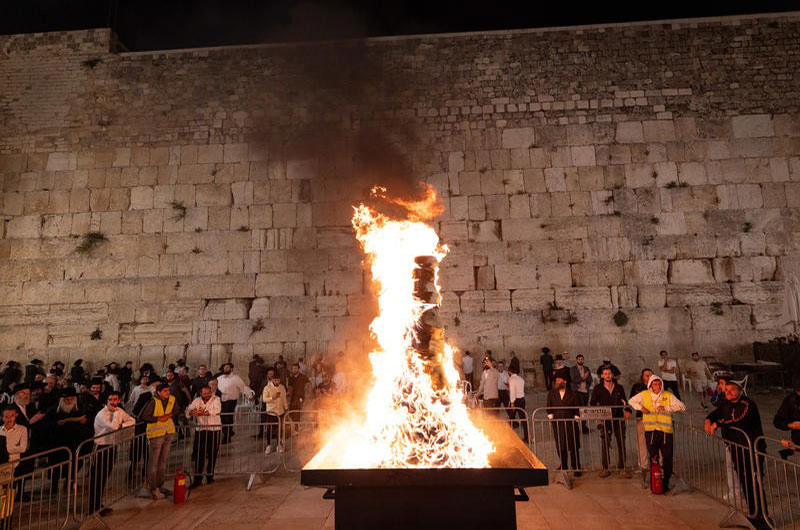
Speaking of bright spots in the Omer period, let’s talk about Lag BaOmer. We’ll start from the beginning. As we just noted, the Omer period was, once upon a time (and in the future will be), a mildly festive period, akin to Chol HaMoed. With the loss of the Beit HaMikdash, the Omer period was stripped of its festive flavor and the resulting vacuum was filled with a mournful nature, referred to in Shulchan Aruch as being a time of “k’tzat aveilut,” a bit of mourning. As we know, marriages do not take place during two-thirds of the Omer period (we’ll get to the details shortly) and hair-cutting and shaving are banned. The 49 days of the Omer include six days of Pesach, three days of Rosh Chodesh, Pesach Sheni, Lag BaOmer, and the three days before Shavuot that led to Matan Torah. And seven Shabbatot. Add to them both Yom HaAtzma’ut and Yom Yerushalayim and you have almost half of the days of the Omer that can hardly be seen as mournful. In fact, of the 49 days, the restrictions mentioned above are generally observed for 33 days. Let’s call those MOP (Mournful Omer Practices). There are two main opinions as to what are the 33 days or MOP. The reason for MOP is the deaths of 24,000 students of Rabi Akiva. Sources say that they died during 33 days of the Omer. Some say that it was the first 33 days, making Lag BaOmer the last day they died. S’faradim (Eidot Mizrach) hold the MOP through Lag BaOmer. Ashkenazim apply “part of the day is like the whole day” and relax the MOP from the daytime of Lag BaOmer. A second opinion begins the MOP from the second day of Rosh Chodesh Iyar (i.e., the first of Iyar) and continues until Shavuot, with a break on Lag BaOmer. This second opinion explains the MOP as relating to the Crusades. It’s interesting to note that original sources use the terms “miktzat aveilut” (a partial mourning) for the Omer and, for Lag BaOmer, “miktzat simcha” (a bit of joy). In the Chasidic world (and those who draw from it), Lag BaOmer, since it is the yahrzeit of Rabi Shimon Bar Yochai, has gone way beyond k’tzat simcha to a full-blown day of joyous celebration.* * * * *
Parshat Emor follows two double sedras and precedes a double sedra (when those doubles are combined). It sort of stands out because of that. It is written on 215 lines in a Sefer Torah, earning it the rank of 20th. Its 124 p’sukim raise it to 15th, but for words and letters it drops to 22nd and 23rd place, respectively. The drop in ranking is due to relatively short p’sukim. When it comes to mitzvot, its 63 make it number one in Vayikra and number two in the Torah, with only Ki Teitzei having more mitzvot (74). Let’s compare the many mitzvot in Emor to those in the previous sedra of K’doshim. Emor’s 63 is obviously more than K’doshim’s 51. But Emor is almost twice the size of K’doshim. The mitzvah density (MD) of K’doshim is 797 (that’s mitzvot per 1,000 p’sukim). Emor’s MD is 508. Most striking, though, is the fact that K’doshim’s mitzvot are all over the place, so to speak. Meaning the topics vary greatly and include mitzvot that are for all times and others that are only for the time of the Mikdash. Those for all over the world, and those for only in Eretz Yisrael. Those between man and G-d, and also interpersonal mitzvot. Emor’s collection of mitzvot, on the other hand, is very neat. A number of mitzvot concerning kohanim. Then the Kohen Gadol. Mitzvot concerning a blemished kohen. Then animals that are blemished and cannot be offered as korbanot. Kiddush and Chilul Hashem are the mitzvot between all the kohen and korbanot mitzvot, and the last section of mitzvot is those related to the cycle of the Yamim Tovim. And the theme of korbanot pervades the Festival portion as well, with the mitzvot to bring the Korban Musaf on the seven holy days – the seven days of Pesach, the day of Shavuot, the day of Rosh Hashanah, Yom Kippur, the seven days of Sukkot, and the day of Sh’mini Atzeret. (Actually, the korbanot mentioned in Emor for Shavuot are the offerings that accompany the two-loaves offering; Musaf for Shavuot is counted as a mitzvah in Parshat Pinchas, when all of the Musafim are detailed – with all except for Shavuot being counted among the mitzvot of Emor.) Also noteworthy is the fact that the prohibitions of melacha on Shabbat and all of the Yamim Tovim are partnered with corresponding mitzvot asei (positive mitzvot) to abstain from melacha. This accounts for 16 mitzvot – eight pairs for Shabbat (counted elsewhere) and the Yamim Tovim, listed earlier. If you are not allowed to do melacha on a holy day, then you must abstain from melacha. Same thing, right? Why both a positive mitzvah and a prohibition for each holy day? The short answer is that when one does not violate a prohibition in the Torah, one’s main motivation is yir’at Shamayim – fear of G-d, fear of Heaven, fear of sin, fear of punishment. But with a positive command to abstain, in this case from melacha, we have the potential to fulfill that mitzvah motivated by ahava – love of G-d, love of Torah, love of mitzvot. The combination of an asei and a lo taasei (do and don’t) allows us and encourages us to rise to the lofty motives of both reverence (yir’a) and ahava (love). Shabbat Shalom and, as a roommate of mine from way back used to say, don’t touch any pencils!