 September 4, 2026
 Categories: Features / Book Reviews
A Witness Who Would Not Declare
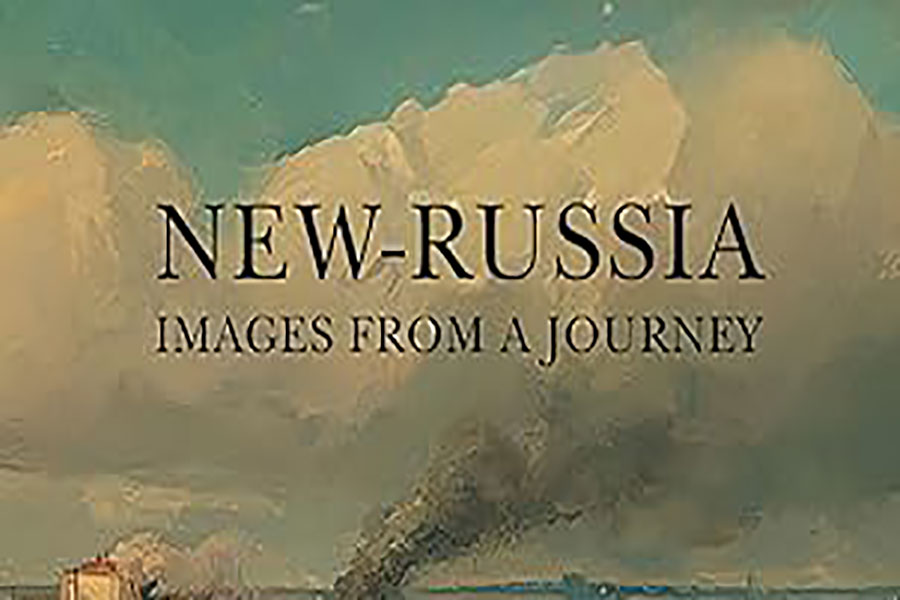


Title: New-Russia: Images from a Journey
By: I.J. Singer. Translated by Joshua A. Fogel
The Toby Press, an imprint of Koren Publishers Jerusalem (korenpub.com)
220 pages
In the Kiev region there had been a town called Tagantsha, with a market, alleyways, a rabbi, a ritual slaughterer, and a wooden wedding canopy. The Ukrainian revolutionary Symon Petliura's gangs came and exterminated it. A few dozen survivors pooled their last kopecks, found land on the Krivarog steppe, built new houses with white walls and newly shingled roofs, and gave this new settlement the name of what was gone. "Such a stirring picture," I.J. Singer writes, "of displaced Jews in their displaced city."
That sentence captures Singer's method, and his problem. He is moved. He records it. He does not explain what it means. New-Russia: Images from a Journey, published by The Toby Press, an imprint of Koren Publishers Jerusalem (korenpub.com), collects the dispatches Singer filed for the Forward during his journey through the Soviet Union in late 1926 and early 1927. Among the great Yiddish writers of the twentieth century, author of The Brothers Ashkenazi and Yoshe Kalb, Singer is perhaps best known in English as the older brother of Nobel laureate I.B. Singer. His eye in these pages is entirely his own. He came to see whether Soviet Russia was saving the Jews or consuming them. What he discovered was that any verdict would have been dishonest. Refusing to render one is the book's deepest argument.
He moved through Moscow, Minsk, Kharkiv, the Jewish colonies of Ukraine, the Crimean steppe, Berdichev, and Kiev. In his brief introduction he warns the reader: "I do not intend with my book Nay Rusland (New-Russia) to offer an estimation of the Soviet Union." He would transmit images. Impressions. What he found was a country that defeated summary.
The book's longest section follows Singer into the Jewish agricultural colonies of Ukraine and Crimea. He meets Moysey Abramitsh, a former landowner who lost everything, went back to the land he once worked as a tenant, and built a colony from nothing, teaching uprooted city Jews to hold a plow. Singer meets him now as the respected chairman of a thriving settlement. "Now we are looking forward to what comes next," Moysey Abramitsh tells him. "Here, the land is now our last card. Life and death are here."
There is a Jew in a city overcoat crossing twenty verst of frozen steppe with his son, looking for a pony that had gone missing two days earlier, carrying the rope it was tied with, telling himself it must have pulled free and walked home. Singer knows the rope means it was stolen. He does not say so. "Who has the heart," he writes, "to deprive this unfortunate Jew of his tiny bit of succor?"
The colonies are real. People are farming. Antisemitism is officially illegal and actually prosecuted. Yiddish courts operate in Minsk and Dzhankoi. But the picture is not simple, and Singer does not simplify it. In Crimea he finds the pioneer communes of Tel-Hai and Mishmar, the best-organized farms he sees anywhere, run by young Zionist men and women who refuse to marry so that Palestine remains possible. "The pioneers stand with one foot in the colony and the other foot in Palestine," Singer writes. The police drop in periodically and arrest some of them for the sin of Zionism. Singer does not say which will win.
Against this, he sets Berdichev. The merchants stand in front of their shops with their heads down. The cooperatives are devouring them. The large tanneries no longer belong to proprietors. One man, on the record, said something Singer writes he would not have believed if he had not heard it himself: a regime change might bring pogroms, yes, but: "A pogrom is a pogrom. Only when the pogrom comes to an end, can one then go on living." That is the sound of a man choosing episodic catastrophe over slow suffocation. The joyousness of the old city has migrated into the club, where thousands of young people crowd onto the steps to read newspapers and hear lectures and argue. It is something. It is not the same thing.
The book's most revealing scene comes late, in a chapter called "What Else I Encountered." On a train Singer falls into conversation with a paranoid, opinionated Jewish passenger who knows everything about Soviet Russia without having looked at any of it. The man insists the colonies are fabricated, the factories a show put on for foreign delegations, the workers secretly miserable. Singer patiently presents what he saw with his own eyes. "Don't believe it," the man says each time. "They directed you specifically to one place." Singer replies that he traveled alone, to dozens of colonies, and that where things were bad, people said so. The man is not moved. Singer does not lose patience. He keeps listing what he witnessed. The man gets off the train still convinced, throwing trembling glances backward to see if Singer will detain him. The last subject they had touched was Jewish schools. Singer had defended teaching children in Yiddish. Singer records the exchange’s final irony without gloss: "It is the Jewish schools, which I discussed with him, that are guilty of everything. It is that more than anything else which convinces him that I am one of those people." Singer's refusal to declare himself is not cowardice. It is the only honest position available to someone who actually looked.
New-Russia was published in Yiddish in 1928 and arrives in English for the first time, nearly a century after its Yiddish publication, in Joshua A. Fogel's translation, at a moment when the questions Singer refused to answer are being asked again. Jewish intellectuals are once more being pressed to declare themselves about Israel and the diaspora, about whether integration is security or slow disappearance. Singer watched such a project unfold in real time and refused tmichael bo supply an answer. At the border on his last night, in the dark, with snow falling and the Dnieper frozen and St. Vladimir casting a shadow on the white hills, he boards the empty train back to Poland. Three people get off at Stowbtsy. A guitar strums somewhere on both sides of the border. He signs his name. He gives the date. He does not ask for a verdict.