 October 16, 2026
 This Year, I Didn't Feel Alone


Every year, when the fast of the Seventeenth of Tammuz arrives, I know what lies ahead. For many people, the Three Weeks are simply a period of diminished joy. For me, they are emotionally draining. As the calendar moves steadily toward Tisha B'Av, I find myself entering a world of mourning that grows heavier with each passing day. The music disappears, celebrations cease, and our thoughts turn to destruction, exile, persecution, and tears. By the time Tisha B'Av finally arrives, I almost find myself longing for it simply to end.
This year began no differently.
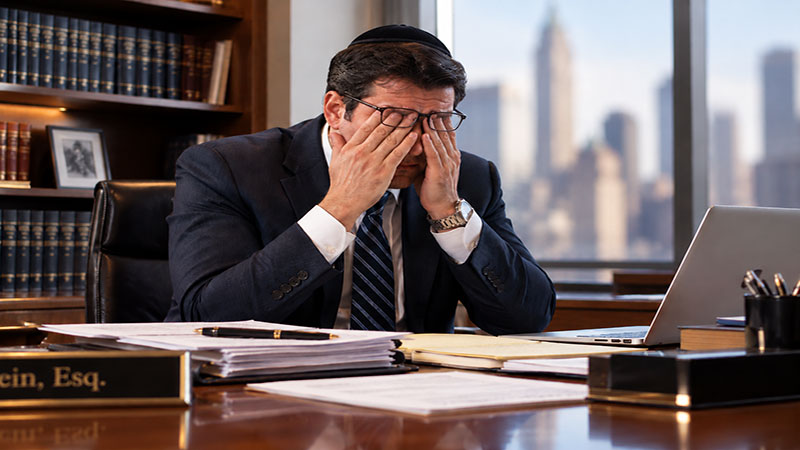
As I entered the synagogue that Tisha B'Av morning, I instinctively reached for my tallit and tefillin before remembering that they would remain untouched until Mincha. Suddenly I felt strangely exposed. Looking around the synagogue, every man appeared the same. The familiar white garments that accompany our daily prayers were absent, leaving a feeling that was difficult to describe. It was not merely the absence of the tallit and tefillin; it was a feeling of loneliness.
As I sat quietly, my thoughts drifted beyond the walls of the synagogue. Almost everywhere we turn today there seems to be another accusation against the Jewish people, another demonstration condemning Israel, another attempt to delegitimize our very existence. Universities that once prided themselves on tolerance have become breeding grounds for antisemitism. International organizations repeatedly condemn Israel while remaining silent in the face of genuine evil. Social media overflows with distortions, lies, and hatred directed against Jews.
At that moment, I felt that our nation stood alone. Why, I wondered, does the world hate us? Is it because we are Jews? Because we believe that every human being is created in the image of G-d? Because Israel builds hospitals that treat patients regardless of religion, race, or nationality? Because we seek nothing more than the right to live peacefully in the land promised to us by our forefathers? The questions weighed heavily upon my heart.
Later that morning, I attended an extraordinary multimedia presentation by Rabbi Yehoshua Grunstein, who masterfully connected the Kinnot we recite on Tisha B'Av with the tragic events our nation has experienced during this past year. Suddenly the ancient lamentations no longer belonged only to history. The destruction of Jerusalem merged with the destruction experienced in our own generation. Jeremiah's tears became the tears of bereaved families, and the cries of exile echoed in the voices of those still waiting for loved ones to return home. More than once, I found myself unable to hold back my tears.
As I listened, another thought entered my mind. People often define insanity as doing the same thing repeatedly while expecting different results. For nearly two thousand years we have observed Tisha B'Av. For nearly two thousand years we have fasted, recited the same Kinnot, mourned the same destruction, and spoken about the dangers of sinat chinam. Yet have we really changed? We continue to struggle with division. We still argue, criticize one another, and allow petty differences to separate us. How many sermons have been delivered on Jewish unity? How many books have been written? How many campaigns have urged us to love one another? Despite sincere and heroic efforts, we still have so much work to do.
The question became almost unavoidable: Why are we doing this again? Will we forever repeat the same cycle of mourning while hoping that somehow things will be different?
Then, almost unexpectedly, the answer came.
Things have changed.
Something remarkable has happened during these past seventy-eight years that distinguishes our generation from every Jewish generation that preceded it.
For nearly two thousand years Jews concluded the Seder and Yom Kippur by saying, "Leshana Haba’a B’Yerushalayim." They whispered those words in the ghettos of Europe, in the villages of Yemen, in Morocco, in Iraq, in the darkness of the Inquisition, and in the ashes of the Holocaust. Generation after generation dreamed of returning to a homeland most would never see.
We are the first generations in almost two millennia that can do more than dream those words.
We can live them.
There is a State of Israel.
Those simple words would have sounded impossible to our grandparents. Against every law of history, the Jewish nation has returned to its homeland. A language that had lain dormant for centuries once again fills the streets with life. The deserts bloom, ancient vineyards flourish, and Jerusalem resonates with the voices of Jewish children. No nation has ever returned to its ancestral homeland after two thousand years of exile. No civilization has revived an ancient language and transformed it into the vibrant speech of everyday life. No people have survived dispersion, persecution, expulsions, pogroms, and the Holocaust only to return stronger than before.
Only the Jewish people.
Only because the promises of the Almighty never fail.
Yes, we still face enemies who seek our destruction. Antisemitism has once again surfaced across much of the world, and Israel continues to fight for its very existence. Yet look at what we have become. We are no longer the helpless Jews dependent upon the mercy of foreign governments. We have sons and daughters who courageously defend our homeland. We have scientists, physicians, educators, and innovators whose contributions benefit all humanity. Israeli humanitarian teams are often among the first to arrive wherever disaster strikes, while Torah learning flourishes throughout the Land of Israel on a scale unimaginable only a century ago.
Every airplane that lands at Ben-Gurion Airport brings another chapter in the ingathering of our people. Every soldier who stands guard over Jerusalem proclaims that the Jewish people will never again be defenseless. Every child laughing in the streets of Israel is a victory over those who sought to erase us from history.
Tisha B'Av will always remind us of what we have lost, and we continue to pray for the rebuilding of the Beit HaMikdash and the complete redemption of our people. But this year I realized that Tisha B'Av also reminds us of what the Almighty has already begun to restore. We no longer mourn as a homeless nation wandering through history. We mourn as a nation that has returned home, a nation rebuilding itself physically and spiritually, and a nation privileged to witness the fulfillment of prophecies that countless generations could only imagine.
As the fast drew to its close, I no longer felt alone.
The Jewish people are not alone.
We have a homeland. We have Jerusalem. We have a flag that flies proudly over our ancient capital. We have an army that protects Jewish lives and a nation whose heartbeat is Torah and whose soul reverberates Zion.
There are still tears to shed and challenges to overcome. There are still divisions to heal and prayers to offer. Yet despair no longer defines us. Hope does.
That is why this Tisha B'Av felt different.
For as long as the State of Israel stands proudly upon the mountains of Zion, every Jew has reason to believe that the story of Tisha B'Av is no longer only a story of destruction.
Before our very eyes, it is becoming a story of redemption.