יום חמישי, כ״ח אלול תשפ״וThursday, September 10, 2026



Follow Us


Rabbi Mordechai Weiss lives in Efrat, Israel, and previously served as an elementary and high school principal in New Jersey and Connecticut. He was also the founder and rav of Young Israel of Margate, N.J. His email is ravmordechai@aol.com.
Read More

The Torah tells us, “And the two of them walked together.” Abraham and Isaac shared the same path, though each carried a different burden. So, it is with the families of Israel.
Against every law of history, the Jewish nation has returned to its homeland.
The very person who wanted to destroy the Jewish people became the messenger who blessed them.

This idea is one of the most comforting themes in Judaism. The Almighty is not merely present during moments of triumph and celebration. He is present during moments of anguish and despair.

“I’m sorry” sometimes simply is not enough. These words echo painfully in my mind whenever I witness tragedy, cruelty, or human insensitivity. They reverberate whenever I see people throw words carelessly at one another, unaware that words themselves can become eternal scars.
At that moment, surrounded by song and holiness, Israel no longer felt like merely a country. It felt like destiny fulfilled.
How do we present our leaders? Do we portray them as flawless beings, untouched by error, existing on a plane so elevated that they bear little resemblance to the people we are raising? Or do we present them as the Torah itself does: as extraordinary individuals who nevertheless grappled with very human struggles?
If our chosenness is not rooted in our righteousness, then what is expected of us? Are we merely beneficiaries of a legacy, or are we meant to rise to meet it?
There is something uniquely powerful about the prayers of a child. Watch a young child daven, and you will see a kind of purity that is difficult to replicate in adulthood.
Centuries later, after the destruction of the First Temple and seventy years of exile in Babylon, something unprecedented occurred. The Persian king granted the Jews permission to return and rebuild the Temple.
When I first learned of this initiative, I felt immediately that it deserved recognition. Not because it is grand, but because it reflects the quiet greatness that sustains Jewish life. Many communities mourn; fewer understand how to transform mourning into blessing.
A single decision, a single misstep, can eclipse decades of dedication.
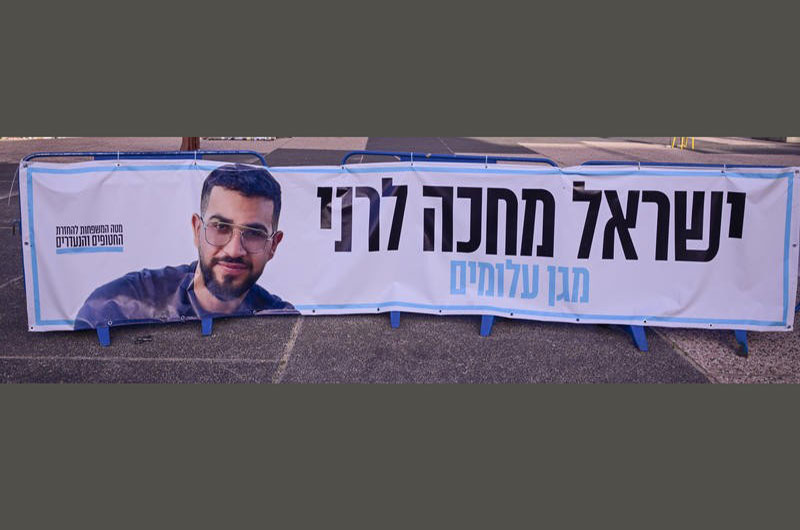
His return was neither simple nor swift. It was not the result of chance, but of determination – quiet, disciplined, and relentless. Israeli Defense Forces soldiers, together with doctors, forensic specialists, and dentists, entered the heart of Gaza on a mission unlike any other.
Experts declared: this should not have happened.
Just as the country began to heal, the unthinkable arrived. October 7, 2023. A day that will be remembered as one of the darkest in Jewish history.
A lack of derech eretz or moral clarity in children is frequently a reflection of what they witness, or fail to witness, in their parents.
My heart raced as I stood before the original handwritten manuscripts of Rambam. The very ink strokes of one of our greatest minds lay before me. To imagine him bending over parchment nearly nine centuries ago, carefully inscribing words that would guide Jewish law and philosophy for generations, was overwhelming.
But as the days went by and the initial euphoria began to settle, another feeling began to rise within me – a quiet, haunting sadness.
It does mean that we must not conflate the fallibility of leaders with the infallibility of the Torah itself.

To destroy is easy. To build is sacred, slow, and infinitely more precious.

We daven together in synagogues that feel familiar whether we’re in Toronto or Tel Aviv. We mourn together when tragedy strikes and we celebrate together when a lost hostage comes home or an aliyah flight lands in Ben-Gurion Airport.
This generation is truly remarkable. They do not flee from hardship. They strive for the elite units, the most dangerous positions, not because of ego or pride, but because they yearn to be protectors.
We have been here before. We have seen how quickly the world turns. How Jewish suffering is minimized. How our tears are measured against the political utility of those who hate us.
Israel’s mourning is not just for Kfir, Ariel, and Shiri – it is for every victim of terror, every life that was cut short in the name of hate and destruction.

When G-d created the world, He did it with words. Every action of creation was accomplished using words. And G-d said, Let there be light. And G-d said, Let us create man. Creation is realized by G-d using words.
It is critical to understand that Israel did not seek out this conflict... The objective has always been clear: a stable, peaceful region where Israelis and Palestinians can live side by side, with dignity and security.
The entirety of the Gaza population, under Hamas’s rule, has become part of this deadly philosophy. One cannot ignore the reality that Hamas, as the governing body, has indoctrinated its people with a worldview that is grounded in violence.
In Israel, elections are held on a national level with voters casting ballots for political parties rather than for individual candidates. This system, while effective in ensuring that political parties gain power based on their collective support, undermines individual representation.

Serving in the IDF can provide personal development opportunities for charedi men. Many who have enlisted report a newfound appreciation for civic duty and a broader understanding of Israeli society.

We all know that sibling relationships reenact themselves when in the presence of parents. Even when we are older and married, we slip back to the times that we were children.
This ability to show respect for the entire life and accomplishments of an individual is essential if we want our children to have respect for our history and our past leaders.

We are taught in Judaism to temper each of these areas and to walk the middle road. To create a balance between these two seemingly opposing forces. Too much materialism is no good. Too much spiritualism also misses the mark.
There is no question in my mind that we as a nation have improved in becoming more sensitized to the plight of our Jewish impoverished and in general to providing chesed, kindness, to people in need... But there is something more that is wholly missing!
It’s time for all our people to stop using these rationalizations because any thinking Jew knows in their heart of hearts that every Jew should be in Israel, and these excuses have no basis. Our grandparents would have given everything that they own to have the opportunity that we have today to make aliyah and live in Israel.

The noise was deafening! I had to find my way to the front of the shul to hear the reading of the Torah, and even then, it was still hard to hear every word. The Mussaf service was no better.
A remarkable occurrence is happening in the state of Israel today. The vast majority of the people living there, whether observant or non-observant, ultra-religious or not, observe the holidays as national or religious events in their lives.
It is the notion that the Arabs, and in turn Hamas, cannot understand or accept that He hit me back. They cannot acknowledge the fact that the Israeli army is so powerful and is not subservient to them and that now they must recognize its superiority.
Mitzvot performed in Eretz Yisrael have far greater significance and impact. Living in Israel, as I do, one can feel the vibrancy of the Torah and how it relates to our daily lives.
Parents are often looking for guidance as to what defines a good Day School. Before registering a child, what should a parent look for in a school? What will determine the effectiveness of a school for their child?
Our sages tell us that there is no calamity that befalls the Jewish people that does not carry within it the sin of the Golden Calf. So devastating was this incident that it was never forgotten in all the succeeding persecutions of the Jewish people.
Before one prays, one must prepare for the experience. There must be a meditative time in which the individual focuses on the significance of the act that he is about to perform.
You may have students who bother you, who have messy hair or unkempt clothes. Maybe a kid who has a disorganized backpack. You might have a student who has an annoying habit. That student is someone’s entire life.
Rarely in the history of our people have we seen such unity and caring for one another. No division here! It doesn’t matter what your level of observance is. We are all one now. Religious or not, we embrace each other. We support each other.
The very fact that the Haggadah that we recite on Pesach speaks to four distinctive personalities is proof that our Sages realized that people are different and they articulate their belief in G-d in many ways.
I often sit at the opening of the Old City of Jerusalem witnessing the prophecies of the prophet Zecharya and others come to fruition, and I wonder why others don’t see what I see.
Consider the fact that when we pray, we are conversing with the Creator of the universe, the One who holds the key to life and death, the One who can grant our deepest desires. Shouldn’t we be even more focused and mindful during our prayer than during a job interview?
We cannot bring these holy souls back to life, nor can we fathom the evil that is in the minds of the terrorists who committed these cruel and cowardly acts of terror, but we can take this moment to introspect...
Almighty G-d threatens to destroy the Jewish people for their grave sin. Moses intercedes and tells G-d, If you destroy the Jewish people, then delete me from your Torah as well.
I believe Moshe was not praying for Aaron to be forgiven, but rather he prayed that the example that Aaron portrayed in building the Golden Calf would not impact on Aaron’s children.
It is only now that they are no longer alive that I value them more and realize the great personal loss of not having them around to talk to or confide in.
The bottom line from these two instances and a host of different statements by our Sages throughout the Talmud is that shalom bayit is essential, and apparently one can lie or even erase the name of G-d to achieve this.
Ultimately each and every one of us is responsible for our own actions. Excuses such as “my parents gave me permission” or “my child would never do that” do not absolve someone from responsibility.
Rabbi Isaac Bernstein of blessed memory, in his tapes on Chumash, states that chumrahs have had only a deleterious effect upon our people – generating only dissension and arguments, feelings of oneupsmanship and elitism, causing separation and fragmentation between one Jew and the next.
We excuse our lack of action because of our economic concerns and that such a move would compromise our ability to provide for our families appropriately.
With the advent of the Internet our generation has entered into a period of instant communication. Ostensibly this way of corresponding would seem the most efficient and best, but in my estimation it represents the worst type of interaction.
I am particularly discouraged and disappointed with the so-called “Women of the Wall” and their monthly actions which disturb the prayers at the Kotel, creating a chillul Hashem.
Hevel’s sacrifice represented the dominance of the spiritual, for as a shepherd he was totally dependent on Almighty G-d – he was alone.

One would think that in the United States, where one’s freedom is protected by law, there is no need to worry about antisemitism.
Anything that the Jewish people accept as holy becomes holy to our people.
Children mimic what they see, and often the child who strays is driven by the inconsistencies and contradictions of his parents.
As I studied this story and related ones in the Torah, it occurred to me that Moses, at times, seems to have lost his faith in the Jewish people.
At times our sages justify King David’s behavior and posit that anyone who believes that King David sinned is wrong. Such a theory obviously goes against the simple meaning of the text.
There are those who recite the words “Next year in Jerusalem” with such fervor at the Seder on Passover eve. But until all of us wholeheartedly accept the reality that we have Medinat Yisrael and recognize the enormity of this gift, Mashiach will unfortunately tarry.
How can anyone rebuff Almighty G-d when receiving a directive to perform a task? What motivated Moshe to refuse this mission?
What has changed in our society that we are so cautious with security and are constantly on edge that something can go wrong? Who are we afraid of?
Shabbat is not a time to burden students with extra homework assignments. It is a time for students to focus on their families and the relationships in a successful family. When we get down to it, the basis of all of Judaism is centered around the family.
The reality is that sometimes our children need to unwind, to take a rest from the vicissitudes of life and once again focus on what’s really important – their family and loved ones.
The gift that had been given to us by G-d is being rejected by many of them as they vindicate Hamas and blame our soldiers as the cruel enemy mercilessly killing innocent Palestinians.
Ultimately each and every one of us is responsible for our own actions. Children’s excuses such as “my parents gave me permission” or parents’ insistence that “my child would never do that” do not absolve them from responsibility.
Often we look at a person or an event and we are convinced that this is the highest level of sainthood and godliness, not realizing that G-d seeks what is in the hearts and souls of humankind and not their outward appearance.
While someone who is born Jewish is undoubtedly according to Jewish law deemed as Jewish, there is still the underlying prerequisite that ones actions also and perhaps equally, define a person’s Judaism.
I have always said that when a Jewish day school closes down, there is no future for the local Jewish population, and within just a few years the Jewish community will be compromised.
It is inconceivable to believe that when we exited Egypt everyone in Israel had the same views on every subject and did not have the distinctiveness and uniqueness that make our people, and each individual, so important.
As he was typing feverishly, he by chance looked up from his computer and glanced at the dance floor. It was then that he noticed something remarkable.
When looking back into our history we often find examples of people being in the right time and place, and making history that gave meaning and purpose to their entire existence.
During the formative years, when the parents have the opportunity, and the obligation, to teach the child and help him develop, the child cannot be labeled a “rebellious child.” Only when it is already too late, when the child is nearly reaching bar mitzvah, can he be labeled rebellious.
To their amazement and astonishment, they began to realize the bounty of blessings that they had and the appreciation that they should show Almighty G-d for these gifts.
As with any program, if you can involve the parents as active participants, then the chances of success increase exponentially.
When one reads the commandments of Shabbat as they appear in the books of Shemot and Devarim, two divergent formulations appear: “Zachor” and “Shamor.” Which one appeared on the Ten Commandments?
To see a person as good despite his/her past actions; To give them a second chance knowing full well that they might ultimately fail again.
There is no question that the congregation of Israel at the time of the giving of the Torah was comprised of divergent views, and that the people who were transgressors and who later would be singled out as sinners were present as well.
I have always believed that the guarantee that G-d presented to Abraham was never said to him directly.
Despite the fact that Abraham had not been prepared to entertain guests, he approached the opportunity with zeal and love and quickly went about the task of making his guests feel comfortable.
One can recognize a gadol, a leader of our people, in how that person respects and values all people. A gadol doesn’t judge or offer a disparaging word against people who are not religious, nor does he degrade a non-Jew.
Introspection is good! Teshuva is good! But to blame anyone is downright sinful. Only G-d judges people. We don’t have that right.
They were taught that a congregation can only pray for relief from one disaster. Which one should they pray for G-d to stop: the plague or the famine?
We feel so fragile and minute, as the entire world is sent into literally a total state of panic and frenzy.
Why was it so important for Moshe to enter the Land? Certainly he had accomplished so much during his lifetime for the Jewish people!
Rashi states that the fire was a sign that G-d would be with the Jewish people even in hard times when they were slaves in Egypt.
Just as Aharon had no envy toward his brother, Moshe, so Moshe had no resentment about the job given to Aharon.
The character trait that makes me personally identify with Judah – is his humanness and the fact that he makes mistakes in his lifetime but has the strength and ability to own up to his wrongdoings and start over.
“Abba,” he said. “How can we believe our gedolim and their decisions when there are so many examples of corruption and abuse amongst them?”
In American society, wealth and power are the goals, while modesty and diffidence are impediments to success.
My wife and I live in Israel now. This has been our lifelong dream. This is where we belong! This is where we want to be!
Each time, as I behold the majesty of our beautiful land of Israel, I wonder: How is it possible that some of our people cannot see what I see – the miracle of the existence of the State of Israel?
He was also more of a moderate, not relying on the zealous methods of his teacher, but on a more pragmatic approach.
You cannot choose a friend just because you like him/her. There must be an interrelationship – a give and take – between the two parties.
What was so unique at Sinai? What was different then? What do our sages mean when they state that we were “as one person with one heart”?
If we would have received the entire Torah in written form then parents would not feel the urgency and the obligation to pass on our Torah to the next generation.
Our Sages tell us that if you want to overcome the hate that you have for someone, give them something – do for them a favor and ultimately the hate will transform to love.


 September 11, 2026