 October 9, 2026
 Categories: Featured / Halacha & Hashkafa / Torah
Trials of a Nation, Faith of a People


Looking back over the past six years, it feels as though the world shifted beneath our feet more times than we could steady ourselves. From the arrival of Covid in 2019 to the horrors of October 7 and the war that followed, my life here in Efrat, and lives throughout Israel, were reshaped in ways we could never have imagined. And yet, through each wave of adversity, something deep and resilient within our people refused to break.
When Covid first reached Israel, the stillness that descended upon Efrat was unlike anything we had ever experienced. Streets that normally echoed with children’s voices and neighborly conversation fell quiet. At times, we were forbidden to leave our homes entirely. Police patrolled the streets – yes, even on Shabbat – gently directing residents back indoors. To see such a scene in the sovereign Jewish State was surreal, almost ethereal.
Even our synagogues, the beating heart of Jewish life, were shuttered. For many of us, it was the first time in our lives that we were unable to enter a shul on Shabbat or Yom Tov. Doors that had welcomed generations of prayer, joy, mourning, Torah, and community were suddenly locked.
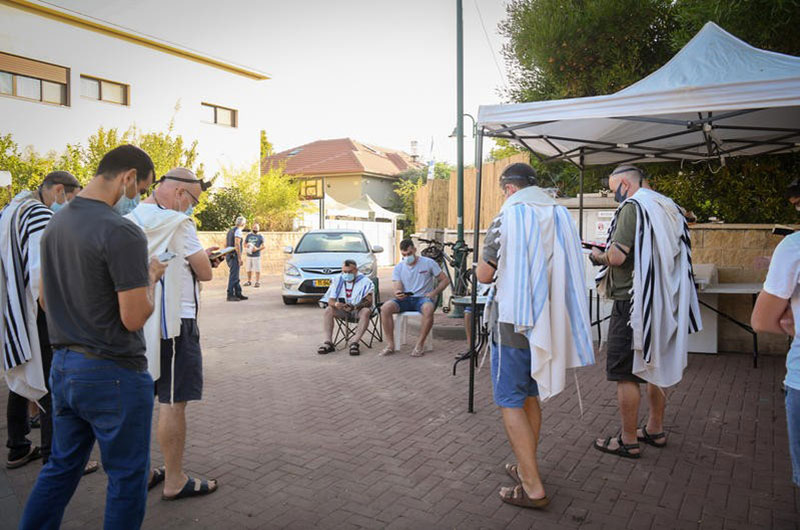
Yet the Jewish spirit found a way to rise. Outdoor minyanim appeared on sidewalks, in courtyards, on balconies and rooftops – wherever ten Jews could gather safely. And I remember vividly those who were in strict isolation, unable to join physically. There were men standing on the third and fourth floors of apartment buildings, leaning out of open windows with tallit and tefillin, straining their voices so they could join the minyan taking place below them. The sight of prayer ascending from balconies, mingling in the open air, remains one of the most powerful memories of that time.
Even the simplest errands became ordeals. Going to the grocery store felt like navigating a military operation. We waited in long lines outside, each person spaced four feet apart from the next, marked by stickers on the ground. Only three or four people were allowed inside at once. Couples waited separately. Crowds were prohibited entirely. It was an eerie, unsettling choreography, reminding us with every step how vulnerable the world had become.
Travel was equally challenging. To return to Israel, one needed a barrage of documentation, pre-flight tests, declarations, medical certifications. And then, immediately upon landing at Ben-Gurion Airport, every passenger had to line up for another Covid test. Only after receiving instructions for quarantine were we allowed to proceed. Entry into our own homeland required not only paperwork, but patience, fear, and uncertainty.
Passover that year, perhaps more than anything else, revealed the depth of the crisis. It was the first Pesach I had ever spent alone with my wife, without children, grandchildren, or guests. The Seder table felt too quiet, the night too long. Across Israel, tens of thousands of Jews experienced similar loneliness. For a people accustomed to celebrating freedom together, the isolation was almost unbearable.
We lost many. Too many. A family I knew personally lost both father and mother within one week. And celebrations, when they occurred at all, were constrained. My grandson’s wedding was permitted only twenty guests. Police arrived to count attendees. Had we exceeded the number by even a single soul, the wedding, the happiest day of their lives, would have been shut down on the spot.
Just as the country began to heal, the unthinkable arrived.
October 7, 2023.
A day that will be remembered as one of the darkest in Jewish history. Over 1,200 men, women, and children were massacred in their homes, in their beds, in their safe rooms. Women were assaulted with unfathomable cruelty. Families were burned alive. Communities were erased. It was a pogrom on Israeli soil, something our ancestors endured in exile but which we dared to believe could never happen here.
And before we could bury our dead, before we even processed the horror, the world turned against us. On October 8, literally the next day, global protests condemned Israel. Not the terrorists. Not the massacre. Israel.
As though Jewish grief was an inconvenience.
As though Jewish blood spilled was a footnote.
As though Jewish self-defense was a crime.
What followed was a war that stretched beyond two years and continues in different forms even now. More than 17,000 Israeli soldiers were injured. Hundreds killed. Over 200 Israelis – babies, elderly, women, and men – were dragged into Gaza. For months, we prayed without rest for their return. In time, through miracles and sacrifice, all the hostages were brought home except for one fallen soldier, whose body remains in enemy hands. Our nation will not rest until he, too, is returned, for we do not leave a soldier behind, not in life, and not in death.
Throughout, Israel faced accusations of genocide even while the IDF implemented the most ethical combat standards in the world, evacuating civilians, issuing warnings, and risking our own soldiers’ lives to protect innocent people. Yet the more we tried to defend ourselves, the more the world condemned us. The moral inversion was staggering.
And through every moment, every funeral, every name announced, every helicopter overhead, we all felt the weight. Our young men were called to the front. Families paced the floors, waiting for updates. Homes opened, meals were delivered, and prayers rose ceaselessly from every street.
And the shockwaves did not stop at Israel’s borders. Even in places long considered safe havens for Jews, the ground began to tremble. The incident at Bondi Beach in Australia has sent a chilling message through Jewish communities worldwide. In broad daylight, in a peaceful seaside setting synonymous with freedom and normalcy, Jewish lives were suddenly reminded that hatred travels far and fast. What should have been an ordinary day became yet another reminder that antisemitism no longer hides in shadows – it shouts, it attacks, it surfaces where Jews least expect it. For many of us in Israel, Bondi Beach felt painfully close to home, not because of geography, but because it underscored a terrifying truth: October 7 unleashed something global. The war was not only on our borders; it had seeped into streets, campuses, beaches, and public squares across the world. And yet, even there, the Jewish response was the same as it has always been. Grief met with resolve, fear answered with unity, and hatred confronted by an unyielding commitment to Jewish life, dignity, and survival.
These six years – pandemic, grief, isolation, war, global hatred – have tested the Jewish soul with relentless force. But they have also revealed a truth that has sustained us for generations:
The Jewish people bend, but we do not break.
We find unity where division once stood.
We react to hate with kindness, responsibility, purpose. We recite Tehillim with voices that could move the heavens. We dance with Torah scrolls before heading into danger. We embrace in unity and love families uprooted by tragedy.
And above all, we always have hope to endure.
Our prayer, after everything we have lived through, is simple yet profound:
May the years ahead be gentler than the ones behind us.
May the last captive finally be returned for proper burial.
May calm settle over our land like a healing wind.
May Israel know security, unity, and peace.
And may the Jewish people across Israel, and around the world, live not in fear, but in dignity, safety, and unbroken hope.
Because after six years of hardship and heartbreak, our nation has earned the right to peace.