 November 13, 2026
Categories: Headline / Parsha / Torah
Above the Stars
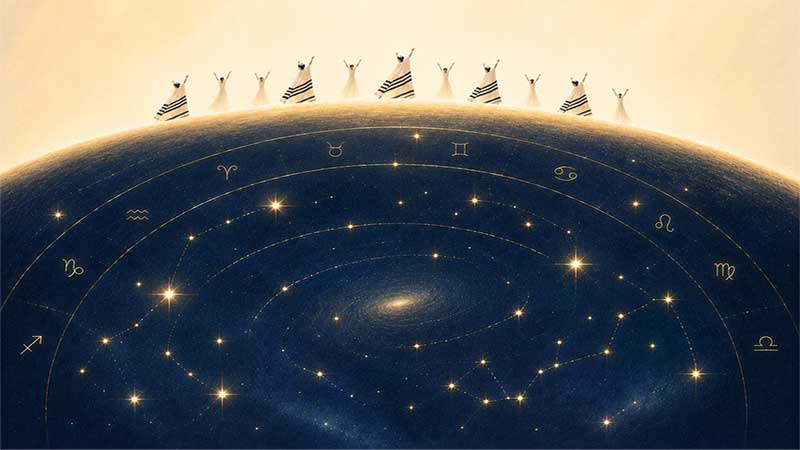


This week, we continue our theme of how the very existence of our forefather Yitzchak defies belief and stretches probability. Last week, we discussed how the Ben Ish Chai saw in the improbable gestation of Sara a message for future generations. In Benayahu, one of his commentaries on aggadot, the Ben Ish Chai examines the Talmudic maxim that the people of Israel are “above,” or not subject to, the dominion of the celestial spheres, i.e., the signs of the zodiac. (Interestingly, in this week’s haftara, we encounter Benayahu ben Yehoyada, the namesake of the Ben Ish Chai’s two commentaries on aggadot.)
That passage (Shabbat 156a) relates to a conversation Avraham Avinu had with Hashem when told he was to bear a son with Sara in spite of their advanced age. Avraham responded that, as a scholar of astrology, he had studied all the augurs and would certainly never have a child. Avraham had held this to be true since he was young – that is, even before it would have required a miracle to engender offspring. He realized that this fate was written in the stars and he had never questioned it before. The Ben Ish Chai asks: Are we to believe that the great tzaddik Avraham doubts what Hashem can accomplish if He wills it, and does he really intend to raise an objection to the Divine decree (favorable, no less) on the basis of his expertise in astrology?
He explains that Avraham never doubted that Hashem could do as He said, nor was he arguing with Him. He simply wanted to understand whether his science (i.e., astrology) was mistaken, or whether Hashem intended to overturn the laws of nature on his behalf. This distinction is important because Avraham understood that it is a bad omen when Hashem has to perform miracles to bring about a necessary outcome: It suggests that the humans involved have messed things up so completely that it became necessary for Hashem to overturn the laws of nature for them. Such a turn of events is a poor reflection on the state of the world, and the one for whom the miracle is performed must be wary of unforeseen costs and examine what was missing in his own conduct such that he required a miracle.
The Ben Ish Chai explains that Hashem told Avraham that his calculations were not mistaken and that, based on the information that was available to him, it was indeed true that it should not have been possible for him to have offspring from his wife. However, Hashem has information which was not available to Avraham – to wit, that Avraham and his descendants are not subject to astrological determination. There is a larger force at work which is part of the plan of Creation; it is miraculous only inasmuch as all of existence, each and every day, is miraculous.
The Maharal in his Chiddushei Aggadot also examines this principle of the People of Israel being above the power of astrology, or – in the terms of ancient and medieval scholars – above the laws of nature. He says there is a common misconception that people draw from this teaching: that they are somehow privileged or immune to the whims of fortune by virtue of being born Jewish. The Maharal explains that the usurpation of these cosmic forces comes about as a consequence of the supernatural power of the performance of mitzvot. It is, he says, the collective power of Israel in service of Hashem and His mitzvot that negates the power of fate and logical determinism. Only such fully embodied Torah can achieve this result in a practical sense.
Avraham and Sara, as well as Yitzchak and other great tzaddikim through the ages, have merited having the forces of nature co-opted into the service of their desired outcomes because, through their righteousness, they became living expressions of the fate of the nation. In this way, history is shaped around the needs of the collective as occasionally exemplified by a single remarkable individual. But individual Jews – no matter how righteous and fastidious in their performance of mitzvot – should never expect or desire to have miracles performed on their behalf. Even entire communities within the People of Israel are responsible for their own practical survival and sustenance; they should never conduct themselves in a manner at odds with common sense or the laws of reason.
Clearly, somebody who habitually relies upon miracles is neither wise nor righteous, and so, paradoxically, is least likely to be able to enjoy the miracles he expects. On the other hand, the truly righteous individual, for whom Hashem freely transforms the laws of nature and of destiny, is the last person in the world to expect or even to want miraculous intervention. This was the character of our forefathers Avraham, Yitzchak, and Yaakov and their partners, our holy mothers.