 October 9, 2026
 Categories: Headline / Features / Book Reviews
Ancient Story – Two New Ways to Make it Come Alive
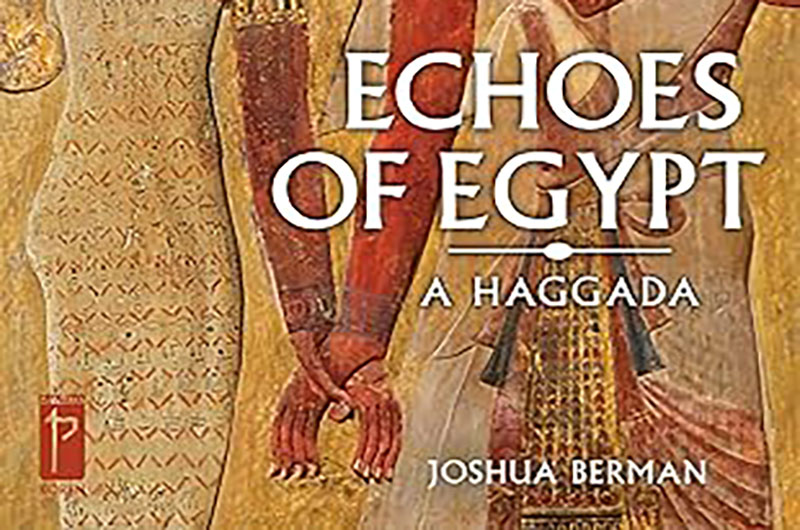


Title: Echoes of Egypt: A Haggada
By: Rabbi Dr. Joshua Berman
Koren
Back in 1960 bibliography, Yaakov Ya’ari made the first attempt to actually count how many times Jews have published versions of the Passover Haggada, and he came up with an incredible 2,717 different editions. By 1997 that number was doubled, and the National Library of Israel now holds 15,000 varieties of this historic guide to the Passover Seder, making it easily the most popular book for the people of the book. There are a lot of reasons for this phenomenon – it’s a fairly brief work (although it might not feel that way for people waiting for the chicken soup), and it is typically purchased in multiple copies for family use – but the main reason for its evergreen quality is certainly the gripping story it tells of the birth of the Jewish people as a nation, a story that the Jewish people enjoys reviewing every year.
For Passover 5786 (2026), I read two amazing new editions that are among the best English-language Haggadas I have ever encountered. One of them, Joshua Berman’s Echoes of Egypt, just came out last month, and provides his unusual and thought-provoking perspective on the Exodus from the vantage point of modern archaeology, providing amazing insights into how the Israelite slaves, raised in Egyptian society, would have perceived the culture- and time-specific events of their liberation.
The second is a version the Haggada that originally appeared in 2019, but I missed it (probably distracted by that first Covid Passover of 2020), but was reissued in a third printing in 2025. Styled as a “Passover Haggadah Graphic Novel,” it capitalizes on two interrelated aspects of the Haggada that reach back to the earliest illuminated editions from medieval Spain: directed at younger readers and heavily illustrated, it provides a very accessible, contemporary feel to the text that revitalizes the Mishnaic directive charging every Jew to consider the Exodus as an event that occurred to one’s self personally.
Title: Passover Haggadah Graphic Novel
By: Jordan B. Gorfinkel and Erez Zadok
Koren
 Echoes of Egypt, written by Rabbi Dr. Joshua Berman of Bar-Ilan University, takes as his starting point an approach that is described by Moses Maimonides in the third section of The Guide for the Perplexed: in order to understand the Torah well, one must understand the specific cultural vocabulary of the time in which it was given. Meaning, Israelite slaves would have perceived the world through the lens of their experience with the dominant society, especially in the period of time before the Torah was given. Their understanding of art and architecture would have been Egyptian, their conception of social and economic realities would have been Egyptian, and so on. When the Torah was given, argues Maimonides (as explained in greater detail by Dr. Berman in his work, Ani Ma’amin), the Israelites would have perceived both continuities and discontinuities with their prior understandings. Exploring those issues – especially the discontinuities – is an incredibly liberating intellectual exercise, demonstrating how radically new and transformational the Torah was in the ancient near eastern historical context.
Dr. Berman’s work is not a simple haggadah. Yes, the text is filled with brief sidebars that explain things like the role of romaine lettuce in Egyptian culture, or how the silence of the dogs during the departure of the Israelites would have been understood in those times as a demonstration of the weakness of the Egyptian canine deity Anubis, and these kinds of passages will certainly enliven the discussion at the Passover Seder. The real value of Dr. Berman’s Haggada, however, lies in the sophisticated essays that precede the work, as well as the richly detailed photographs of Egyptian artifacts that deserve advance study. Plan on reading this Haggada now, so you can really share its insights at the table.
Joshua Gorfinkel’s Haggada, on the other hand, is immediately accessible in the way that only a graphic novel could achieve. The illustrations by Erez Zadok are phenomenal, composed with a sense of drama and humor that is probably best appreciated by teenagers (but also enjoyed by this Zayde as well). One of the most appealing aspects of this great work, which I intend to gift to my grandchildren this year, is the careful alternation of historical representations of ancient Egypt with contemporary Jewish life, connecting the story to the lives of this current generation – just as the Haggada has done for centuries, in over 15,000 ways, and counting.