 October 9, 2026
 Categories: In Print / Features On The Jewish World
Auction Attractions: European Treasures Steal the Show in Jerusalem


On October 21, the auction house Kedem, located in Jerusalem, held a sale of “Rare and Important Items.” Here are the highlights:
The showstopper of the sale was a truly rare silver piece: a hanging Sabbath lamp from England, dating to the year 1726, as indicated by the numerous British silver hallmarks found on the lamp. Sabbath lamps were popular in Jewish communities in Germany, Eastern France, and the Netherlands.

This type of lamp typically consisted of a spouted, star-shaped (six-, seven-, or eight-pointed) or narrow bowl in which oil was lit. This center part would have hooks as well as ratchets so it could be raised and lowered while being attached to the ceiling above the dining room table. In Germany, these lamps were known as a Judenstern (“Jewish star”) for the shape the German examples tended to be in, and it seems that every religious Jewish home in Germany owned one, made of bronze.
This silver Sabbath lamp sold at the auction was made by Abraham Lopes de Oliveyra (1657-1750), who, in 1725, was officially registered as a silversmith in London – the first Jew known to be given a license to practice the trade in the city. Jews had been allowed back into England just 70 years before, following an expulsion centuries earlier, and de Oliveyra’s registration established him as a prolific maker of silver Judaica for the city’s synagogues.
De Oliveyra was born in Amsterdam to a Jewish family of Portuguese descent that had settled in the Dutch city, which was known for its climate of tolerance, after fleeing religious persecution. By his early 30s, he moved to London, where he and other Jewish artisans had become eligible for membership in professional guilds – which was most unusual, as Jews in Western Europe were typically excluded from artists’ guilds until the 19th century. The vast majority of 18th-century European pieces of silver Judaica were made by Christian silversmiths.
De Oliveyra made this Sabbath lamp in the style he was familiar with – those he saw while growing up in the Jewish community of Amsterdam. There are both silver and brass examples of 18th-century Dutch Sabbath lamps that appear strikingly similar to this one, and were it not for the British hallmarks seen on this lamp, it would be assumed to be Dutch in origin.
The Kedem auction catalogue picturing this lamp states: “An exceptionally fine Judaica object of notable rarity and importance, distinguished by a solid and well documented provenance dating back to 1882; one of only two hanging Sabbath lamps produced by the famed silversmith de Oliveyra (the other lamp – London, 1734 – is found in the collection of the Jewish Museum of London); one of the few Judaica objects by de Oliveyra to remain in private hands, and one of just a few silver hanging Sabbath lamps produced in London, and indeed in England, in the 18th century.”
Assigned an estimate of $500,000-$1,000,000, it sold for $712,500 – setting a new world auction record for a Sabbath lamp.
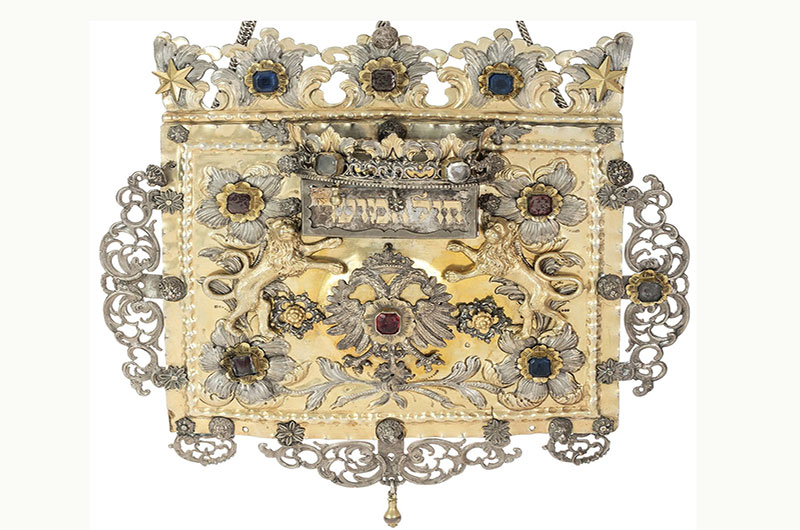
The next highest achieving lot of the sale was a German Torah shield dating to circa 1700. A magnificent example, made of silver that is almost entirely gilded and set with gemstones, it features a pair of lions flanking the removable plaque that states the Jewish holiday / Torah portion in Hebrew, above a crowned double-headed eagle. The hallmarks on the shield indicate it was made sometime between about 1680 and 1720, which raises the possibility that it was crafted in the 17th century. As such, it is appealing to even the most discerning collectors and institutions, as Jewish ceremonial objects that are European in origin and date to before the year 1700 are extremely rare, and most examples are almost entirely in the hands of museums in Israel, the United States, and assorted Western European countries. There are only about twenty known Torah shields from Germany that date to between 1680 and 1720. Assigned an estimate of $80,000-$100,000, this treasure sold for $112,500.
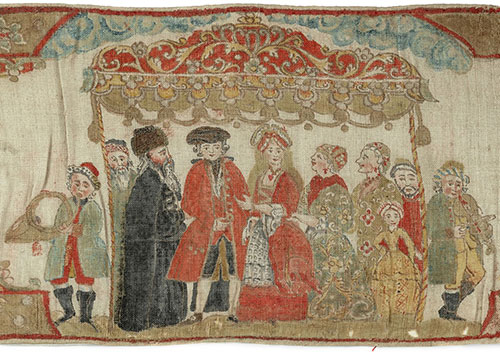
Turning from precious metal to textile art, the next featured lot is an entirely hand-painted textile which was made to wrap the Torah scroll – something known as a Torah binder. Torah binders were popular in the Jewish communities of Italy, Germany, and France, and amongst German Jews, the item was known as a wimpel. Wimpels were cut from the swaddling cloth that held a baby on the days of his bris, and then either embroidered or painted with the name and date of birth of the baby in Hebrew, which, on elaborate examples, would feature various decorative scenes of people and/or animals.
The German wimpel offered at Kedem, dated 1776 in Hebrew, was a breathtaking example, both in terms of quality of decoration and the scenes depicted. With the Hebrew stating “Yehuda Leib, son of Rav Pinchas, born Wednesday, 8th Av 5536; may G-d raise him to Torah, marriage, and good deeds,” there are many scenes: one showing a cartouche with the inscription “A lion has roared; who will not fear?” (Amos 3:8), alluding to the child’s name, alongside a depiction of a lion; an open Torah Ark in a synagogue containing Torah scrolls; and, shown here, a large depiction of figures dressed in elegant 18th-century clothing under the chupah, with a pair of musicians playing instruments outside the chupah. Given an estimate of $10,000-$15,000, this Torah binder sold for $35,000.
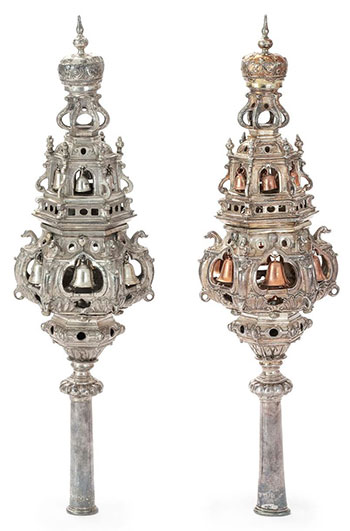
Finally, we have an impressive early pair of silver Torah finials from Amsterdam, dating to the year 1705. Standing almost 18 inches tall, these finials have a fascinating provenance, as some of their history is quite recent. In addition to the silver Dutch hallmarks stating the year of manufacture of 1705, and the silversmith who made them, Pieter van Hoven, each finial also has stamped inventory marks of the Ashkenazi Jewish community of Amsterdam, as they once belonged to the Dritt Sjoel, a synagogue that was established in the year 1700.
Shockingly, several decades ago the present Jewish community of Amsterdam separated this pair of finials – selling one while retaining the other. Then, in 2006, the second finial was sold at Sotheby’s. After that sale, the pair were reunited, and now the current owner offered them to Kedem for auction.
A Protestant, Pieter van Hoven is best known for the Torah finials and Chanukah menorahs he produced for both the Portuguese and Ashkenazi Jewish communities in Amsterdam. The estimate for these finials was $80,000-$120,000, and they sold for $81,250.
A special notice to all readers: After being made aware of my column in the July 4 issue of The Jewish Press, “No, I Don’t Know Everything,” in which I discussed a charity token and medallion in my personal collection, I received a friendly email from Mel Wacks, a legendary figure in the field of Jewish coins and medals. Mel writes, “The American Israel Numismatic Association (AINA) is pleased to offer a free digital copy of the 300th issue of The Shekel to your readers. Requests should go to ainapresident@gmail.com.” The Shekel is a periodical that discusses the history of various Jewish coins and medals, from ancient Israel to the present.