 October 9, 2026
 Becoming A Teivah
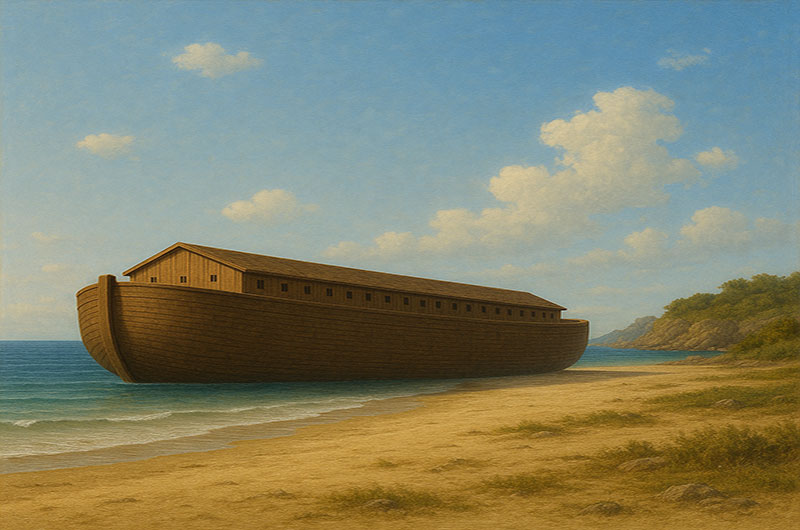


It is of course well known that with the approach of the divinely ordained flood, Noach was commanded to build a teivah – a vessel in which he would be spared destruction (along with his family and, as it turned out, representatives of species of animals that populated the earth). The Torah goes into exhaustive detail explaining the specifications and parameters of this teivah and, as nothing in the Torah is extraneous, there are evidently lessons to be learned from these details.
Two spiritual masters residing on opposite sides of the world in the mid-nineteenth century each encountered the description of the teivah as a reflection of the moral qualities of the righteous individual who warrants salvation from the impending destruction. These are the Ishbitzer Rebbe, leader of the eponymous chassidic sect in Poland, and Rabbi Yaakov Abuchatzera, the Abir Yaakov (grandfather of the Baba Sali), spiritual leader of the Jews of Morocco and to a large extent the foremost spiritual figure of Sephardi Judaism, at least in the Mediterranean basin, during his lifetime.
R’ Yaakov Abuchatzera, as was typical for him, demonstrates through numerology and encoded Divine Names that the teivah is an allegory – or probably more to the point, a representation in the physical world – of Noach’s own righteousness. He addresses this in slightly different variants in two separate commentaries on the Chumash – Pituchei Chotem and Machsof HaLavan. The details of the gematria and the permutations are too abstruse for this column, but readers with a numerological bent are encouraged to examine them in the aforementioned texts. At the conclusion of his disquisition in Machsof HaLavan, the Abir Yaakov explains that the physical existence of the teivah was the embodiment of the immanent Divine Presence in Creation, whereby Hashem protects those He favors just as readily (and far more miraculously) than He smites those who are deserving of destruction. He compares this to the mission of Bnei Yisrael in the world, as the heirs of Avraham who carry on the work which Noach could not complete successfully.
The Abir Yaakov understands the teivah as an early prototype, an instantiation of the spiritual structure of the Beit HaMikdash that would someday be built by Shlomo HaMelech. This is noteworthy because again, as noted, the teivah – and by extension, the Beit HaMikdash – derive their form and structure from the moral spiritual qualities of the righteous. In Noach’s case, his own righteousness frames the teivah that saves humanity in the guise of his family. In our case, the Beit HaMikdash is constructed from the collective spiritual rectitude of all of Israel, and when we are worthy to see our own best qualities embodied in this form, it saves all of humanity and provides a vehicle for us to transcend the mundane and debased and to avoid the destruction of the world in response to what wickedness prevails outside its walls.
The Ishbitzer Rebbe, in his classic Mei HaShiloach, examines the details of the physical specifications of the teivah as illustrative of the moral qualities of Noach, by virtue of which humanity was saved from destruction. First of all, he cites the Gemara in Pesachim (113b) listing three types of people whom Hashem “loves,” explaining that the teivah explicitly refers to each of these characteristics. These are described as one who never becomes angry, one who doesn’t become intoxicated, and one who overcomes his negative tendencies. The Rebbe elaborates that what is common to all these qualities is they demonstrate a moral and spiritual intelligence which supersedes the emotional excesses of less refined individuals. That one doesn’t become angry doesn’t mean that he is callous or unfeeling, but rather that he doesn’t allow the anger to dominate his character and shape his conduct. Not being intoxicated doesn’t mean that somebody never partakes of wine or other intoxicants, but that he keeps his wits about him and doesn’t allow himself to be reduced to a state where he cannot be or claims not to be responsible for his behavior. The one who overcomes his negative tendencies (this was the best way I found to translate the difficult expression maavir al midotav) doesn’t ever let his own feelings and prejudices dictate his behavior, and in particular never holds grudges. Noach, in order to save himself and to save the human race had to master all of these three qualities which are expressed in the architecture of the teivah.
The Rebbe references the Hebrew name of the wood from which the teivah was constructed (“gopher wood”), which might be cypress but the etymology is unclear. What is clear is that “gopher” is related to sulfur (gaphror in Hebrew), and thus correlates to burning and simmering rage. In the teivah, this rage surrounds the structure but it doesn’t impact on the internal characteristics – on the qualities of the righteous individual as he conducts himself day to day. The teivah is constructed with numerous distinct compartments, each serving a specific purpose. This reflects the mental fortitude of an individual who doesn’t lose control of his mind or his behavior when he consumes intoxicants. Finally, the entire vessel is covered in pitch, as the morally upright individual maintains equanimity and a pleasant disposition in spite of whatever environmental conditions might assail him. Thus, Noach’s mastery of these qualities enables him to manifest the teivah and to save himself from the fate of his generation.
However, it is noteworthy that Noach fails to maintain this elevated spiritual state, which in turn sets the stage for the rise of Avraham to carry on this work (as noted above). No sooner does Noach leave the teivah, he violates each of these moral qualities in the merit of which he was saved. He gets intoxicated, acts foolishly, becomes enraged with his son Cham, and finally fails to recognize his own flaws or to overcome them in the wake of this affair. Thus, we find that although Noach was a tzaddik – in his time, just enough and just long enough to prevent the total annihilation of humanity – he eventually fades into obscurity as someone who never again demonstrates these leadership qualities that were so crucial in exactly the time and place where they were necessary to fulfill the Divine Plan.