 September 18, 2026
 Categories: Collecting / Arts
Born, Einstein, and Kant
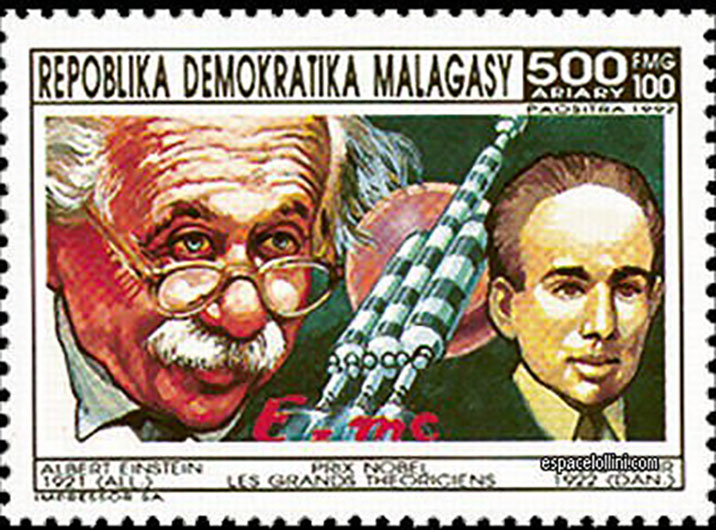


Max Born (1882-1970) stands among the most consequential scientific thinkers of the twentieth century for his decisive role in shaping quantum mechanics – the branch of physics that explains how nature behaves at the smallest scales (atoms and subatomic particles), where things do not act like everyday objects; that is, particles can behave like waves, outcomes are described by probabilities rather than certainties, and simply measuring something can change what happens. As the head of the Institute for Theoretical Physics at the University of Göttingen in Germany before being expelled by Hitler, he helped to train a generation of the world's leading physicists, including Pauli, Jordan, Oppenheimer, Teller, and Heisenberg (who, using Born’s theories, discovered the “Uncertainty Principle”).
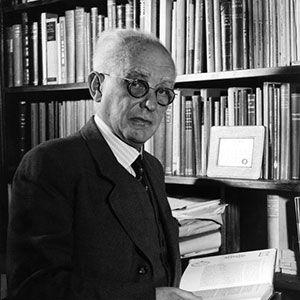
Born’s life spanned the height of German scientific culture, its catastrophic collapse under National Socialism, and the uneasy aftermath of exile and reckoning. His enduring intellectual relationship with Albert Einstein, marked by mutual admiration, sustained disagreement, and unusually candid correspondence, constitutes one of the most illuminating dialogues in the history of modern science. Equally essential to understanding Born is his Jewish origin and identity: formed within the assimilated German Jewish bourgeoisie, tested by antisemitic persecution, and never renounced, even as it was expressed more through ethics, historical consciousness, and moral responsibility than through religious observance.
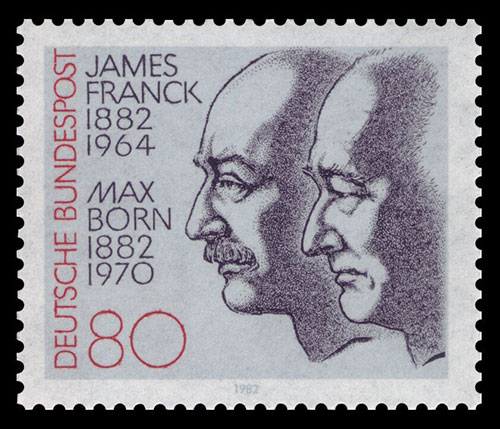
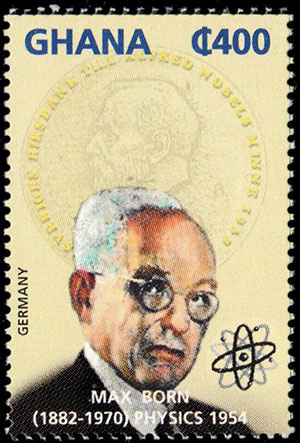
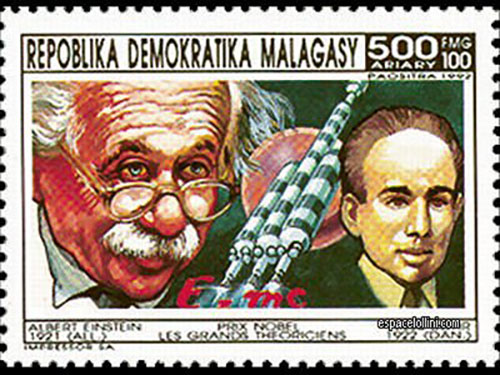
Born was born in Breslau, then a major city of the German Empire, into a family emblematic of cultivated, professionally successful German Jewry. His father, Gustav Born, was a distinguished professor of anatomy and embryology at the University of Breslau, widely respected in academic circles and fully integrated into German intellectual life, and his mother, Margarethe Kauffmann Born, came from a similarly established Jewish Silesian family of industrialists; her death when Max was four years old left an emotional void but did not diminish the household’s devotion to learning and culture. The Born home reflected the values of Bildung prized by educated German Jews: the lifelong shaping of the whole person, intellectually, morally, culturally, and aesthetically through learning and self-reflection, including reverence for classical music, literature, philosophy, and science, combined with a strong sense of identification with German culture and civic belonging.
Judaism in Born’s childhood was non-ritualistic. There is no evidence that the household observed the Sabbath, kept kosher, or attended synagogue regularly, and Jewish identity functioned primarily as ancestry and ethical inheritance rather than as religious discipline, a pattern that was typical of upper-middle-class German Jewish families who regarded themselves as Germans of Jewish origin. Born later recalled that in his youth he rarely thought about being Jewish at all, yet he never denied or disavowed his Jewish origins, and this tension between deep assimilation and inherited difference would become central to his later life.
Born’s intellectual gifts emerged early. After initial studies in Breslau, he attended the universities of Heidelberg and Zurich before gravitating to Göttingen, then the world’s foremost center for mathematics, absorbing a mathematical ethos emphasizing abstraction, logical rigor, and structural clarity. He was awarded his doctorate in 1906, initially working on elasticity theory and crystal lattice dynamics, fields that demanded sophisticated mathematics and foreshadowed his later role as an important bridge between mathematics and theoretical physics.
Born’s gradual transition into physics coincided with the intellectual upheavals of the early twentieth century, as he followed Einstein’s work on relativity with admiration, recognizing its conceptual audacity. The two great physicists met before World War I and quickly developed a close relationship marked by mutual respect; Einstein valued Born’s intellectual honesty and analytical discipline, while Born saw in Einstein an unmatched capacity for independent thought and moral seriousness. Their early interactions laid the foundation for a relationship that would deepen into one of the most consequential scientific correspondences of the century.
Born’s appointment in 1921 as professor of theoretical physics at the University of Göttingen marked the beginning of his most influential scientific period as, under his leadership, the university became a world center for theoretical physics. Born was not only a prolific researcher, but also an extraordinary mentor and institutional builder, and among those who worked under his guidance were Werner Heisenberg and Pascual Jordan, collaborators with Born in the development of matrix mechanics, the first internally consistent formulation of quantum mechanics.
Born’s most enduring contribution emerged in 1926 with his interpretation of the wave function. While Erwin Schrödinger initially hoped that the wave function described a real physical wave, Born proposed a fundamentally different view: that the wave function encodes probabilities and its squared magnitude represents the likelihood of finding a particle in a particular state or location.
Classical physics assumed that if you knew the present state of the universe with enough precision, the future was fixed, but quantum physics, as Born helped to formulate it, shattered that assumption: even with complete knowledge of a system, only the likelihood of outcomes can be predicted. This proposal, now universally known as the “Born rule,” introduced probability as a basic feature of nature rather than as a reflection of incomplete knowledge, which marked a decisive break with classical determinism and reshaped the philosophical foundations of physics.
This step placed Born at the center of a profound and lasting disagreement with Einstein, who accepted the empirical success of quantum mechanics but rejected its probabilistic interpretation as incomplete. In a December 1926 correspondence to Born, Einstein wrote one of his most oft-cited aphorisms: that quantum mechanics was impressive but that he remained convinced “the Old One (i.e., G-d) does not play dice.” Born replied respectfully but firmly, arguing that physics must follow experimental evidence even when it challenges deeply rooted metaphysical intuitions. This exchange crystallized a debate that would persist between the two scientists for many decades.
The Einstein-Born correspondence is remarkable not only for its scientific content, but also for its tone, as the two men debated determinism, realism, causality, and the limits of knowledge with exceptional candor and mutual respect. Einstein confided to Born his growing sense of isolation as younger physicists embraced interpretations that he found philosophically troubling, and Born, in turn, treated Einstein’s objections as serious challenges rather than obstacles to be dismissed. Their disagreement never became personal; instead, it deepened their intellectual bond, and Born would later acknowledge that Einstein’s criticism helped to prevent him from turning probabilistic quantum mechanics into dogma.
Their relationship was also shaped by shared historical experience as German Jews. Both were beneficiaries of German culture and education, yet both were ultimately expelled from that culture by antisemitism. Einstein left Germany earlier; Born remained until 1933, hoping, like many assimilated Jews, that professional distinction and loyalty to science would offer protection, a hope that sadly proved illusory.
In 1912, Born had met Hedwig (Hedi) Ehrenberg, the daughter of a Jewish Leipzig University law professor who came from a distinguished Jewish family deeply embedded in German intellectual life. When Hedwig’s father remarried and became a practicing Lutheran, she converted as well. Despite never really practicing Judaism, however, Born refused to convert, and his wedding on August 2, 1913 was a simple garden ceremony rather than a church service; however, he was baptized as a Lutheran a short time later in March 1914 in deference to his wife and because he sought to assimilate into German society to promote his scientific standing.
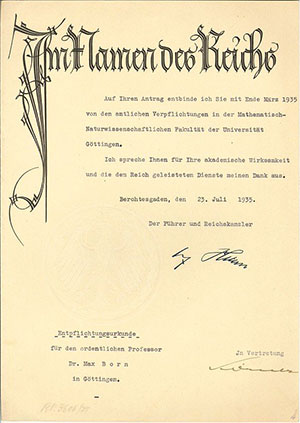
The Nazi seizure of power transformed Born’s life abruptly. In April 1933, under laws excluding Jews from the civil service, he was dismissed from his professorship at Göttingen, a dismissal that was devastating both personally and symbolically. Göttingen, which Born had helped build into a world-leading center of physics, was dismantled within months as Jewish scholars were expelled; for Born, this was not merely professional discrimination, but the collapse of a civilization in which he had deeply believed.
Exhibited here is a copy of Hitler’s letter to Born terminating his professorship at Göttingen. Ironically, the Fuhrer attributes Born’s termination to his “request” when, in fact, Born was fired pursuant to the Nuremburg laws and as part of the Nazi purge of Jews from German educational institutions:
Upon your request, I hereby release you from your official duties at the Faculty of Mathematics and Natural Sciences of the University of Göttingen at the end of March 1935.I express my gratitude for your academic work and the services you have rendered to the German Reich.
(signed)
The Fuhrer and Reich Chancellor
There is documented correspondence between Einstein and Born covering the period 1916 to 1955, which encompass a broad variety of scientific, ethical, and political topics. In one letter of note, Einstein wrote to him about making aliyah and Born explicitly referred to having refused Einstein’s suggestion that he go to Eretz Yisrael:
Unlike my last letter, which I hope you received, this one has nothing to do with quantum theory, but with Palestine. You will say “why does this concern you?” Indeed, when you wrote to me in 1933 suggesting that I should go to Palestine, I refused...
Exile reshaped Born’s understanding of Jewish identity; though not religiously observant, he now experienced Jewishness as an imposed and inescapable category. He left Germany with Hedwig and their children, first finding refuge in Cambridge, later spending time in Bangalore, and eventually settling in Edinburgh in 1936. The experience of exile – loss of homeland, language, and institutional belonging – left a permanent emotional mark.
Their children were raised in an environment emphasizing ethical responsibility, intellectual seriousness, and cultural breadth. Although they did not attend Jewish religious schools or receive formal religious instruction, the family’s Jewish identity was unavoidable, but defined by persecution and exile rather than by ritual, and their upbringing was shaped less by religious practice than by historical consciousness and moral responsibility.
Exile intensified Born’s engagement with Einstein, transforming their correspondence from primarily scientific exchange into a shared meditation on morality and historical catastrophe. From Cambridge and later Edinburgh, Born continued to write to Einstein with remarkable frankness, and Einstein, settled in Princeton, increasingly viewed Born as one of the few contemporaries capable of understanding both his scientific misgivings and his ethical despair at the direction of modern civilization. Their letters from the 1930s and 1940s reveal a deepening personal trust, and Einstein confided his fear that quantum mechanics, whatever its empirical success, reflected a deeper epistemic crisis: a loss of confidence that nature could be described as an objective reality independent of observation. Born, while rejecting Einstein’s conclusions, acknowledged the seriousness of the concern and conceded that the philosophical implications of quantum theory remained unresolved.
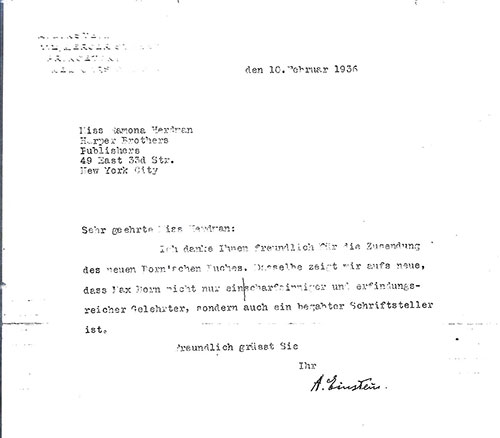
In the dramatic, historic, and extremely rare February 10, 1936 correspondence exhibited here, Einstein writes on his Princeton letterhead to Ramona Herdman, Harper’s publicity director, evidencing the high regard in which he held Born:
I thank you kindly for sending Born’s new book. It shows once again that Max Born is not only an astute and inventive scholar, but also a gifted writer.
The book to which Einstein is referring is the first American edition of Born’s translated work, The Restless Universe, which was published by Harper & Brothers. The Restless Universe is a lucid, non-technical attempt to explain what the “new physics,” including relativity and, especially, quantum mechanics, had done to the old, comfortable picture of a clockwork cosmos. Born’s core message is the “Born rule:” that nature, at its deepest level, is not governed by strict determinism, but by probabilities.
Born consistently resisted efforts by younger physicists to portray Einstein as obsolete or reactionary, and he publicly emphasized Einstein’s foundational role in creating the conceptual framework without which quantum theory itself could not exist. Thus, even while defending his own probabilistic interpretation, Born described Einstein’s objections as “intellectually honorable” and historically indispensable. After Einstein’s death in 1955, Born wrote movingly of the loss not merely of a scientific giant but of a moral compass, describing Einstein as a man whose integrity transcended disciplinary boundaries. Their disagreement, Born insisted, should be remembered not as a victory of one view over another, but as an enduring dialogue about the limits of human knowledge. In my mind, this is analogous to the lifelong and enduring disputes between Beit Hillel and Beit Shamai in the Talmud: so much of their dialogue in the Talmud is marked by passionate disagreement, yet they maintained a close and collegial relationship, even love, for each other.
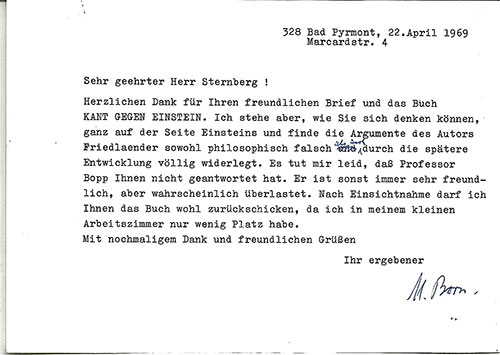
In this April 22, 1969 letter to “Mr. Sternberg” written a year before his death, Born conveys a sense of his genteel nature, even while disagreeing with his correspondent, and also evidences his willingness to back Einstein, notwithstanding his keen disagreement with him regarding the essential nature of quantum mechanics:
Thank you very much for your kind letter and the book KANT AGAINST EINSTEIN. However, as you can imagine, I am entirely on Einstein’s side and find the author’s arguments to be flawed and completely refuted by later work from Friedlander. I am sorry that Professor Bopp did not reply to you. He is usually overworked. After reviewing it, I hope I may return the book to you, as I have very little space in my small study.With renewed thanks and kind regards
Kant contra Einstein is a short 40-page philosophical pamphlet written by Lenore Ripke-Kühn and published in German in 1920, shortly after Einstein’s theory of relativity became famous, that criticizes Einstein’s use of Kantian philosophical categories and, by implication, of Einstein’s physics. The author rejects Einstein’s relativity theory on philosophical grounds, claiming that the way Einstein views space and time conflicts with Kant’s framework of how humans understand them.
Immanuel Kant (1724-1804) argued that space and time are not learned from experience; rather, they are forms of human sensibility, ways the human mind organizes experience. This means that we cannot know “things in themselves,” but only how they appear within these forms, the critical argument he makes in his Critique of Pure Reason. In his theory of relativity, however, Einstein shows that measurements of space and time depend on the observer’s motion and gravity and that time dilates and space contracts relative to observers. In philosophical terms, Einstein’s view treats space and time as part of the physical world, not as fixed mental categories, which was seen as a challenge to Kant’s view. Thus, although Einstein himself did engage with Kant’s ideas, his theories moved far beyond Kant’s a priori categories in ways that were not philosophically objectionable to scientists, even if Kant’s deeper epistemology remains a major topic in philosophy.
Ripke-Kühn uses a Kantian lens to attack relativity: she argues (like many other critics in the neo-Kantian camp of that era) that Einstein’s relativity incorrectly denies the a priori status of space and time, which undermines either Kant’s philosophy or Einstein’s physics. She thus sees Einstein as mistaken because relativity treats space and time as empirically contingent – that is, dependent on observers and motion – instead of as universal cognitive frameworks.
Ripke-Kühn (1878 -1955) was a German philosopher and writer who studied philosophy in Germany, earned a doctorate, and was involved in the intellectual currents of the early 20th century. Her social and political involvements aligned with nationalist and anti-Jewish movements in Weimar Germany; she was active in right-wing intellectual circles, including associations that explicitly opposed perceived Jewish influence in academic philosophy; and she was connected with nationalist and later völkisch (ethno-nationalist) movements and had clear antisemitic positions in her career. Her antisemitism surely underscored her attack against Einstein.
Born’s disagreement with the pamphlet arises from several points. First, Einstein’s theory made predictions (e.g., bending of light, relativity of simultaneity) that were tested and confirmed by experiment, which is why physicists like Born endorsed Einstein; there is simply no scientific basis, from a physics standpoint, to treat relativity as “refuted.” Second, Born, like Einstein, saw physics as grounded first in empirical and mathematical frameworks, with philosophical reflection secondary; Einstein also read and thought about Kant, but his physics didn’t depend on preserving every detail of Kant’s transcendental idealism. Third, the arguments against relativity from such pamphlets were not sustained against later work. As such, Born’s siding with Einstein and rejection of Ripke-Kühn’s critique was because physics had moved beyond Kantian philosophical objections, and the empirical success and internal coherence of relativity outweighed purely philosophical concerns.
During his years of exile, Born became increasingly involved, quietly and without publicity, in efforts to assist Jews, particularly displaced Jewish scholars. During 1939, he got as many of his remaining friends and relatives still in Germany as he could out of the country, including his sister Käthe, in-laws Kurt and Marga, and the daughters of his friend Heinrich Rausch von Traubenberg. Meanwhile, Hedwig ran a domestic bureau, placing young Jewish women in jobs. Born received his certificate of naturalization as a British subject on August 31, 1939, one day before World War II broke out in Europe.
Born supported refugee aid organizations, wrote letters of recommendation, and used his international standing to help younger scientists secure positions abroad. For example, after his dismissal from Göttingen in 1933, he actively supported the Academic Assistance Council (AAC)/ Society for the Protection of Science and Learning (SPSL), writing letters of recommendation for refugee physicists; using his personal standing and professional contacts in Britain, Europe, and the U.S. to advocate for placements; and participating in evaluations of candidates’ scholarly merit, which was often decisive. Working with the Emergency Committee in Aid of Displaced Foreign Scholars based in New York, he worked closely with Einstein and American universities to bring refugee scholars to the United States, and he corresponded with American colleagues and supported cases forwarded through this network.
Among the displaced Jewish scholars he assisted were Jewish Nobel laureate James Franck, on whose behalf he coordinated with British and American colleagues and facilitated his eventual relocation to the United States, and Austrian Jewish physicist Lise Meitner, whom he supported professionally in exile and on whose behalf, he marshalled public and private support. Though not a communal leader in the traditional sense, he regarded such efforts as a moral obligation rooted in shared fate rather than religious commandment and his Jewishness, never expressed through formal observance, found practical expression in solidarity with those uprooted by antisemitic persecution. His efforts on behalf of Jews were intentionally quiet and non-public because he was deeply modest and ethically reserved; he disliked self-promotion and moral grandstanding; he feared that loud advocacy could backfire; and, unlike Einstein, he avoided public political statements whenever possible. This explains why many survivors remembered him with gratitude, even if his name does not appear prominently in institutional histories of rescue.
Born’s views on Zionism were measured and cautious. He did not identify as a political Zionist in the sense of advocating nationalism as a primary solution to Jewish vulnerability, but, at the same time, he corresponded with Chaim Weizmann and he recognized the historical necessity that led many Jews to embrace Zionism after the collapse of European Jewish life. In private correspondence, he expressed sympathy for the aspiration of Jewish self-determination while also voicing concern about nationalism of any kind, which he believed carried inherent dangers. This is consistent with positions he advanced in published essays such as Physics and Politics (1962) and in My Life and My Views (1968), where he repeatedly criticizes nationalistic ideology in all forms, arguing that narrow nationalism, whether German, Jewish, or other, carries inherent moral dangers, and his Nobel lecture and other later writings also emphasize that belief.
Antisemitism profoundly affected Born’s professional and personal trajectory; the loss of his Göttingen position, the destruction of German theoretical physics, and the betrayal by institutions he had served left deep scars; he never returned to Germany during the Nazi period; and he struggled after the war with the question of reconciliation. Although he eventually accepted honors from German institutions and resumed limited engagement, he never fully overcame his sense of disillusionment, and he regarded antisemitism not as a marginal aberration, but as a structural failure of European civilization, one that science alone could not prevent.
In 1954, Born was awarded the Nobel Prize in Physics for his fundamental contributions to quantum mechanics, particularly for his statistical interpretation of the wave function, an award that was widely regarded as long overdue. Einstein, though already deceased, had previously supported Born’s nomination despite their philosophical disagreements. The Jewish press covered the award with particular attention, emphasizing both Born’s scientific achievements and the historical irony that a Jewish physicist expelled from Germany had reshaped modern physics, and articles in Jewish periodicals portrayed him as a symbol of intellectual resilience and moral seriousness rather than as a triumphalist figure.
In his later years, Born increasingly turned his attention to ethical questions surrounding science. The development of nuclear weapons deeply troubled him and, unlike some contemporaries who justified such developments as inevitable, he argued that scientists bore moral responsibility for the applications of their work. He joined international movements calling for nuclear disarmament and spoke publicly about the dangers of technological power divorced from ethical restraint, concerns that were shaped by his experiences as a Jewish exile and as a witness to civilization’s collapse. For Born, the same scientific rationality that enabled unprecedented insight into nature had also facilitated unprecedented destruction.
Born returned to Germany in the final years of his life, settling in Bad Pyrmont. The return was cautious and emotionally complex; he did not seek restoration of his former status and remained skeptical of claims that Germany had fully reckoned with its past. Nonetheless, he believed in the possibility of moral renewal grounded in honest confrontation with history, and his writings from this period emphasize humility, responsibility, and the limits of scientific authority.
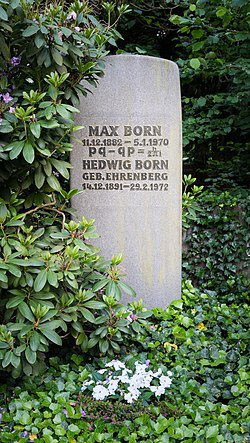
Born died in 1970 at age eighty-seven. He was buried in Germany, and his funeral was not conducted according to traditional Jewish religious rites, reflecting the secular character of his life, yet his Jewish identity was openly acknowledged. He was remembered by colleagues, former students, and members of the Jewish community as a man whose life embodied the tragic arc of German Jewish intellectual history: brilliant integration, catastrophic exclusion, and partial, uneasy return.
Born’s legacy is inseparable from his relationship with Einstein and from the historical experience of Jewish exile. Scientifically, his probabilistic interpretation of quantum mechanics remains foundational, shaping every subsequent application of the theory; philosophically, his willingness to accept uncertainty as a fundamental feature of nature marked a decisive departure from classical thinking; and, ethically, his insistence on responsibility, restraint, and humility offers a model of scientific conscience rare in any era.