October 2, 2026
 Categories: Halacha & Hashkafa
Coat Confusion
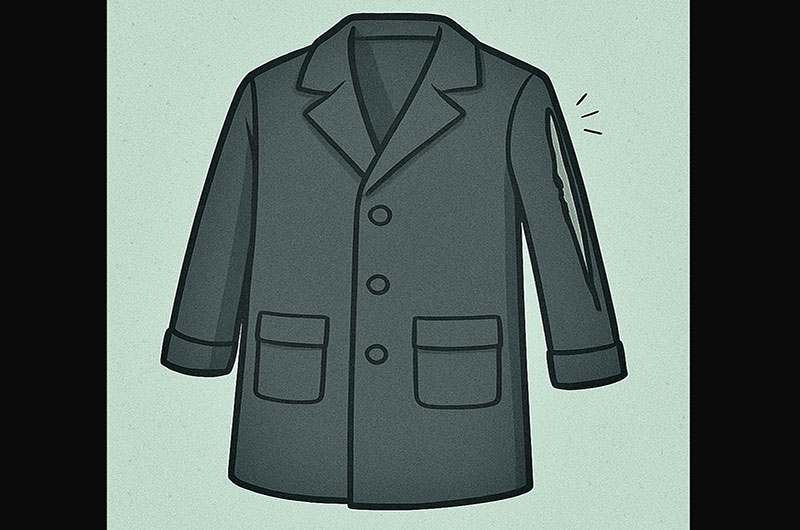


A sharp winter wind whipped through the yeshiva courtyard as Avi began heading home. Suddenly, his phone rang.
It was his friend Eli. “Can you bring the black coat from the coatrack in my room?” Eli asked. “I forgot it when I left.”
“Sure, no problem,” Avi replied.
Avi went back to Eli’s room and immediately spotted a black winter coat hanging on the coatrack. He took it and headed home, holding the coat over his arm.
A few minutes into the walk home, a teenager on an electric scooter zoomed by in the adjacent bike lane. The scooter swerved into the pedestrian walk, and its handlebar snagged the coat sleeve, tearing a long rip straight down the side before the rider sped away.
Avi stared at the gash. “What a wild rider… that’s really bad luck,” he murmured. The coat was clearly damaged, but Avi shrugged helplessly – he certainly hadn’t caused the tear.
When Avi got home, he brought the coat to Eli and apologized for the tear.
Eli looked at the coat. “That’s not mine,” he said. “Mine has a hood. You took the wrong one!”
A quick call to Eli’s roommate, Daniel, confirmed it – the coat belonged to him.
The next morning, Avi brought Daniel the torn coat.
“You took my coat without permission,” Daniel said sternly. “That’s like stealing it, and now it’s ruined! You’re liable, even though it got torn through oness.”
Avi’s eyes widened. “Stealing?!” he replied. “I was doing Eli a favor! That was the only coat on the coatrack – I never intended to take yours.”
The two decided to turn to Rabbi Dayan and asked:
“Is Avi liable for the coat that he mistakenly took?”
“The Mishna (B.K. 26a) teaches that even a person who damages unintentionally is liable,” replied Rabbi Dayan. “The Gemara (B.M. 26b) derives this from the verse ‘petza tachas petza’ regarding one who injures.”
“Ketzos (25:1) suggests, though, that this applies only to one who damaged, but not to one who stole unintentionally, such as if A gave something belonging to B to C because he mistakenly thought that it belonged to C. He posits that the derivation adding shogeg (unintentional acts) is limited to damage, which entails immediate loss, but should not be expanded to unintended theft, because at the time that A took the item and gave it to B, it was still intact and returnable.
Ketzos refers to the Mishna (B.K. 79a) that addresses the case, according to one interpretation, of a person who told a kohen to take money that was not his for pidyon haben. Shach (348:6) writes that the kohen who took the money is not liable should it be lost, because he thought it had been rightfully given to him. The Rishonim dispute, though, whether the person who instructed the kohen is liable, based on limitations of the principle ‘Ein shaliach l’dvar aveirah’ – there is no agency for sin (Sma 348:20).
Nesivos (25:1) concurs that if someone steals unintentionally, he is not liable for oness to the item, as other thieves are. However, he maintains that if the person mistakenly gave the item to a third party in a manner not returnable, he is no better than someone who damaged unintentionally, and is thus liable.
Machaneh Ephraim (Gezeilah #7) distinguishes that if someone took something that he thought was his, he is not liable as a thief, because he had no intent to acquire the item, which he thought was already his. However, if he took something belonging to another for himself, even if he mistakenly thought that it was with permission, he is liable as a thief, because he had intent to acquire it (see also Shaar Mishpat 72:31; Pischei Choshen, Gezeilah 4:23[19,31]).
Thus, because Avi took the coat from the coatrack in good faith and had no intent whatsoever to steal it, he is not liable for its being ruined through oness, as in this case, nor for theft.
“However, Avi is no less than a shomer chinam,” concluded Rabbi Dayan, “because he intended to take it on behalf of Eli, so that had it been ruined due to negligence, Avi would be liable (Nesivos 348:4).”
Verdict: According to many authorities, a person who mistakenly took something belonging to another in good faith is not liable for the item as a thief if it is subsequently ruined through oness. However, he might be liable as one who mistakenly damaged if he ruined the item or gave it away.