October 2, 2026
 Categories: Featured / Parsha / Torah
Coercive and Voluntary


Parshas Yisro
We are told that two things persuaded Yisro to convert to Judaism. The first was the splitting of the Red Sea and the second was the war with Amalek (Rashi, Shemos 18:1). What was it about these two events that made such an impression on him?
Yisro was used to an environment where might was right, where the defeat of an enemy had to be crushing and total. But what he saw at the Red Sea was the administration of justice. The punishment was tailored to the crime and was not over the top (Rashi, 18:11). The Egyptians were drowned because they drowned the Jewish children. The Egyptians were weakened, but they were not totally obliterated. They raised their heads again later on in Jewish history when the Jews abandoned the Torah in the time of Rechavam. And anything good that the Egyptians did was not overlooked. They were rewarded for saying “G-d is righteous and we are sinners” by being accorded a burial in the bed of the sea (Rashi,15:12). It was this carefully calibrated justice system of the Torah that so attracted Yisro.
Yisro was also struck by the ability of the Israelites to control their fate, irrespective of what the stars held in store for them. He saw that the Jews were attacked by Amalek from behind, when they were weak and exhausted. The natural course of events should have resulted in their total defeat. But he witnessed G-d’s prescription for salvation. “As long as Moshe held his hands up Israel won, but as soon as he let his hands down, Israel lost (16:11). “But do Moshe’s hands win or lose wars? Rather, so long as Israel looked up to heaven and subjugated their hearts to G-d they would prevail, but if not they would fail” (Rosh Hahanah 29a.). Yisro wanted to rewrite his own destiny too.
So he converted. As with so many converts, like Ruth after him and King David in her footsteps, and like Unkelos and so many others, his contribution to Judaism was massive. He taught us to be excited to be Jews. Unlike the Israelites who took G-d’s protection for granted because they were born into it, he was wowed by what he saw. He said, “Blessed be G-d who rescued you from the power of Egypt and Pharaoh” (17:10). “It was to the discredit of Moshe and the Jews who experienced the Exodus themselves that they did not bless G-d until Yisro, the convert, came along and did so” (Sanhedrin 94a). It is often the convert’s delight at his or her recent engagement with Torah that renews our romance in the longstanding marriage between G-d and the Jews.
The Israelites encamped in the desert and they camped opposite the mountain (19:2). Rashi explains why the Hebrew word “Vayichan,” they encamped, is used both in the plural and the singular. All the other encampments were riddled with strife and dissent, but here they encamped as one man with one heart. They demonstrated that they understood what Hillel told the gentile who asked to be converted to Judaism while standing on one foot. The essence of the Torah is “love your neighbor as yourself” (Shabbos 31a).
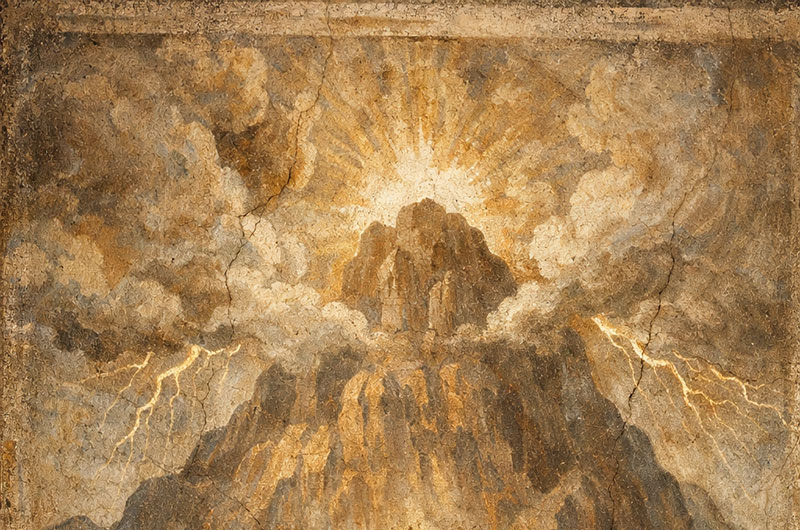
At the Revelation, the Jews stood at the foot of the mountain. We are told that G-d suspended the mountain over their heads like a barrel and gave them an ultimatum: “If you accept the Torah you will live, but if not, here you will die” (Shabbos 88a). But this was not a threat. It was a fact that the Israelites experienced in the moment. “And Mount Sinai was wrapped in smoke as G-d descended upon it and the whole mountain quaked violently” (19:18). It was this overwhelming spectacle of G-d’s indisputable presence that robbed them of their freedom of choice. It was crystal clear to them that the only option in life was to cling to G-d and his word. They were intoxicated by this barrel of spirit that hung over their heads. It was like we are on Yom Kippur when we most resemble angels and the Satan has no sway over us.
But like any enticing advertisement, the draw of Revelation waned quickly as they returned to everyday life. It did not take long before they forgot what they saw and reverted to their old idol worship ways.
And G-d understood this. He gave the Israelites an escape clause. Had G-d summoned them to judgment for disregarding the Torah’s commandments, they could have successfully pleaded that the Torah was given to them under duress and they did not need to keep it (Shabbos 88a). Only later, in the days of Mordechai and Esther, did the Jews, after having been threatened with and saved from physical annihilation, willingly accepted that their only ticket to survival is adherence to the Torah.
“And G-d spoke all these words saying” (20:1). This sentence teaches us that G-d said all of the Ten Commandments in one utterance, something which is impossible for man to do” (Rashi).
The Ten Commandments incorporate within them all of the 613 mitzvos. We know this from the piyutim of Shavuot. Each piyut informs us which mitzvos fit in as sub categories to the each of the Ten Commandments. They were all uttered in one pronouncement because they are all interconnected. Like the Menorah that was fashioned out of one piece, the Torah is one integrated structure. If we are missing one of the 613 pieces in our observance of the Torah, the whole edifice falls apart and is meaningless.