 October 9, 2026
 Categories: Headline / J.E. Dyer
Cry Havoc: Iran Builds Land Bridge to Syria


{Originally posted to the author's website, Liberty Unyielding}
Americans were startled to learn on Saturday that Lebanon’s Prime Minister Saad al-Hariri had resigned abruptly – addressing his nation from a remote perch in Saudi Arabia – and within a short time, Iran-backed Houthis in Yemen had fired a ballistic missile at King Khalid International Airport near the Saudi capital of Riyadh.
The Saudis intercepted the incoming missile. They were also busy throughout the day on Saturday rounding up princes and arresting them, in order to consolidate power in the Kingdom.
Lebanon will be left with Hezbollah to decide what comes next there. Whatever the Saudis’ next move is, it won’t be brokering a follow-on coalition in Lebanon under the now-ended status quo. Riyadh has effectively checked out of that loop for the time being.
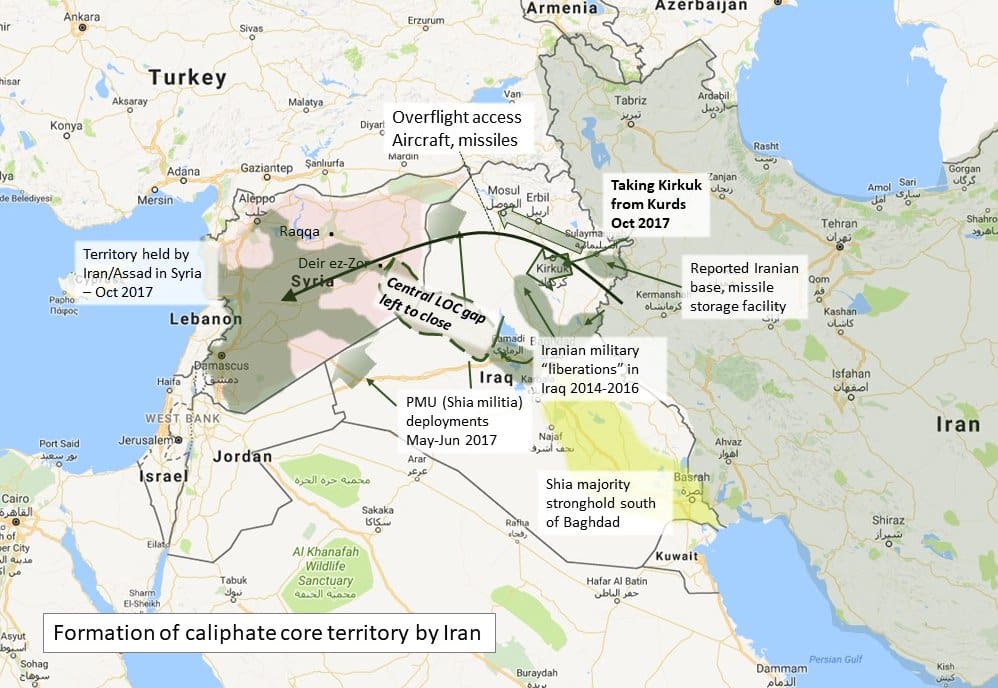
This isn’t some nutty Middle Eastern ritual going on. The reason it’s all happening now is that a sequence of events is unfolding: one that’s visible on a map, but that there is virtually no reporting on in the U.S.
The sequence of events, taken together, equals Iran completing her land bridge – her military line of communication – across Iraq and into Syria. This is a major shift, one that under the best of circumstances would be a permanently destabilizing, if latent, condition.
But the best of circumstances are not what we face. The U.S. is out of position to contain this situation. No one else can contain it. It will metastasize; the only questions are how, and how fast.The pretext for Iran, as always (since 2014), is “defeating ISIS.” Iran has exploited this strategic pretext throughout her campaign across Iraq, and the companion drive with Assad into eastern Syria, to gobble up the territory that will form her land bridge.
Her move against the Kurds in northern Iraq a few weeks ago makes the land bridge more secure, relieving the pressure on Iran from Kurdish military capabilities in northern Iraq, and positioning Iran to hold a veto over the territory where Turkey will also want to gain leverage.
In brief, Assad and the Iran-backed militias on the Syria side have fully taken the key city of Deir ez-Zor, and are now moving southeast from it toward the border town of al-Bukamal. They are also headed east along the border toward al-Bukamal (see map).
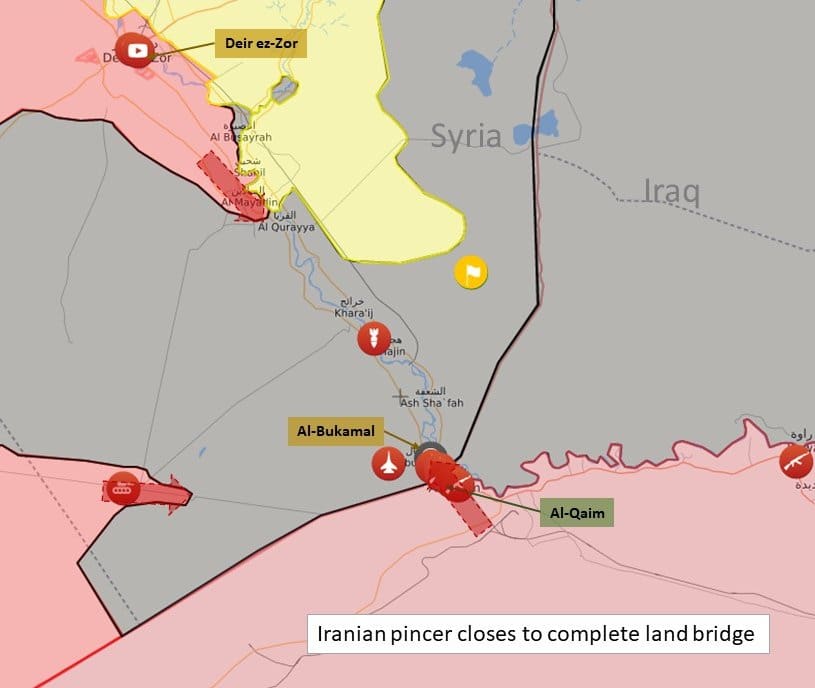
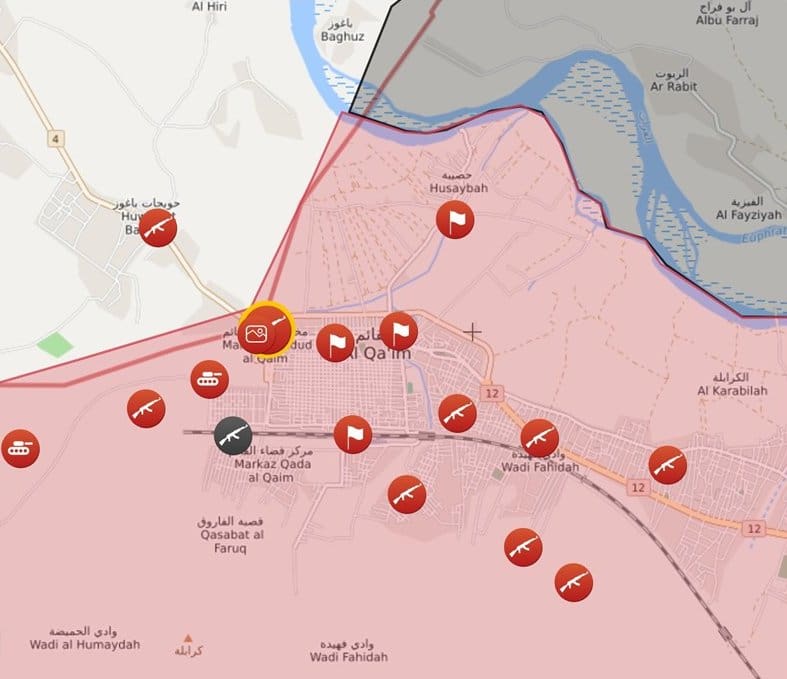
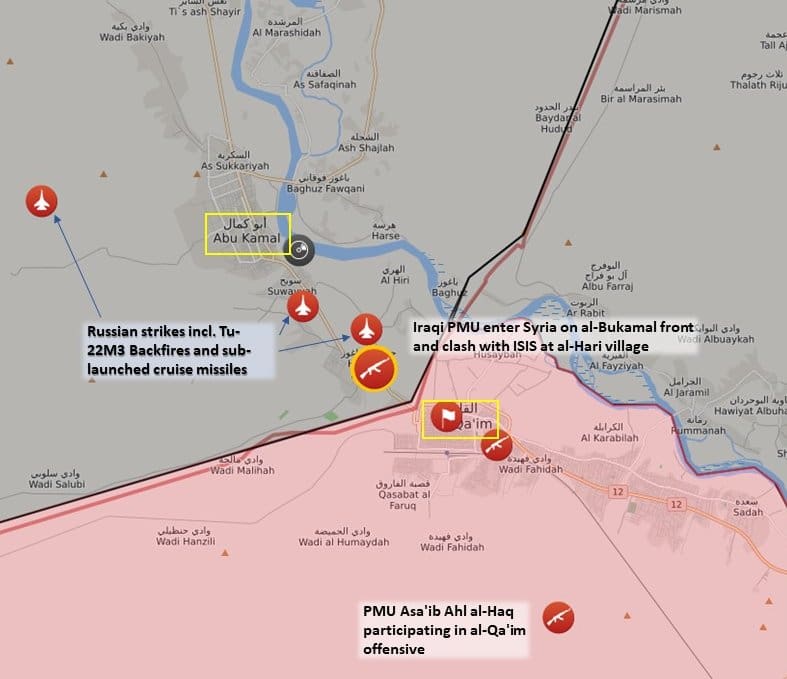
This imminent hook-up is why the Saudis are changing their posture as we speak. It’s also why Benjamin Netanyahu has been so vocal in recent weeks about Israel’s “red lines” in Syria, and what Israeli security cannot tolerate.
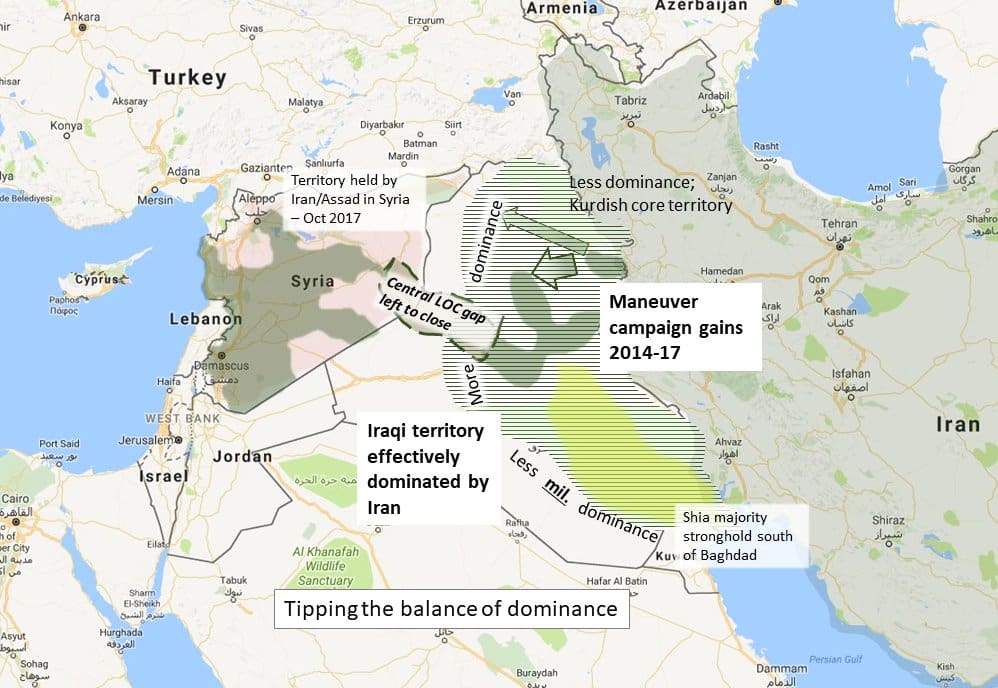
If Iran can use this corridor for maneuvers with a military purpose – and Iran will be able to; Iraq is incapable of preventing it – then nothing in the Middle East can remain as it is. (Next two maps are from my post a few weeks ago (link above) outlining how Iran’s influence in Iraq is tipping to military dominance.)
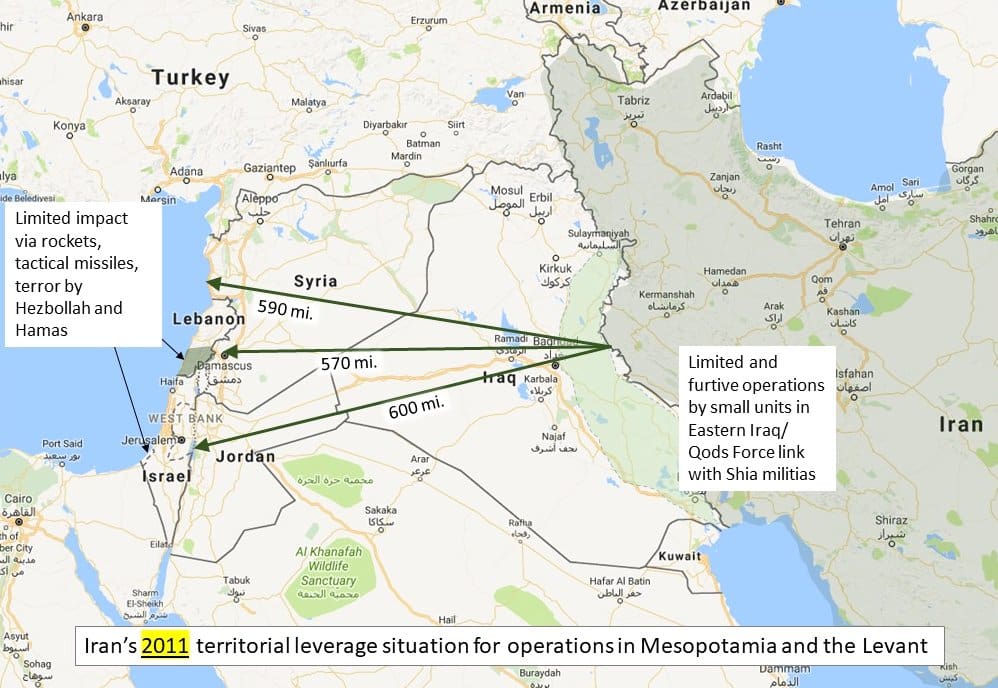
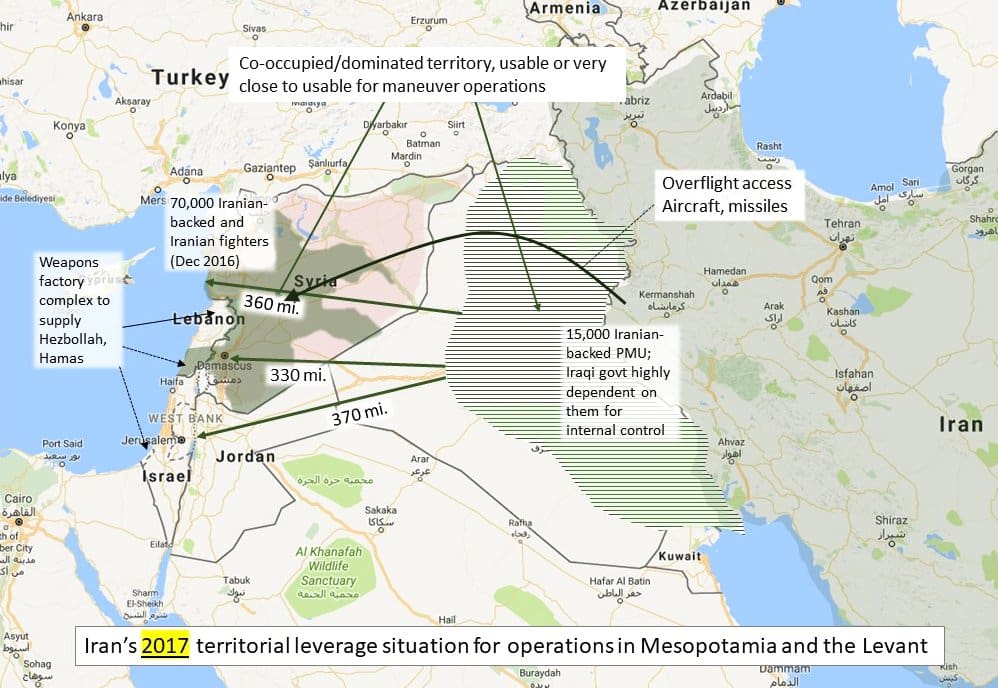
If you think revolutionary Iran wants this land bridge in order to sit quietly and wait at one end of it, you haven’t been paying attention for the last 38 years.
(Remember, it was 38 years ago to the day, on Saturday, when the U.S. embassy in Tehran was overrun by “student” revolutionaries during the Iranian revolution. 4 November 1979.)
Geography hasn’t changed in the last 2,300 years. But the character of today’s Iran is a modern, radical-Islamic phenomenon. It marries the inevitable, perennial calculations about natural resources and topography with a radical, apocalyptic ideology, and the information-age vision and technology of warfare and geopolitics.
And Iran has no reason to anticipate that this extremely disruptive move on her part will be followed by a period of stability. The mullahs will want to move quickly toward their goal. That, we can recognize, even if the exact outlines of the strategy are not clear yet.
Iran knows she cannot simply marshal forces and attack Israel, for example. Not at the moment. But that is what the mullahs have in mind, along with a vision for a Shia caliphate to which the rest of the West will be subjugated. The question is not whether the revolutionary leadership will pursue that goal, but exactly how.
There will be much to sort out in the coming days. Three additional factors should both give us pause, and shape our thinking.
The first one is this: the U.S., for whatever reason(s), is essentially a neutralized quantity in this emerging problem. In the interest of keeping this short, I won’t even spend time analyzing why that is. We have been neutralized in relation to this dynamic – Iran moving across Iraq – since 2011. It didn’t start with Trump, but it hasn’t ended with him either.
Here is a token of just how neutralized we are. If you think we may be over there protesting ineffectively against Iran’s move to complete her land bridge, think again. Far from protesting, we are congratulating Iraq and the Iranian-backed militias on their successful action.
The second factor is the involvement of Russia. Russia is all over this campaign in a supporting role. Russian forces have launched cruise missiles (from submarines) at targets south of Deir ez-Zor in the last 48 hours, and have mounted air strikes with Tu-22M3 Backfire bombers, near al-Qaim and al-Bukamal, every day since 1 November.
(Note: the original report on this was updated between 4 and 5 November to remove the references to Backfire bomber attacks and sub-launched cruise missile strikes. However, the Backfire bombers have been reported separately on Twitter. I include them both here, with a screen capture of the archive of the original report. If the archived version is scrubbed, the screen cap shows that the reference was in it originally.)
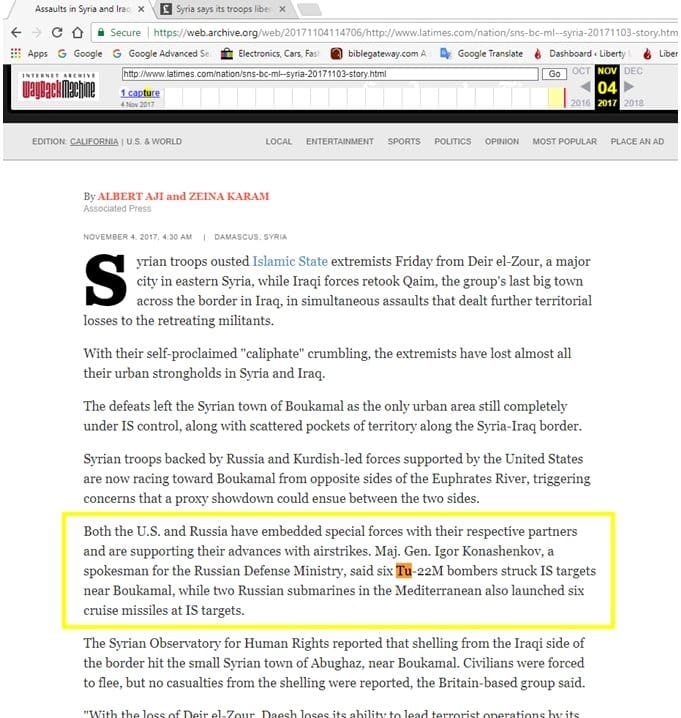
Now the robust Russian participation in the Qaim-Bukamal link-up clarifies the same thing. Russia regards this as an interest of hers.
The third factor is Netanyahu’s repeated representations that Israel can’t sit still for this. I wrote once before that it would be wise, if you haven’t consulted a map in a while, to look at one, and think about what Israel may have to do to keep her territory defensible, if Iran can move men and weaponry so much closer to it without resistance. All I will say tonight is that what Israel may have to do will not be confined to bombing weapons depots in Syria.