 October 9, 2026
 Categories: Torah
Double Sedra Details & A Mikdash vs. Shabbat Correlation
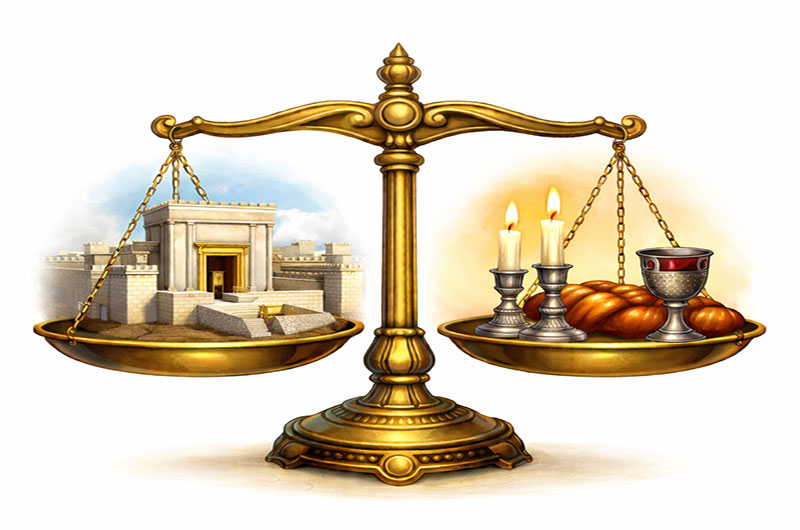


Parshat Vayakhel-P’kudei – Parshat HaChodesh – Shabbat M’vorchim
Let’s start with the first double-sedra of the year.
There are seven pairs of sedras that are sometimes read separately and sometimes combined. Four of the double-sedras address the additional Shabbatot of years that have 13 months – that is, two Adars (Shana M’uberet). The other three pairs have other functions. All seven pairs are either combined or separated to allow the whole cycle of the Torah to go smoothly from Shabbat B’reishit around the year to the following Simchat Torah.
Whereas the general year has 365 or 366 days, the Jewish Calendar has years that have 353, 354, or 355 days or 383, 384, 385 days (depending on the year-type). And thus, relevant to the topic of double-sedras, the number of Shabbatot each year varies – there can be 50, 51, 54, or 55. Furthermore, some Shabbatot are not “available” for Parshat HaShavua – and that number also varies year to year. Rosh Hashanah, for example, can be Shabbat or not. So too Yom Kippur (though not in the same year as a Shabbat Rosh Hashanah). Sukkot always has one Shabbat with a special Torah reading. And sometimes, when Sukkot begins on a Shabbat, there will be a second Shabbat unavailable for Parshat HaShavua. Pesach always has one Shabbat, and outside Israel there can be two Shabbatot. Shavuot in Israel never falls on Shabbat, but in Chutz LaAretz, it can be Friday-Shabbat, making another Shabbat unavailable for the cycle of the 54 sedras of the Torah. We’ll talk more about this in future columns, im yirtzeh Hashem.
Without looking at the entire picture (we have plenty of things to look at this week), here’s the Vayakhel-P’kudei (let’s call it VP for short) story.
In six of the seven year-types of Shana P’shuta (12-month, one-Adar years), VP are combined. This occurs 59.86% of the time. (That’s 60% for those who don’t like fractions.) Furthermore, when VP are combined, they are joined by a special maftir. In 42% of years, VP is also Parshat HaChodesh, as it is this year; 18% of the time, it is joined by Para.
Side point: The Rambam explains why the hour in his works is divided into 1,080 chalakim (parts, which are three-and-a-third seconds each). He writes that 1,080 can be divided by 2, 3, 4, 5, 6, 8, 10, and 12 evenly, without remainders or fractions. (It seems that the Rambam knew of people who didn’t like fractions back in his day, too.)
VPH (VP combined with Parshat HaChodesh) is Shabbat M’vorchim for Nissan, with Rosh Chodesh falling on either Sunday-Machar Chodesh, Tuesday, or Thursday (like this year). When VP is VPP (combined with Parshat Para), then the coming Rosh Chodesh is the following Shabbat.
The one year-type of the Shana P’shuta when Vayakhel and P’kudei are read separately is the very rarest of year-types, in which Vayakhel is read with Para and P’kudei with HaChodesh. We had that last year; the next one is scheduled for 5805/2045.
That leaves the seven year-types of Shana M’uberet. Vayakhel and P’kudei are always read separately in years with two Adars (including next year) and the special parshiyot join one or the other as follows: Vayakhel is Sh’kalim and P’kudei is a Hafsaka (break) – that’s the most common scenario. Rarer is Vayakhel being alone and P’kudei being joined by Sh’kalim. And rarer still is Vayakhel on its own and P’kudei being paired with Sh’kalim and Rosh Chodesh.
Calendar trivia: P’kudei is the only sedra that is always within the range of the Four Parshiyot – either Sh’kalim or a Hafsaka or HaChodesh (with or without Vayakhel). Sedras that are sometimes within the range of the Four and sometimes not are: Mishpatim, T’ruma, T’tzaveh, Ki Tisa, Vayakhel, Vayikra, Tzav, Sh’mini, and Tazri’a.
* * * * *
Now a word – and a lot of numbers – about the Book of Sh’mot. There are 11 sedras in Sh’mot, made up of 1,210 p’sukim all told. That averages neatly to 110 p’sukim per sedra, ranging from Yitro’s 75 p’sukim to Ki Tisa’s 139. The first six sedras bring us from slavery and oppression in Egypt to the miraculous plagues to the first Korban Pesach and the Exodus to the splitting of the sea and Az Yashir to miracles providing us with water and food (the Manna) to our first encounter with Amalek to the Revelation at Sinai (Matan Torah) and the mitzvot of Mishpatim, mostly dealing with laws of a proper functioning of society. Those six sedras consist of 660 p’sukim, nicely keeping to the average. The second group of sedras, five of them, deal mostly with the Mishkan and everything related to it, including the garments of the kohanim. The breakdown of the 550 p’sukim of these five sedras (again, neatly averaging 110 p’sukim per sedra) goes like this: Mishkan with everything: all of T’ruma (96 p’sukim), all of T’tzaveh (101 p’sukim), and the first third of Ki Tisa (39 of its 139 p’sukim) – totaling 236 p’sukim. This is followed by a six-pasuk section about Shabbat, highlighting that the work on the Mishkan cannot be done on Shabbat. Then comes the remaining 94 p’sukim of Ki Tisa that tell us about the sin of the Golden Calf and its aftermath, concluding with the second set of Luchot, G-d’s forgiveness (not without consequences), and the Thirteen Attributes of Hashem’s Mercy. This is followed by a three-pasuk command/reminder of Shabbat at the beginning of Vayakhel and the actual carrying out of the command to make a Mikdash for G-d in the sedras of Vayakhel (the remaining 119 p’sukim) and P’kudei (92 p’sukim). That’s another 211 p’sukim about the Mishkan, bringing us to a total of 447 p’sukim of the total 550. That’s over 80% of the second part of Sh’mot (or 37% of the whole Book of Sh’mot). And this doesn’t count much of Vayikra and parts of Bamidbar that deal with the korbanot (offerings) in the Mishkan.* * * * *
Let’s talk about Shabbat and Mikdash. We’ve already counted the p’sukim in the five sedras of the latter part of Sh’mot. Score: Mikdash – 447; Shabbat – 9. But the Written Word is not the whole Torah. The Mishna (Chagiga 1:8) makes it clear that some mitzvot are spelled out clearly in Torah She’bichtav and others are like “mountains hanging by a hair,” with volumes of material in Torah She’b’al Peh connected to a relatively small amount of text. Shabbat is the original demonstration of k’dushat z’man, the sanctity of time. Mikdash is the prime example of k’dushat makom, the sanctity of place. The building of the Mikdash, the making of the fabrics, and a variety of other activities in the fulfillment of the mitzvah of “V’asu Li Mikdash…” (Make for Me a Sanctuary) – none of that may be done on Shabbat. On the other hand, many forbidden activities on Shabbat were actually required and done on Shabbat in the Mishkan, and later, in the Beit HaMikdash. It seems kind of even in the comparison. Joining these two forces of sanctity is the fact that the 39 categories of forbidden melacha (creative activities) on Shabbat derive from the making of the Mishkan. And then there is a pasuk – occurring twice in the Torah (both in Vayikra – 19:30 in K’doshim and 26:2 at the end of B’har): “Et Shabtotai tishmoru u’Mikdashi tira’u, Ani Hashem” – You shall observe My Sabbaths and revere My Sanctuary, I am Hashem. Twice, the Torah equates Shabbat and Mikdash. If this was a “competition” between Shabbat and Mikdash, we’d have to look at the six p’sukim in Ki Tisa that follow 236 p’sukim dealing with the Mikdash (that is, the Mishkan) and everything about it. Sh’mot 31:13: “And you (Moshe), speak to the Children of Israel and say: ‘Ach [but, or however] keep My Sabbaths! For it is a sign between Me and you for your generations, to know that I, Hashem, make you holy.’” We are still commanded to rebuild the Mikdash – the Beit HaMikdash. We pray for that a number of times a day, every day. But Shabbat is what G-d created at the very beginning, and it was potentially for all the people of the world. After a considerable while and many different events, He gave it to us, to Bnei Yisrael, forever. To be observed and honored every single week, all the time.* * * * *
One nagging question for some people, especially while listening to this week’s double VP reading, is: Why so much duplication? T’ruma, T’tzaveh, and Ki Tisa say it all, and so does VP – in a different order and with other interesting differences, but still... The content of the 236 p’sukim about the Mishkan in T’ruma, T’tzaveh, and the first third of Ki Tisa was known only to Moshe Rabbeinu at the time. It was part of the Torah and mitzvot that G-d taught him on Har Sinai during the 40 days and 40 nights Moshe spent there, after the Revelation at Sinai that was witnessed by all the people. Moshe was supposed to descend the mountain with the Luchot and begin teaching all of Israel that which he had learned from G-d. Because of the Golden Calf fiasco, he did not have the chance to teach them – yet – about the construction of the Mishkan. Our tradition is that Moshe cme down from Har Sinai on the 17th of Tamuz and broke the Luchot, destroyed the Calf, castigated the people, went back up Har Sinai, and came back down again on Yom Kippur, two-and-a-half months later. Only after that did he transmit the commandments related to the Mishkan et al. So, Dor HaMidbar, the generation of Israelites who actually lived through the Exodus and Maamad Har Sinai, only actually witnessed what is recorded in Vayakhel and P’kudei. We, on the other hand – all the generations of Jews from then on – because we have the Torah, are aware of the Mikdash from two perspectives. The first is having the command to make a Mikdash for Hashem with the background of the wondrous events of the early sedras of Sefer Sh’mot. Our introduction to the Mikdash is not tainted by the devastating event of the sin of the Golden Calf. We see G-d’s original plan, so to speak – to facilitate the meaningful contact between Him and us via the endeavor and functioning of the Mikdash. We were to build the Mishkan for Him, so that He will dwell within us – as individuals and as a nation. Dor HaMidbar missed that perspective. To them, the Mishkan was primarily a tikkun, a repair and atonement for Cheit HaEigel. And that takes away a lot of the meaningfulness of the whole Mikdash idea. We ned to see things in both perspectives. This is best accomplished by the whole presentation in the Torah – before the Golden Calf and after. The idea just presented to you, dear reader, is significant, but be aware that not all commentaries see it the same way.* * * * *
Parshat HaChodesh is the last of the four special maftirs we read right before Adar (usually), during Adar (always), until (and sometimes including) Rosh Chodesh Nissan. HaChodesh is 20 p’sukim from Parshat Bo. It begins with two p’sukim containing the first mitzvah addressed to Bnei Yisrael as a whole – namely, the establishment of a calendar, unique to our nation. Our months are to be based on the cycle of the Moon, and our years are to be adjusted by the addition of a 13th month (on average, 7 years out of 19), so that Pesach is always in the spring (and Sukkot is always in the fall). As tempting as it is for me to continue with this – one of my all-time personal favorite topics – I will suffice in this week’s column just to say that Kiddush HaChodesh (sanctifying the month and setting up the Jewish Calendar) represents the Sanctity of Time, Part Two. G-d, having sanctified time by creating Shabbat, which He did on His own and commands us to keep and observe, now wants us to become His active partners in further sanctifying time with the calendar and the holy days thereon. G-d created the Sun and the Moon and the Earth – and the laws of nature that govern the cycles of the Moon around the Earth and the Earth and Moon around the Sun. He commanded that we observe Pesach (for example) on the 15th of Nissan until the 21st. He forbids us to eat chameitz. He commands us to eat matzah, and so on. But it is conditional upon our sanctifying the month of Nissan on its Rosh Chodesh. If we don’t, chas v’shalom, sanctify Rosh Chodesh Nissan, then there is no Pesach. No Yom Tov. No prohibition of chameitz. No mitzvah of matzah. We are His partners in this and He won’t do it without our participation.