October 2, 2026
 Categories: Headline / Perspectives / Op-Eds
European Erasure, the U.S. National Interest, and Israel’s Security
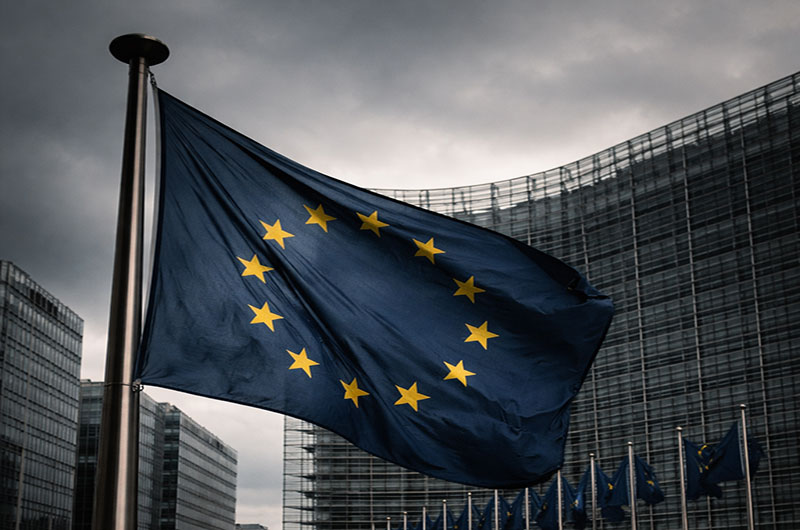


European elites – and their American counterparts – are in an uproar. The Trump administration could not be more satisfied.
A few pointed sentences in the President’s annual report to Congress on national security – warning that Europe faces “civilizational erasure” – have forced Brussels to confront the fact that Washington no longer accepts the European Union’s political project as Europe’s destiny, or as aligned with America’s national interest.
The fury over the National Security Strategy was entirely predictable. Brussels is accustomed to American strategic documents wrapped in gauzy language about “shared values,” “integration,” and “ever closer union.” EU leaders have also gotten used to Donald Trump accusing them of not shouldering their fair share of the financial burden of defending Europe.
NSS 2025, which was released on December 4, is markedly different. The section on Europe argues that its problems run “deeper” than defense under-spending or economic stagnation, emphasizing demographic decline, mass migration from Third-World countries, pressures on social cohesion and political polarization as serious security risks. The document warns that if current trends persist, some of America’s oldest allies could become “unrecognizable” within two decades – too demographically transformed, internally fractured, and politically unstable to preserve the Transatlantic Alliance.
And the NSS goes further, urging the United States to back a major course correction. It pledges to support “aligned countries” aiming to preserve Europe’s freedom and security and restore its “civilizational self-confidence and Western identity,” explicitly endorses “resistance” to the continent’s current direction, and expresses “great optimism” about “patriotic European parties” promising a different trajectory.
European politicians and commentators reacted with alarm bordering on hysteria. Some branded the document a “far-right pamphlet,” others an “existential threat” to Europe, while still others claimed it read as if it had been drafted in Moscow.
All of this is nonsense. What has changed isn’t America’s interest in a strong Europe, but Washington’s willingness to say aloud that the EU’s drive toward ever-tightening political union is draining Europe of strength, identity, and democratic accountability – and pushing it toward self-inflicted decline.
That judgment makes sense once one recalls how the European project began – and how profoundly it has changed.
From the end of World War II through the early Cold War, the U.S. had three clear interests in Western Europe: economic recovery, anti-Soviet alignment, and access to markets. Washington sought to prevent a power vacuum that might prove tempting to Moscow, to anchor West Germany firmly in the West, and to create a prosperous industrial base that would buy American goods and host American troops.
None of those goals required a sovereign European political union with its own flag, anthem, legal supremacy, and ambitions to “speak with one voice” to Washington.
Early European integration – the Coal and Steel Community and later the European Economic Community – was pragmatic and limited. It eased trade and reduced the risk of another intra-European war.
That phase of integration, from the 1950s through the late 1980s, worked remarkably well. The mistake was treating economic cooperation as if it logically required a federalizing political superstructure centered in Brussels and Strasbourg, the EU’s two institutional capitals, complete with a court that overrides national law and a bureaucracy that imagines itself the embodiment of a new, post-national “European people.”
Over time, the EEC, informally referred to as the Common Market, morphed into the EU: a polity with its own legal order, currency, foreign-policy pretensions, and even dreams of a European army – yet without either a constitution ratified by a people or a genuinely shared political community capable of conferring democratic legitimacy.
What emerged was an institutional structure resembling a bureaucratic labyrinth designed by committee – and then revised by several more committees to ensure no one is ever fully accountable for anything.
At the center sits the European Commission, an executive body that looks like a government but carefully avoids calling itself one. It alone can initiate most EU legislation – an extraordinary power for an institution whose members are appointed, not elected. Each member state contributes a commissioner theoretically sworn not to national interests but to “Europe,” as interpreted and enforced by a vast, permanent civil service.
The Commission drafts laws, spends money, polices compliance, and negotiates abroad, all while insisting it is merely a neutral “guardian of the treaties.” In practice, it functions as a technocratic command center largely insulated from voters and national parliaments.
Commission proposals then move to the Council of the European Union – not the European Council, despite the name – where national ministers rotate in and out depending on the subject, casting votes under opaque qualified-majority rules that few citizens could explain without a flowchart. The Council amends and adopts legislation, shares budgetary authority with the European Parliament, and operates under a rotating presidency that changes every six months, ensuring that continuity is always someone else’s problem.
Both intergovernmental and legislative, the Council allows national governments to claim credit at home while blaming “Brussels” for anything unpopular.
Hovering above this machinery is the European Council, composed of presidents and prime ministers meeting in periodic summits to issue grand declarations and solemn pronouncements. It doesn’t make laws; it announces what the laws should be about. This division of labor allows national leaders to posture as statesmen while delegating responsibility for consequences to unelected institutions below.
The result is a system in which power is widely wielded, narrowly controlled, and rarely traceable. Voters elect national governments that sit in one council, appoint commissioners who sit in another, and are governed by rules drafted by officials they can’t remove. When policies fail, responsibility circulates endlessly among bodies with similar names and overlapping mandates.
For Washington, this has meant dealing less with a Europe of sovereign states and more with a centralized authority that speaks in the name of 27 countries, insists on “strategic autonomy,” and displays growing discomfort with American primacy in security, energy, and technology. What began as a Cold War economic arrangement has developed into an entrenched supranational governing body that often behaves more like a rival than an ally.
The consequences are tangible. America’s bilateral leverage has weakened as negotiations increasingly occur with “Europe” as a single actor whose internal compromises yield the lowest common denominator in security and the highest common denominator in moralizing rhetoric. The EU has also produced a Europe that is less militarily useful – dependent on U.S. security guarantees while lecturing Washington on migration, climate, and energy.
This context gives meaning to the NSS warning about “civilizational erasure.” Political union has fostered an EU institutional culture that treats borders, national traditions, and historical identities as embarrassing relics to be dissolved in a thin gruel of “values.” Mass migration is framed not as a challenge, but as an inevitability.
If nations lose confidence in their own history, if public life is increasingly policed by supranational courts and commissions, and if voters are told that defending borders is illegitimate, why assume future governments will feel the same loyalty to NATO – or the same instinctive alignment with America? It’s realism, not hostility, for NSS 2025 to question whether “majority non-European” states will remain reliable NATO allies.
That is why the strategy praises those European forces that resist Brussels’ trajectory – because they still speak the language of a nation with concrete interests. Hungary is the clearest example. Prime Minister Viktor Orban insists Hungary will never leave the EU but looks to reform and reorient it away from federalization. He describes the current EU enforcement regime as one that uses money as a weapon against governments that oppose open borders, resist mass migration, and defend sovereign control over family and demographic policy.
For Israel, the EU’s evolution has been especially damaging. Over the past two decades – and with particular intensity since 2014 and October 7, 2023 – the EU’s institutional center of gravity has shifted from treating Israel as a strategic ally to treating it primarily as a human rights and international law violator to be constrained and counterbalanced by Palestinian statehood.
The EU–Israel Association Agreement of 2000 cast the Jewish state as a close political and economic counterpart. Over time, EU institutions subordinated that relationship to backing the Palestinian cause. Through Council conclusions, Commission practice, and court rulings, “territorial differentiation” became doctrine. The EU recognizes Israel only within the 1949 armistice lines – boundaries Abba Eban famously called “Auschwitz borders” – while treating Judea and Samaria, East Jerusalem, and the Golan as occupied territory to be excluded from EU preferences and labeled accordingly.
From the late 2000s onward, the Commission and Council constructed a legal-bureaucratic scaffolding that normalized this separation and enabled economic pressure: funding exclusions, settlement-labeling rules, and now movement toward suspending trade benefits. In parallel, EU institutions elevated recognition of Palestinian statehood into a moral and political imperative.
EU diplomatic machinery has become a steady producer of reports and resolutions portraying Israel as a systematic violator of international law, while channeling large flows of funding to the Palestinian Authority, UNRWA, and anti-Israel NGOs.
Since October 7, the EU’s posture has hardened into an overt sanction-and-lawfare agenda. The High Representative – the EU’s de facto foreign minister – and the European Parliament, have pressed for arms-export restrictions on Israel, conditionality on EU research and trade benefits, and institutional backing for international investigations of alleged Israeli war crimes, including explicit support for the International Criminal Court’s despicable issuance of arrest warrants for Prime Minister Benjamin Netanyahu and former defense minister Yoav Gallant.
Consequently, Israel’s most dependable European relationships today are bilateral and concentrated in countries that still assert meaningful sovereign control over borders and foreign policy – Hungary, Poland, the Czech Republic, Romania, and Greece. These ties flourish despite Brussels, not because of it.
Beyond its fixation on Israel, the EU’s broader record reveals a pattern of systematic appeasement of international political Islam. Under the banners of “dialogue,” “integration,” and “religious accommodation,” EU institutions have legitimized Islamist-aligned groups, funded Islamist interlocutors, and built bureaucratic partnerships with foreign state-controlled Islamic institutions. Core red lines have been crossed in the name of avoiding confrontation.
Since the 1990s – and with intensity after the Arab Spring – the EU has treated legalized Islamist parties as normal democratic partners, asking chiefly whether they accept elections rather than probing their commitments to pluralism, women’s rights, or secular law. This approach has conferred legitimacy and resources while signaling that antidemocratic doctrines will not be seriously challenged so long as they remain formally non-violent.
EU counter-terrorism policy has followed the same logic. Since 2005 it has emphasized “prevention” through dialogue and community partnerships, treating supposed nonviolent Islamist groups as bulwarks against jihadism despite repeated warnings that they propagate radical worldviews. The consequences are visible. Antisemitism has been normalized, Jewish life increasingly endangered, and large parts of Europe made unsafe for Jews.
EU migration and asylum policy has compounded these trends. The Common European Asylum System offers high protection standards and broad rights to lodge claims inside EU territory, while the Schengen system of passport-free internal travel allows migrants to reach destination states with the most generous welfare regimes. Family reunification rules have generated sustained chain migration with limited integration requirements.
The demographic impact has been enormous. During the 2015–2016 crisis alone, more than 1.2 million people arrived in a single year, many from Muslim-majority conflict zones. This was a mass demographic shock – in effect, an invasion – that EU institutions proved structurally incapable of preventing.
Looking at what the EU has become, what it has done to Europe, and what it will do absent radical reform, it is difficult to argue that the EU’s continued existence as a political union serves the national interest of either the United States or Israel.
The Trump administration is therefore right to prioritize bilateral alliances and to encourage a return to the EU’s original purpose: a free-trade community of democratic states, not an ideological superstate. The NSS warning is not an attack on Europe, but an appeal to recover the virtues that sustained it during the Cold War – national identity, democratic accountability, secure borders, and civilizational confidence.
American Jews who are genuinely concerned about the future of America and Israel should applaud the administration’s clarity and initiative.