 October 9, 2026
 Categories: Featured / Parsha / Torah
Facing the Hungry


Parshas Terumah
G-d, like a parent who has raised a child at home but does not want to be forgotten once the child grows up and moves out, asks for a room in His adult child’s house so that He can visit and remain part of his child’s life. G-d wants to know that the Israelites who saw Him face to face at Mount Sinai will retain that memory for life, even as the revelation will fade into a thing of the past. The best way to do that is to build Him a house where His constant presence in our lives will be witnessed through the small miracles on daily display – like the circle of the letter Samech staying in place in the tablets of the law, defying the laws of gravity by not falling out, like the western light of the Menorah burning twenty four-hours on twelve-hour fuel, and like the Lechem Hapanim showbread remaining fresh from one Shabbat to the next. That is the meaning of “Veyikchu li terumah” (25:1), contribute to the building of the Tabernacle “for My sake.” It was G-d’s wish, more than it was the peoples’ wish. They were still dazzled by the events at Mount Sinai and the ongoing miracles in the desert. They felt the Mishkan was unnecessary.
But then came the golden calf. How quickly did they push G-d out of their lives. And how devoid of His presence did they feel after that. Now they needed Him back among them, more than He needed them. And so the initiative shifts to them and they are the ones now asking G-d to come back and live amongst them. That is the meaning of “Ve’asu li Mikdash” (25:8); it is they who will initiate the building of the Tabernacle and invite G-d in.
What personifies G-d’s presence in the Mishkan most of all? It is the Torah, in the form of Tablets of the Law. The Torah is G-d’s representative on earth. We communicate with Him by studying His words.
The Torah was placed in a box called the Aron which symbolically represents people. It was made of wood wedged between gold on its inside and gold on the outside. Like us, wood expands as it breathes and shrivels as it dies. But the wood was lined internally and externally with gold, eternal material. That is the effect the Torah has on us when sincerely practiced. It refines the human being in such a way that its message becomes manifest both in one’s external appearance, in the manner one conducts oneself with the outside world, and in one’s internal appearance, in the manner one conducts oneself at home and in the privacy of one’s own company.
The ark was equipped with two poles so that it could be carried from encampment to encampment in the wilderness (25:13-16). Other articles in the Tabernacle were also furnished with carrying poles such as the Shulchan (the table) (25:27) and the Mizbe’ach (the altar) (27:7). The difference between the carrying poles of the Ark and those of the table and the altar was that the poles of the Ark were never removed (25:15), even when the Ark was stationary, whereas the poles of the table and the altar were removed whenever they were not travelling. That is because the Torah is not meant to be immobile. It is constantly on move with us wherever we go. The Tablets of the Law are with us even when they are physically not present, as has been the case since slightly before the destruction of the first Temple when the Aron with the tablets inside were hidden from the invading enemy, never to be seen again. But not only did their physical absence not result in their obliteration, it led to their expansion. It was during this period of their concealment that the Oral Law bloomed with the compilation of the Mishnah and the Talmud, all derived from the hidden Tablets of the Law and which accompany us in exile to this very day.
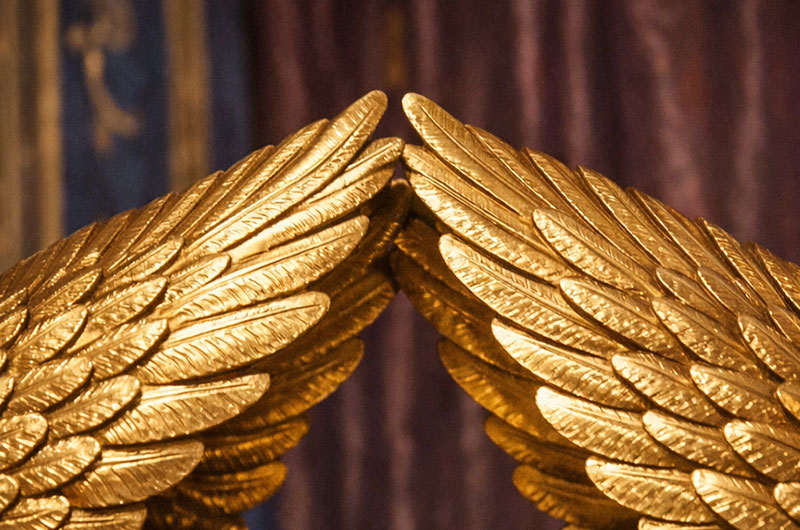
The Ark was furnished with a golden lid out of which two golden childlike Cherubs were carved out, one male and one female (25:18-20). The Cherubs spread their wings upwards and shielded the Ark. The Torah was given by G-d, but it is protected by us, in households created by husbands and wives wherein the Torah is the bedrock of children’s’ education. The guarantee of the Torah’s survival into future generations is through the mouths of nursing babes (Tehillim 8:3). It is between the two cherubs that provide this assurance of perpetual Torah transmission that G-d Himself shows up to speak to Moshe (25:22).
On entering the Tabernacle one encountered, on one’s right, the table, the Shulchan, which symbolized physical prosperity, and opposite it on the left, one encountered the Menorah, which symbolized spiritual enrichment. That is the way we humans view it. But viewed from G-d’s perspective from the Holy of Holies, the Menorah was on the right and the Shulchan was on the left, because the very purpose of financial success is to support spiritual growth.
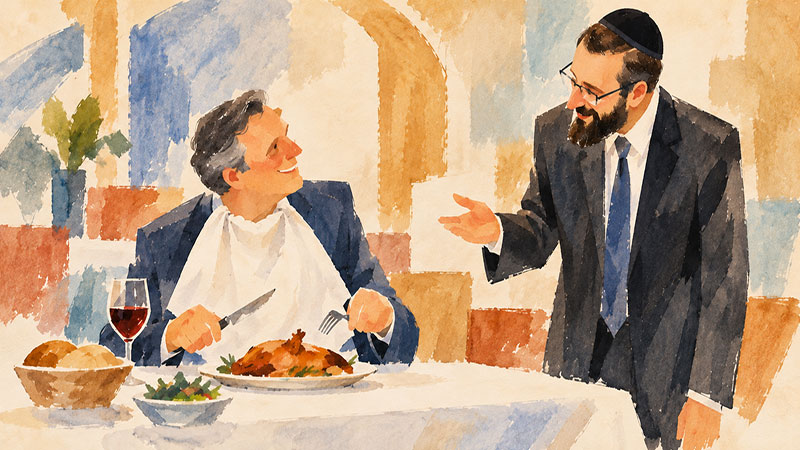
On the Shulchan were the twelve loaves of bread called the Lechem Hapanim, (25:30). Each Shabbat, the Lechem Hapanim of the previous Shabbat were removed and replaced with twelve new loaves, (Vayikra 24:8). The old loaves that were removed and eaten by the kohanim a week after they were placed there remained miraculously as fresh as the news ones that replaced them (Menachot 96b). Our tables will always have fresh bread as long as we understand that the purpose of the Shulchan is not just to feed ourselves, but to also look out that others do not go hungry. That is why the twelve loaves are called Lechem Hapanim. We should not sit down to eat before we have looked into the faces of others to make sure they are fed too.