 October 9, 2026
 Categories: Halacha & Hashkafa
Fallen Angels and Elevated Humans


Zevachim - Daf 119
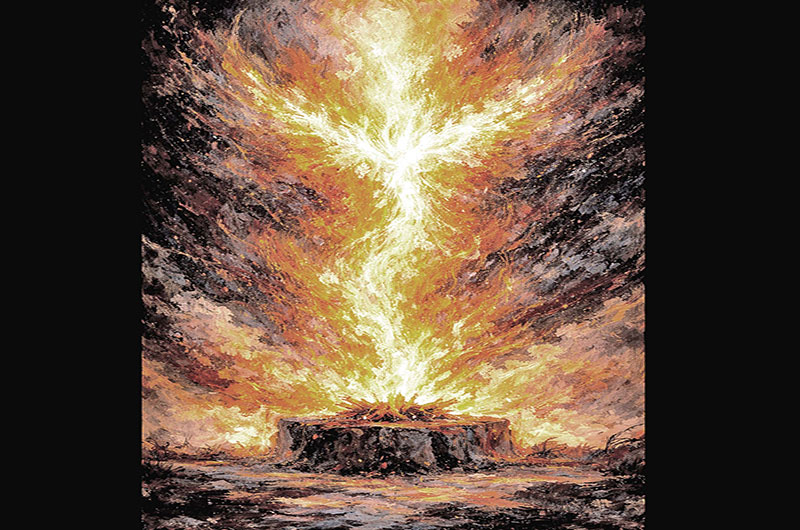
Our Gemara on amud beis discusses the sacrificial process of Manoach, Shimshon’s father. After being told that his wife would be the mother of a future savior and instructed to treat Shimshon as a Nazir, Manoach offers a sacrifice. The verse (Shoftim 13:19-20) describes what transpired: “Manoach took the kid and the grain offering and offered them up on the rock to G-d; and a wondrous thing happened while Manoach and his wife looked on. As the flames leaped up from the altar toward the sky, the angel of G-d ascended in the flames of the altar…”
Apparently, the angel miraculously ascended along with the flames, indicating acceptance of Manoach’s offering. This is not a typical encounter with an angel; other Biblical figures encountered angels without such a dramatic departure. What is the meaning of this?
Likkutei Halachos (Orach Chaim, Laws of Meals 5:49) explains that Manoach’s angel was from the same group of angels that met with Avraham. There is a mystical backstory – this angel remained trapped on earth all this time until Manoach’s era (the other two returned earlier by Yaakov’s ladder). Why were they detained?
To answer this, we must first recall the aggadah about the angels’ reaction to the giving of the Torah (Shabbos 88b). The angels were indignant that human beings should receive something so Divine. Moshe defended mankind by pointing out that the Torah addresses human struggle – work, family, temptation in its laws of honoring parents, and other civil rules.
Avraham deliberately fed the angels to expose them to human physicality. According to Likkutei Halachos, the angels had to process the mundane physicality and elevate it into something spiritual. It was not easy for them, and it took two angels until Yaakov’s time and one angel until Manoach’s time to encounter the physicality, elevate it, and be ready to go back to G-d. Avraham wanted them to experience this firsthand; then they would understand human nature, its subjective challenges, and how the earthly version of Torah is designed to help mankind. This is similar to the aggadah of the fallen angels or Nephilim (see Pirke DeRabbi Eliezer 22.)
How fitting that this culminates with the birth of Shimshon, a Nazir who lives in abstention like an angel, yet still struggled with desire.
Demonic or Demented?
Daf 120Our Gemara on amud aleph cites a verse which describes King Shaul’s encounter with a sacrifice-related sin committed by the people. The verse (I Shmuel 14:32–33) describes it as “eating on the blood,” which seems to be a reference to the Biblical prohibition (Vayikra 19:26): “Do not eat with blood.”
The prohibition is ambiguous and is actually used as a proof text for several prohibitions which are unrelated except that, in some way, they are literally or metaphorically “eating on blood.” For example, it is prohibited to eat before one prays, because it is as if one is eating while his “blood” (mortal fate) is hanging in the balance. Also, judges are prohibited from eating on the day that a person was put to death. There is also a prohibition against partaking of sacrificial meat until after the blood is sprinkled on the altar (see Rambam, Sefer HaMitzvos, Sharashim 9:5).
However, the simple meaning of the verse is a prohibition against eating blood. What is the reason for this taboo? Rambam (Moreh III:46) and Ramban (Vayikra ibid.) both explain that ancient idolaters practiced rituals involving the animal’s life force in order to obtain contact with demons for soothsaying. In fact, this is what King Shaul’s army was attempting to do as part of their intelligence-gathering during the war with the Philistines. This is why Shaul was aggrieved and exhorted them to offer a proper sacrifice and beseech G-d, not demons.
Though they agree about the prohibition, there is an important and subtle difference in the language of Ramban and Rambam. Ramban describes it as a prohibited form of demonic or witchcraft ritual without characterizing it beyond its being forbidden. However, Rambam adds a broader comment: “The Torah, which is perfect in the eyes of those who know it, and seeks to cure mankind of these lasting diseases, forbade the eating of blood, and emphasized the prohibition exactly in the same terms as it emphasizes idolatry.”
What does Rambam mean by the Torah curing mankind of “lasting diseases”?
To understand this difference, let us look at another set of verses that prohibit divination (Devarim 18:10-18):
Let no one be found among you who consigns a son or daughter to the fire, or who is an augur, a soothsayer, a diviner, a sorcerer, one who casts spells, or one who consults ghosts or familiar spirits, or one who inquires of the dead. For anyone who does such things is abhorrent to Hashem, and it is on account of these abominations that Hashem your G-d dispossessed those nations from before you. You shall be tamim with Hashem your G-d. Those nations that you are about to dispossess do indeed resort to soothsayers and augurs; to you, however, your G-d has not assigned the like. From among your own people, your G-d will raise up for you a prophet like myself; that is whom you shall heed.Taken as a whole, this passage instructs the Jewish people to refrain from using unauthorized channels to discern or influence the future. Instead, they are to rely on prophets who are sanctioned by Hashem to communicate His will. The underlying idea seems to be that magical and formulaic methods do not constitute true connection with G-d. In contrast, seeking out a prophet offers more than just foresight – it provides moral and spiritual instruction.
The Torah commands us to be tamim with Hashem. How should we understand this term? The root of tamim is related to shalem (Tav and Shin often interchange), which can mean whole, unblemished, pure, or without guile. This range of meaning is reflected in several verses:
- Shemos 12:5 – tamim, referring to an unblemished korban
- Bereishis 6:9 – “Noach was a righteous man, tamim in his generations”
- Bereishis 20:5 – indicating sincerity and lack of deceit on Avimelech’s part
- Bereishis 25:27 – describing Yaakov as an ish tam, implying innocence or simplicity
Rambam, however, takes a different stance. For him, not only are these practices idolatrous, they are also intellectually corrupt, leading to a loss of connection to Hashem. Rambam sees intellectual development as encompassing both wisdom and character. This intellectual pursuit (wisdom and character development) facilitates attachment to G-d, since it represents humanity’s highest resonance with the Divine. But corrupt beliefs lead to corrupt behaviors, and ultimately to spiritual disconnection.
In Hilchos Avodas Kochavim (11:16), Rambam writes: “All the above matters are falsehood and lies, with which the original idolaters deceived the gentile nations in order to lead them astray… Whoever believes in such things and considers them to be true – just forbidden by the Torah – is foolish and feebleminded… For this reason, when the Torah warns against these false matters, it commands: ‘Be tamim with Hashem your G-d.’”
Here, tamim means intellectual and spiritual wholeness, not naïveté. The Torah is commanding refinement of belief so that one can properly relate to Hashem.
Rambam did not view superstition as merely religiously problematic, but as socially destructive. In a remarkable teshuvah (Ma’amar Chozim Be-Kochavim), he asserts that the true reason the Beis HaMikdash was destroyed was that Jews began relying on astrology. This led them to neglect rational military planning in favor of baseless predictions.
Rambam outlines three valid sources of belief:
- Logical proof
- Sensory perception
- Reliable tradition from sacred texts or righteous sages
This message remains profoundly relevant today. Even if modern society is less overtly superstitious, we are still vulnerable to intellectually and morally undeveloped worldviews that obstruct genuine wisdom and true attachment to Hashem.