 October 9, 2026
 Categories: Headline / News & Views
Federal Court in Md. Pauses Gun Ban Against Local Shul


The enforcement of a Maryland county law against Silver Spring Jewish Center, which would have restricted concealed carry in “sensitive places” such as houses of worship, was put on hold by Maryland District Court Judge Deborah K. Chasanow last Thursday while a challenge is being heard. The 72-page memorandum opinion came just one day before Rosh Hashanah and the heightened security fears that the High Holidays now bring.
“We think it’s a pretty good sign,” plaintiff Rabbi Menashe Shapiro told Bethesda Magazine. “While we didn’t get full relief at this preliminary stage, we think the seeds have been sown for a substantial victory.” Shapiro is a student at George Washington University Law School and is representing himself in Silver Spring Jewish Center, et al. v. Montgomery County. The New Civil Liberties Alliance (NCLA) is representing the Silver Spring Jewish Center in this case. “We now have the ability to ensure the protection of our institution as we go into this critical time [of Rosh Hashanah],” Shapiro told JNS.
Expedited Bill 23-26 was enacted in response to New York State Rifle & Pistol Association, Inc. v. Bruen, a 2022 Supreme Court case that struck down New York’s requirement that one have a “special need” to obtain a concealed carry permit. Shapiro and the Orthodox synagogue sued the county on July 30, three days after County Executive Marc Elrich, a Democrat, signed the bill into law.
In issuing a preliminary injunction against the enforcement of the Montgomery County concealed carry ban, the Court expressed its belief that the plaintiffs would succeed on the merits. The Court did not address the freedom of religion prong of the plaintiffs’ challenge to the law, nor did it address a “buffer zone” law prohibiting guns within 100 yards of houses of worship. For now, the latter measure stands, and the Court’s injunction applies only to the plaintiffs and not to any other synagogues or other houses of worship in the county.
Expedited Bill 23-26 applies even if someone is lawfully carrying a firearm with the consent of the property owner. Thus, the plaintiffs argued that Montgomery County’s gun ban could prevent volunteer security members from traveling to or from the synagogue with firearms. Mark Chenoweth, president and chief legal officer of the NCLA, said that Expedited Bill 23-26 denies synagogue worshipers their Second Amendment right to bear arms to defend themselves in the current antisemitic climate. “[Montgomery County’s] interference in the internal management of a place of worship violates the First Amendment [freedom of religion] too,” he said. Before the preliminary injunction was granted, Montgomery County State Attorney John McCarthy agreed not to press criminal charges under the law while the case is pending. As a result, the plaintiffs voluntarily dismissed McCarthy as a defendant in the case.
A similar case to the Silver Spring Jewish Center challenge was filed in August by the United States Department of Justice against Montgomery County over Expedited Bill 23-26 in U.S. District Court in Maryland. The Justice Department called the 100-yard buffer zones “arbitrary,” arguing that the ordinance violates the Supreme Court’s recent decision in Wolford v. Lopez, which held that a law that bans citizens from carrying firearms into “places that people routinely visit in the course of their daily routines… hobbles what the Second Amendment protects: the right of Americans to carry arms for self-defense as they go about their daily lives.”
That decision put the kibosh on attempts in some states and cities to issue blanket gun bans in places open to the public. On September 10, the County asked a federal court in Maryland to dismiss the DOJ case because the bill “narrowed, rather than expanded, the restrictions that had been on the books for years.” A decision in United States v. Montgomery County, et al. remains pending.
Under N.Y. State Rifle & Pistol Ass’n, Inc. v. Bruen, the Supreme Court determined that laws implicating the Second Amendment must be evaluated based on a historical-tradition test. In her 72-page opinion in the Silver Spring Jewish Center case, Judge Chasanow said there is no historical tradition of banning firearms from houses of worship.
“The practice of carrying firearms to church thus goes back to the days of the Pilgrims, who thought it necessary to keep and bear arms to ensure their safety before, during, and after church services,” said Conel John Eidsmoe, senior counsel to the Foundation for Moral Law in the wake of New York’s 2022 Concealed Carry Improvement Act. In a 1627 letter, Isaac de Rassieres, Secretary to the Director-General of the New Netherlands colony in Manhattan, describes church members constantly on guard, carrying arms to and from church.
In his filings in the Silver Spring Jewish Center case, Rabbi Shapiro cited the Talmud and Shulchan Aruch, Choshen Mishpat (425:1) in arguing that Jews are required to defend themselves and their fellow Jews. In this case, volunteer security members would have to walk to shul on Shabbos through areas where, under Montgomery County’s law, they would be prohibited from passing while armed. In a statement in support, Rabbi Yaakov Greinman, the senior rabbi of Silver Spring Jewish Center, wrote that in the wake of October 7, his synagogue organized a security team and that “for practical and halachic reasons, we rely primarily on volunteer members of the synagogue.”
Indeed, at issue is not just the synagogue’s ability to hire armed security guards to protect the congregation. As Liel Liebovitz noted in Tablet Magazine recently, “If it becomes widely understood and accepted that most synagogues are filled with frightened, unarmed Jews who outsource their security, the only barrier to a successful attack is getting through that one single – and nowhere near impregnable – layer. If the public perception is that most synagogues are stacked with well-regulated minyans of trained shooters inside, that’s a much less appealing target.” Describing the difference between heavily fortified synagogues, which have long been the norm in Europe, and communities where legal gun ownership – even among Jews – is commonplace, Liebovitz wrote:
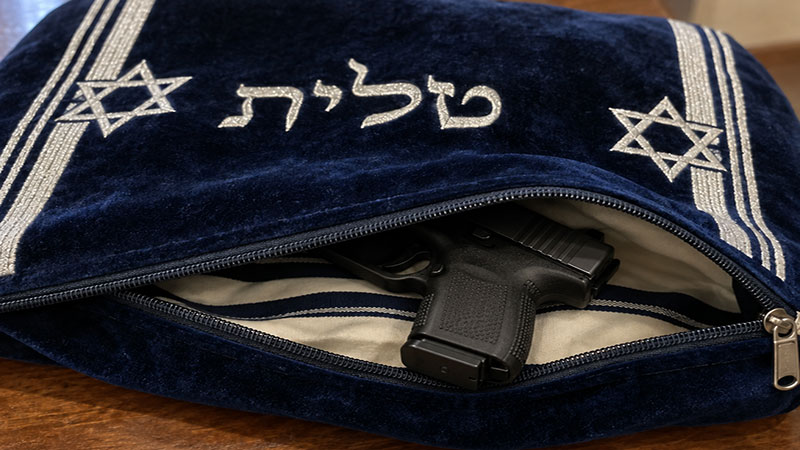
“In the former…the experience feels like walking into a war zone, not a house of worship. And then there’s Texas, where some synagogues have a guard posted somewhere on campus but don’t really need it because multiple gentlemen davening inside have sidepieces tucked neatly into their tallis bag. As a result, the entire experience feels more open, normal, and free.”
Eli Davidovics, CEO and co-founder of Six Point Security, a private security firm whose website says it was founded by “former operatives of Israel’s Diplomatic Security, Police, and IDF Elite Special Units,” told The Jewish Press: “In general we are proponents of people who are well trained and responsible and mentally stable having the ability to carry a gun for protection of themselves and their families.
“When you get to discussions about carrying in a shul or other institution with large crowds, the issue is more delicate. You need to ensure that the person is much better trained, has trained in that facility, trained with the rest of the security team, and the firearms are only one component of a solid security posture. (There's no point, for example, of people carrying guns if the doors are regularly left open and the cameras are broken.) …
“We are generally opposed to just regular untrained congregants carrying without coordinating with the rest of the team and training together. If they do train and they're part of the team, then definitely there's a place for it.”
Davidovics added that Six Point Security has been running such training programs for over ten years.
Expedited Bill 23-26 treats houses of worship differently from other private properties where owners can decide whether or not to allow guns on their premises. Judge Chasanow looked favorably at a Second Circuit Court of Appeals panel decision consolidating four cases in which New York’s ban on carrying guns in places of worship was struck down under the First Amendment. That decision, Antonyuk v. Chiumento, determined that New York’s Concealed Carry Improvement Act, which included houses of worship on the list of “sensitive locations,” burdened religious practice in a non-neutral manner and was therefore subject to strict scrutiny. The Second Circuit found that “the State has not demonstrated that allowing church leaders to regulate their congregants’ firearms is more dangerous than allowing other property owners to do the same.”
Most states treat houses of worship as ordinary private property, meaning that licensed gun owners can carry their firearms unless the institution posts a sign prohibiting guns on the premises. Laws vary, however, for houses of worship connected to schools – which are gun-free zones under federal law. Some states enforce 24/7 bans while others make exceptions during non-school hours. Notably, Nebraska limits the carrying of guns in houses of worship to designated security personnel. California’s attempt at a blanket ban on concealed carry in “sensitive places,” including houses of worship, was blocked by the Ninth Circuit. And in the aforementioned Wolford v. Lopez case, Hawaii attempted to ban firearms on all private property without the express permission of the owner (a provision known as a “vampire rule”), but the U.S. Supreme Court struck down the statute in June. The synagogue in the Silver Spring case argued that Montgomery County’s ordinance is even more restrictive than Hawaii’s failed legislation.
Judge Chasanow found that at this preliminary stage, the plaintiffs had met their burden of proving that Montgomery County’s law burdens their free exercise of religion under the First Amendment. The defendant claimed that congregants may have a right to defend themselves, but that the County can tell them which instrument of self-defense they may use. “This is insane,” said constitutional law attorney Mark Smith on his Four Boxes Diner YouTube show, which focuses on the Second Amendment. “As Jews face increasing threat of attack, they are being told to use a lampshade, throw a Talmud, but you can’t use a gun.”
For the time being at least, the Court’s preliminary injunction protects Silver Spring Jewish Center congregants’ constitutional rights and security needs. However, while the lawsuit proceeds, enforcement actions may still proceed against others found to be violating the county’s ban.
A spokesperson for the Montgomery County Council told The Jewish Press: “Public safety is one of the Council’s top priorities, and law enforcement needs the ability to take illegal firearms off our streets to keep our communities safe.... We remain hopeful that the ultimate resolution will protect the County’s ability to regulate public safety and protect our residents.”
Additional reporting by Ziona Greenwald.