 October 16, 2026
 Categories: Book Reviews / Features / Headline
Freed Hostage Eli Sharabi Talks about Survival & His Award-Winning Book
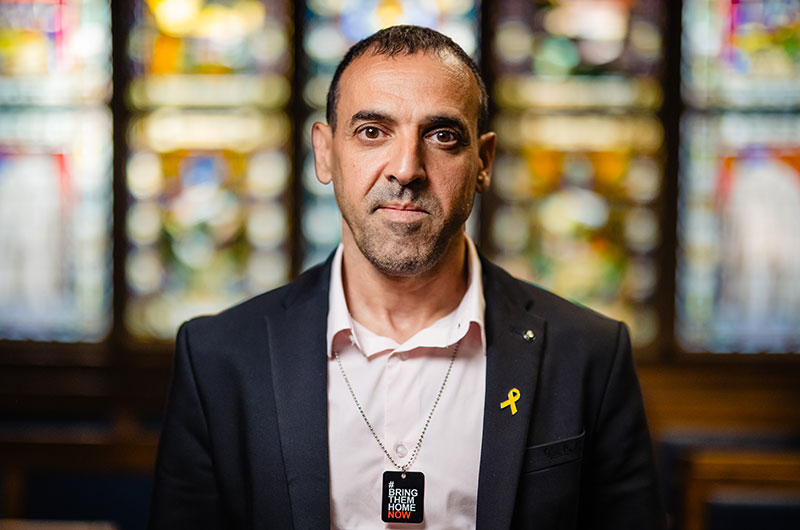


In his monumental book Hostage, recently named “Jewish Book of the Year” by the Jewish Book Council, Eli Sharabi writes that after surviving 491 days in Hamas captivity in Gaza, during which he was beaten, starved, and chained, he stood on a stage in front of a huge crowd in Gaza as cameras broadcast him being taken by masked terrorists with machine guns who asked how he felt about shortly reuniting with his wife and two daughters.
He realized the terrorists were lying when an IDF member said his mother was waiting for him. This meant that his wife of 23 years, Lianne, and teenage daughters, Yahel and Noiya, had been murdered.
In an interview with The Jewish Press, Sharabi said that while Hamas was cruel to lie and tell him his family was alive as a means of psychological torture, the thought that they were alive had fueled him to fight during the long time of his captivity.
“I thank G-d nobody told me in the 491 days about my wife and daughters,” Sharabi said. “I think it would have hurt my chance to survive.”
In his book, published by HarperCollins and a New York Times bestseller, he writes of the harrowing moments when terrorists came to his home in Kibbutz Be’eri on October 7, 2023. They separated him from his wife and daughters, but he told them he’d be back. He thought his wife’s British passport might help. It didn’t.
Hostage, which sold a record 20,000 copies in Israel in its first five days of release, is written so vividly, readers will feel like the horror is happening to them. In one surreal scene, he describes being taken out of the car while blindfolded.
“I hear a noisy crowd, ecstatic, and suddenly hands start pulling me,” he writes. “Many hands. I’m being dragged into a sea of people who start thumping my head, screaming, trying to rip me limb from limb. They’re fighting over me. Cursing and whistling all around. I can barely breathe. I’m a goner…”
But Hamas terrorists pulled him away. He’d first stay in a building with a Thai hostage who didn’t speak Hebrew or English. Sharabi’s fluency in Arabic allowed him to communicate well with the terrorists, who after 52 days transferred him to the tunnels, which he first refused to go down into, but was forced to.
What was it like to talk to the people holding him captive?
“We had many conversations,” Sharabi said. “You live with them 24/7. You have a delicate relationship. You need to be very careful of what you say. You listen to them on the phone when they speak to their families. You can see also they have a normal life with their family and kids and things that they’re caring about.”
One time, when he spoke out in a gut reaction, there was a punishment of less food, which would often be only a stale pita. The hunger pains for him were worse than the pain of being kicked in the ribs and being chained.
And he will never forget something they’d often repeat.
“They said it doesn’t matter if the war is finished, and if we will be released, if it’s a year, two years, or three years later, they will come to Israel to kill us all,” Sharabi said. “The next thing they will do is come to the U.S., France, and the U.K. because Islam should be the only religion in the world. You just look at them, and you wonder how brainwashed they can be.”
Shortly after being brought in the tunnels, Sharabi met Ori Danino, Almog Sarusi, and Hersh Goldberg-Polin, who had lost an arm when attacked with grenades in a shelter after fleeing the Nova festival.
Sharabi praised Goldberg-Polin for sharing a key to survival, telling them that “he who has a ‘why’ can survive any ‘how.’”
Sharabi, 54, said Goldberg-Polin, 23, was impressive. “To see someone without an arm was very shocking in the first few moments,” Sharabi said. “I found him to be an amazing, modest, intelligent guy. I was amazed how he could speak calmly in this situation. I wish I had more time with him and I wished he was left with us so we could have survived together.”
Goldberg-Polin became the face of the hostages in America – he had lived in Virginia before moving to Israel in 2018, Hamas released a hostage video that showed him begging for his release, and his parents, Jon and Rachel, campaigned for him and all the hostages extensively. His body was found at the end of August 2024, in a tunnel in Rafah, along with the bodies of Danino, Sarusi, Eden Yerushalmi, Alexander Labanov, and Carmel Gat. The IDF has stated that Hamas executed them only a day or two before Israeli forces arrived there.
Sharabi became a father figure to fellow hostage Alon Ohel, whom Sharabi advocated for in an emotional speech at the United Nations on March 20, 2025. Ohel would eventually be released. Sharabi said while he’s been in front of many crowds who have cheered him, “the U.N. was one of the most important places I’ve ever been since my release,” as he was able to tell his story. He was also with Eliya Cohen and Or Levy, who were released.
Sharabi said it was important for him to write Hostage to let people know the true story of what happened, and he’s aware that people will spread false narratives.
“I needed to write this,” he said. “This is my testimony and I will not let anyone in the future change the facts.”
Hostage is one of the most powerful books I’ve ever read due to the vivid imagery and emotional depth. It is a book that should be read not only by every Jew, but every person of good conscience, and even people who are evil. One of its strengths is there is no self-pity, there is great emotional depth, and strangely there is a lack of fury or desire for revenge. Another strength is that it is sharply worded, with no fluff. Sharabi also weaves in small victories, like drinking a Fanta soda bottle before a terrorist could drink it, then denying it was there.
The book begins with the separation from his wife and daughters and ends with him at their graves, crying for 40 minutes and understanding he must live his life because he is alive.
“I try not to be angry about anything,” Sharabi said. “I try not to deal with feelings that will hold me back. I always look forward.”
Sharabi said he was hopeful for peace before October 7, and after, he is still hopeful, though he knows it would take time. He said members of his kibbutz and the surrounding ones had a history of donating money and food to those in Gaza.
“We took some kids from the border to get medical treatments in Israeli hospitals,” he said. “October 7 for all of us was a very brutal and cruel wakeup call. But we still believe one day in our future, there will be peace in the area with all our neighbors. But a lot of things need to be changed. You cannot let a terror organization be in control of people. They want to kill us and bring darkness to our area. It will be a process where there needs to be reeducation about Israel as a state because they are brainwashed in schools and in mosques. It’s very sad.”
He said his most fearful moments were when he was taken from his family, when he was nearly lynched, and when he had to go down in the tunnels.
As for Hamas and the sadistic interviews of hostages prior to the release, he said “it was the last humiliation” when he stood on the stage with Or Levy and Ohad Ben-Ami.
“We didn’t really care what we were being asked or what we were going to answer – we just wanted to be transferred to the Red Cross, then the IDF,” Sharabi said. “It’s what we dreamt of.” They were released on February 8, 2025.
Sharabi’s wife Lianne met him while visiting Israel from Bristol, England, and while she only intended to stay a short time, they fell in love. He said his wife sang Amy Winehouse songs at kibbutz events.
What was Sharabi’s reaction to the news of the assassination of the leader of Iran, who used Hamas as one of his proxies?
“Some people just look at it as a war,” Sharabi said. “It’s a historic time. We want the Iranian regime to fall. It would be a great thing. It’s a great opportunity to have something different in the Middle East in the future.”
Sharabi said that at a time of rising antisemitism, people should embrace their identity.
“Be proud to be Jewish,” he said. “We are going to continue to spread our light against all this darkness.”
In one especially moving section of his book, he mentions how people take for granted the ability to open the fridge and freely have a piece of fruit. In one of the most heartbreaking openings to any book you will read, he recounts how he told his daughters, 16 and 13, not to be afraid. They did not scream or cry, and he writes that he will never forget the terror in their eyes.
Sharabi dedicated the book to his wife and daughters, murdered on October 7, and his brother, Yossi, killed in captivity. Yossi’s body was returned to Israel four months ago.
Sharabi moved to Kibbutz Be’eri from Tel Aviv as a teenager and said the managerial role he had gave him skills that came in handy as a hostage. He has said that in order to move on with his life, he will not be moving back to the kibbutz.
He added that writing the book was therapeutic and he’s received enormous support from people who have been moved by it, including some with post-traumatic stress disorder.
He also said that people should focus on what is really important, which became abundantly clear during his captivity.
“It’s never material things,” Sharabi said. “You never miss your car, your house, or how much money you have in the bank account. You miss your family and friends, and you’d be willing to do anything to have even five more minutes with them.”