October 2, 2026
 Categories: Perspectives / Op-Eds
From Saddam’s SCUDs to Iran’s Arsenal: The Normalization of Attacks on Israeli Cities


One fact about the current Middle East conflict should alarm the world, yet it is barely acknowledged. Iran and its proxies are deliberately firing missiles at cities – targeting Israeli and Arab civilians alike.
Instead of condemning this plainly, the so-called international community and much of the liberal media retreat into euphemisms about “escalation” or “trading strikes,” as if the deliberate bombardment of civilian populations were simply another military exchange between morally equivalent sides.
For Israel, the normalization of this kind of warfare began long ago – in 1991.
That was the year the regime of Iraqi dictator Saddam Hussein fired SCUD ballistic missiles at Tel Aviv and Haifa. For the first time in its history, Israel absorbed strategic attacks on its cities and did not strike back.
Washington demanded restraint. The administration of President George H. W. Bush feared that if Israeli aircraft struck Iraq, Arab members of the coalition fighting Iraq would abandon the war. Israel was promised Patriot missile defenses, intelligence cooperation, and assurances that the United States would deal with the threat.
Israel complied, and the precedent proved consequential.
During 39 days in January and February, Iraq launched approximately 40 SCUDs at Israel, most aimed at Tel Aviv and Haifa, damaging apartments and office buildings. Families taped plastic sheeting over windows and doors, stacked cardboard gas-mask boxes in hallways, and waited. Israelis feared the missiles might carry chemical warheads, and households across the country prepared sealed rooms in anticipation of such an attack.
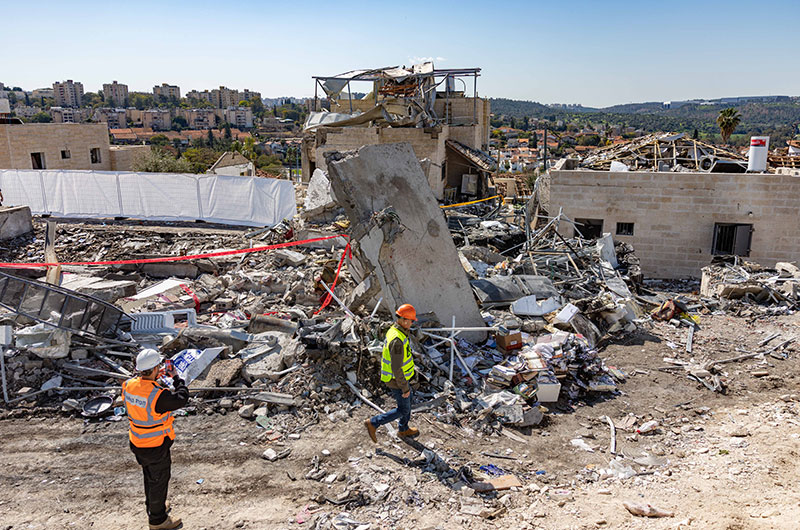
Apartment buildings in Tel Aviv and Ramat Gan were heavily damaged, with facades blown out and sections collapsing. In the end the missiles killed two Israelis, but at least a dozen more died from heart attacks, accidents, and panic linked to the emergency gas-mask drills and sealed-room preparations.
Israel’s traditional response to attack had always been retaliation. When the country was struck, it answered with force intended to restore deterrence. That principle had defined Israeli strategy since the founding of the state.
But in 1991 the Israeli Air Force – the strongest in the region – remained grounded.
In narrow military terms the coalition war succeeded. Saddam Hussein’s invasion of Kuwait was reversed and the Arab partners remained in the alliance.
But another lesson spread from the war. Israel’s military superiority remained intact, yet its cities had been placed under sustained missile attack.
Hostile states and terrorist movements drew the same conclusion: Israel could be forced to absorb strikes on its civilian population.
In the early 2000s, Hamas began launching homemade Qassam rockets from Gaza – crude metal tubes welded together in workshops. They were inaccurate and carried small warheads, but they were cheap, easy to produce in large numbers, and capable of reaching Israeli towns beyond the Gaza border.
Early Qassams could travel only a few kilometers, striking places like Sderot and nearby kibbutzim. Their shrieking warning sirens quickly became a permanent feature of daily life in Israel’s south.
Hezbollah, backed and armed by Iran, expanded the concept dramatically.
By the time it provoked the Second Lebanon War in 2006, Hezbollah had assembled a rocket arsenal in the tens of thousands. During that 34-day conflict it fired roughly 4,000 rockets into northern Israel – well over 100 a day at the peak – killing civilians, forcing more than a million Israelis into shelters or to flee their homes, and emptying streets in cities such as Haifa, Nahariya, and Tiberias.
Israel could dominate Lebanese airspace and destroy fixed military targets. Yet mobile rocket launchers allowed Hezbollah to continue striking civilian populations.
The rockets were central to the strategy.
In the years that followed, Iran transformed this approach into a regional system of missile warfare.
The Islamist regime built the largest missile arsenal in the Middle East while simultaneously exporting rockets, missiles, and drones to a growing network of proxies – Hezbollah in Lebanon, Hamas and Palestinian Islamic Jihad in Gaza, the Houthis in Yemen, and Iranian-backed militias in Iraq and Syria.
Iran developed families of ballistic missiles such as the Shahab-3, Ghadr, Emad, Fateh-110, and Zolfaghar, along with land-attack cruise missiles and long-range drones. Many of these weapons are mobile, solid-fuel systems designed for rapid launch with little warning.
When Iran launched direct missile and drone attacks on Israel, the regime was effectively executing a more accurate, higher‑volume version of what Saddam achieved – long-range strikes on Israeli territory to impose strategic costs.
Iran’s Lebanese, Shiite Arab arm, Hezbollah, built the largest non-state missile arsenal in the world. Most open‑source and Israeli assessments indicate the terrorist organization’s rocket and missile arsenal peaked sometime between about 2015 and 2023 at roughly 150,000 projectiles, ranging from short-range Katyushas to longer-range systems capable of striking every major Israeli city. Some missiles were upgraded with precision-guidance technology supplied by Iran.
Hamas and Palestinian Islamic Jihad accumulated thousands of rockets during two decades of conflict, including both locally manufactured weapons and Iranian-designed systems smuggled into Gaza or assembled from imported components.
The Houthis constructed their own missile and drone force capable of striking Saudi Arabia, the Gulf states, Israel, and shipping in the Red Sea.
Through years of steady expansion, Iran built an integrated regional strike network – tens of thousands of rockets, missiles, and drones positioned across the Middle East and aimed primarily at Israeli cities and civilian populations.
These arsenals have been repeatedly degraded in war – through successive conflicts in Gaza, Israeli campaigns against Hezbollah in Lebanon, and continuing strikes on Iranian weapons infrastructure in Syria and across the region.
The current war has inflicted some of the heaviest damage yet, destroying missile factories, launchers, storage depots, and command infrastructure. Large quantities of rockets and missiles have been eliminated.
But analysts believe substantial forces still remain.
Iran itself may still possess well over 1,000 ballistic missiles along with significant inventories of cruise missiles and attack drones. Hezbollah, though heavily degraded, likely still possesses many thousands of rockets and missiles capable of striking throughout Israel. Hamas is believed to still retain hundreds of rockets and a reduced capacity to manufacture more. The Houthis continue to possess ballistic missiles, cruise missiles, and long-range drones capable of threatening shipping and regional targets.
The system Iran spent years building has been seriously weakened, but it has not been erased.
And it was built for one purpose – to kill, maim, and terrorize civilians.
Missile defenses such as Iron Dome have saved countless lives, but they cannot by themselves restore deterrence. An adversary willing to fire thousands of rockets at cities can continue to test those defenses with larger salvos, longer ranges, and more sophisticated weapons.
Ultimately, deterrence depends on the clear understanding that deliberately attacking Israel’s population centers will bring consequences severe enough to outweigh any possible gain.
This war must restore that principle.