 October 16, 2026
 Categories: In Print / Featured / Torah
From Teshuvah to Shofar: Making Rosh Hashana Count


Parshat Nitzavim & Rosh Hashana
As was mentioned (okay, more than mentioned) last week, Parshat Nitzavim is always read on the last Shabbat of the year – the Shabbat right before Rosh Hashana. Sometimes, it’s read then on its own; other times, it is combined with Vayeilech.
Nitzavim is combined with Vayeilech when the upcoming Rosh Hashana is on Thursday (and Friday) or Shabbat (and Sunday). This is so because there is just one more Shabbat available for a Parshat HaShavua until Simchat Torah, when we will be reading Vezot HaBeracha and beginning Bereishit. So Ha’azinu, the penultimate sedra of the Torah, will be read on Shabbat Shuva (the Shabbat between Rosh Hashana and Yom Kippur), and then we are ready to finish the cycle and begin it anew on Simchat Torah.
But when Rosh Hashana is Monday (and Tuesday), or Tuesday (and Wednesday) as it is in 5786 – coming upon us fast – then we need to split Nitzavim and Vayeilech, so that Vayeilech will be read on Shabbat Shuva and Ha’azinu will be read on the Shabbat between Yom Kippur and Sukkot. (In a year beginning on a Thursday or Shabbat, there is no Shabbat between Yom Kippur and Sukkot.)
Nitzavim and Vayeilech are combined in 60.46% of years, and read separately in 39.54% of years. Note that the usually combined Matot-Masei will split occasionally to allow Nitzavim to bring us into Rosh Hashana.
* * * * *
And now to our sedra of Nitzavim.It’s the 51st of the 54 sedras; the 8th of the 11 in Devarim. It is written on 87 lines in a Sefer Torah (rank: 52); only two sedras take up fewer lines – Vayeilech and Vezot HaBeracha.
The sedra is composed of four parshiyot – one open (petucha) and three closed (setuma).
Nitzavim has only 40 pesukim – the second shortest sedra, pasuk-wise. Only its sometimes partner Vayeilech has fewer (30). Interestingly, though, its pesukim are the second longest in the Torah in words and letters (Vayeilech’s are the longest). This makes it longer than Ha’azinu and Vezot HaBeracha, in addition to Vayeilech. Ha’azinu, written in a Torah in special form of a Shir, has a lot of blank spaces, which keeps it longer than Nitzavim in number of lines in a Torah.
The bottom line (pun sort of intended): Nitzavim is one of the four shortest sedras of the Torah’s 54.
It may be short, but it is packed with important concepts and messages. Remember: it is always the sedra that brings us into Rosh Hashana – either by itself (like this year) or together with Vayeilech. And one of the main points of Parshat Nitzavim is the mitzvah of teshuvah (repentance). Devarim 30:2 states: “Veshavta ad Hashem Elokecha…” – And you will return to Hashem, your G-d, with all your heart and with all your soul, and you will listen to His voice according to all that I am commanding you this day you and your children... Certainly, this is a main reason for Nitzavim’s “task” of bringing us into Rosh Hashana and the Yamim Nora’im (Days of Awe).
Briefly, teshuvah can be described as having five components:
(1) Recognizing that what you have done (once or repeatedly; intentionally or inadvertently) is wrong – that is, a sin.
(2) Stopping the sinful behavior. (Or starting to do it, if the sin was non-fulfillment of a positive mitzvah.)
(3) Feeling sincere regret for having sinned.
(4) Accepting for the future not to continue sinning.
(5) Vidui – verbal confession to G-d. Vidui is sometimes the culmination of the teshuvah process, and sometimes it is the first step, which puts a person on the path to teshuvah.
Also, keep in mind that interpersonal sins (bein adam lachaveiro) also require one to seek forgiveness from the offended party in addition to forgiveness from Hashem.
One more thing to keep in mind: Don’t be discouraged if your teshuvah is not complete; your good intentions and partial success are important. Just keep at it.
With all this said (and all that was not said, as much can be elaborated on each of these steps), there is a glaring point to be made about the mitzvah of teshuvah: Neither the Rambam nor the Sefer HaChinuch count any mitzvot from Parshat Nitzavim. Teshuvah is not on the list of the Taryag (613) mitzvot for either of these two most famous mitzvah-counters. Puzzling.
The Rambam in Hilchot Teshuvah begins with the following statement: If a person sins... When he does teshuvah and repents... the process must include verbal confession. This vidui is a mitzvah in the Torah (counted from Parshat Naso).
The Rambam’s view of teshuvah seems to be that it is a G-d-given opportunity which a person should take, rather than a command. Certainly, teshuvah is a mitzvah, but he doesn’t count it among the 613.
Another way to look at teshuvah is as an add-on to all mitzvot, rather than a mitzvah standing on its own. For example, it is forbidden to violate the Shabbat. But if you do, you have to repent and not do it anymore. Thus, teshuvah h is part of the mitzvot of Shabbat. So too with all mitzvot.
Teshuvah, while not numbered among the Taryag, is a supra-mitzvah (and a super-mitzvah). We should use it well.
Concepts in Nitzavim (and elsewhere) that are essential if a command to repent is to have meaning include reward and punishment, free will, and the accompanying accountability we humans have for our actions.
* * * * *
What happened to Rosh Chodesh bentching this month? There is none for Tishrei – its Rosh Chodesh is eclipsed by Rosh Hashana. In davening, there are a couple of references to Rosh Hashana’s also being Rosh Chodesh, but that is not a focus of the day.The pasuk in Tehillim (81:4) reads: “Tiku bachodesh shofar bakeseh l’yom chageinu,” Blow the shofar on the New Moon (Rosh Chodesh Tishrei), on the moon’s covering, for our festival day (referring to Rosh Hashana). The reference to keseh – from the same root as kisui, covering – also explains our not announcing it in advance.
Nonetheless, the molad (New Moon) of Tishrei is most important for fixing our calendar today, when we are temporarily without a Sanhedrin (which used the knowledge of the molad to know how to question witnesses to the first visibility of the lunar crescent).
The molad of Tishrei 5786 is on Monday (September 22, our erev Rosh Hashana), 10 minutes and 7 parts (a bit more than 23 seconds) after 12 noon.
The rule for our fixed calendar is that Rosh Hashana is on the day of the molad, unless the molad occurs after noon. The molad is then called a molad zakein (an “old molad”), and Rosh Hashana is fixed for the following day. Hence, Rosh Hashana 5786 is Tuesday and Wednesday. (There are other situations that will bump Rosh Hashana to the day following Tishrei’s molad, but that’s a discussion for another time.)
It’s ironic that we announce all the other moladot of the year (which do tell us things), but not the most important one for the calendar. We might not announce it, but we do calculate it and use it well.
Rosh Hashana falling on Tuesday-Wednesday is the rarest of the four possibilities, occurring only 11.51% of years. The last time we had a Tuesday-Wednesday Rosh Hashana was four years ago; the next scheduled one is 20 years from now. (Note, though, that with the restoration of a Sanhedrin and its role in setting the calendar, the days of the week for Rosh Hashana cannot necessarily be predicted in advance.)
* * * * *
Number-wise, Rosh Hashana has (at least) two areas of interest.Our weekday Amidah has 19 brachot; the Amidah of Shabbat and Chagim has 7 brachot. The Mussaf of Rosh Hashana (on each day) has 9 brachot. The first three and last three brachot of the Mussaf Amidah are the same as always (with additions and one crucial ending-change for the ten days from Rosh Hashana through Yom Kippur). However, the middle three brachot are unique.
The first is Malchiyot – consisting of text and pesukim concerning G-d’s Kingship. The second is Zichronot – text and pesukim focusing on remembrances, including Hashem’s promise to No’ach, His taking us out of Egypt, and more. And the third is Shofarot – again, text and pesukim about events in which a shofar plays a role.
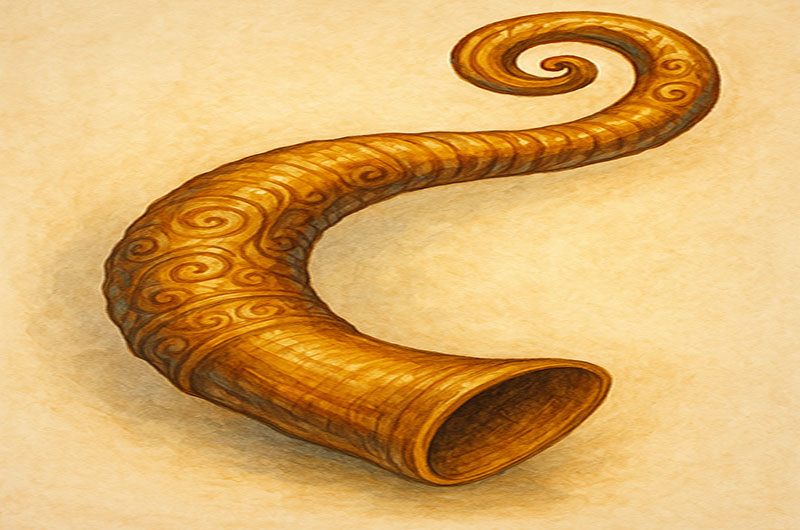
The other number focus of Rosh Hashana pertains, of course, to shofar-blowing.
The Torah commands us to hear the shofar on Rosh Hashana with a slightly vague wording: “Yom Teruah tihyeh lachem” – You shall have a “Teruah Day” (on the first of Tishrei, and, by Rabbinic decree, on the second day as well). The Torah’s command is to hear the sound called Teruah three times, each time to be preceded and followed by a Peshuta, a long monotone blast which we call Tekiah.
Because of the uncertainty of what a Teruah sound is, we have what we call a Shevarim, a Teruah, and the combination of Shevarim-Teruah. Each of these has a Tekiah before and after it. This requirement results in what we call 30 kolot. That’s three TASHRATs (Tekiah, Shevarim-Teruah, Tekiah); three TASHATs (Tekiah, Shevarim, Tekiah); and three TARATs (Tekiah, Teruah, Tekiah). These 30 blasts of the shofar are considered to be the fulfillment of the Torah's mitzvah of “Yom Teruah tihyeh lachem.”
Our Sages discussed and debated whether the 30 kolot should be sounded at one time or should be divided among the three theme-brachot of the Mussaf Amidah.
So we do both. We make the brachot and blow a full set of 30 blasts after the haftara and before Mussaf. Then we blow 10 kolot (one each of TASHRAT, TASHAT, and TARAT) for each of Malchiyot, Zichronot, and Shofarot.
The question is: In which Amidah – the silent one or the repetition?
Everyone agrees on the repetition, Chazarat HaShatz. Some also blow during the silent Amidah. Those who do so will hear 30 before Mussaf, 30 during the silent Amidah, and 30 during the repetition. Those who don’t blow during the silent Amidah will hear a total of 60 kolot during the chazan’s repetition.
Our Sages decreed that we should hear 100 shofar-blasts on each day of Rosh Hashana. To accomplish this, the 90-kolot communities will add ten more blasts (one small set) after the repetition of the Amidah, and the 60-kolot shuls will add 40 kolot after the Repetition.
The weaving of the shofar blasts and the davening add meaning to both.
When shofar is blown for a homebound person, 30 kolot are sufficient to fulfill the Torah’s mitzvah.
There is more – oh, so much more. But let’s save some for next year.
Shabbat Shalom, K’tiva Vachatima Tova, and Shana Tova U’metuka*!
*The Kotzker Rebbe would explain the significance of the word U’metuka (And Sweet) in the greeting for the new year as follows: Saying Shana Tova, asking Hashem that the coming year should be good, is fine, but everything that Hashem does is good and for the good – including things that we perceive as not so good. So we ask Hashem that the good new year should also be sweet for us.