 November 6, 2026
Categories: Headline / Parsha / Torah
Gam Zu LeTovah


Parshas Chayei Sarah
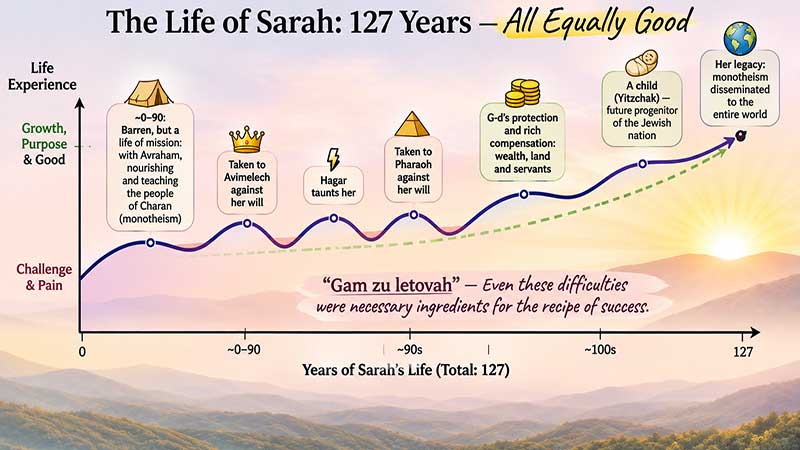
“And the life of Sarah was for 127 years, were the years of Sarah’s life” (23:1). Why does the Torah repeat the word “chayei,” the life of Sarah? Rashi answers this question and tells us that all the years of her life were equally good. What does this mean? Wasn’t she barren for 90 years? Didn’t Hagar taunt her about her plight? Wasn’t she taken against her will by Pharaoh and Avimelech?
All true. But Sarah was able to accommodate these trying events and understand that they all led to an ultimately good and successful life. During the years she had no children, she was able to dedicate herself, together with her husband, to nourishing the bodies and souls of the people in Charan whom they turned into monotheists. Not only did G-d protect her from the unwanted approaches of Pharaoh and Avimelech, but she was given riches, land and servants as compensation. Ultimately, she was given a child who was to become the progenitor of the Jewish nation which would disseminate her and her husband’s idea of monotheism to the entire world. Considering her life as one complete organic unit, she was able in retrospect to say “Gam zu letovah,”even thesedifficulties were necessary ingredients for the recipe of success.
“Avraham came to eulogize Sarah and to weep for her” (23:2). Usually when someone dies, the first reaction is to cry. After drying one’s tears, one collects one’s thoughts and eulogizes the deceased. In the case of Sarah, however, we are told that the tears came after the eulogy. Well, Sarah was 127 years old and so here death could not have come as a shock. What does one expect from a person that old? It is only after the eulogy, when one is made aware of the person’s virtues and accomplishments and how the good deeds of the deceased protected the living – like how with the death of Miriam the wells dried up and with the death of Aharon the clouds of protection disappeared – that one feels the loss. A life well led is one that was dedicated to helping others so that the passing of the benefactor brings tears not only to their immediate kin, but to the wide circle of people whom they served.
“Give me a possession of a burial place with you so that I can bury my dead” (23:4). The people of Chet made Avraham a generous offer. They were prepared to gift Avraham, a long-standing resident of Hebron, a choice free burial place for Sarah (23:6). But Avraham wanted an achuzas kever, a plot of land that he could call his own. Avraham understood the meaning of the words “the Kena’ani then dwelt in the land” (13:7). The land of Israel did not yet belong to Avraham and he wanted to make sure that no one would ever challenge his rights to that little burial place called Me’arat Hamachpelah. So he insisted on paying top dollar for it.
“For a full price Efron should give it to me, for a possession of a burying place among you.” The Torah does not use the words “sell it to me,” even though Avraham is offering an inflated price. It uses the word “give it to me” as if it were given to him as a gift. The point is that Avraham was aware of what the Talmud tells us, that people who sell their land do so grudgingly because they need the cash, not because they want to rid themselves of their prime investment (Bava Basrah 64b). As such they will take the first opportunity to challenge the sale once they come upon better times. Avraham did not want to chance that. He wanted an unchallengeable right to the land that was not yet given to him by G-d. He wanted to pay so much for the land that Efron would be delighted to “give it to him” willingly, and not sell to him reluctantly.
And Avraham was old, “ba ba’yamim.” At the age of about 140, Avraham was no longer counting the years of his life. He was counting the days. If it happened to Sarah, it could happen to me tomorrow and I have neglected one of my paternal duties, to help my almost forty-year-old son find a wife (Kiddushin 29a). But he does not want his son Yitzchak to marry a girl from Kena’an. He would rather look for someone in Charan, the place he lived in for so many years, the place where he had converted so many people to monotheism, “es hanefash ahser asu beCharan” (12:5).
But he cannot send Yitzchak there. Yitzchak will never be allowed to leave the land of Kenaan, not even for a moment. He is the permanent resident in the land that will become Israel. Any interruption in that permanent residence will break the chain of the Jewish claim to the land. So he sends his trusted servant Eliezer on a mission to go to his country and his kinsmen to find a wife for Yitzchak there.
In fact, Avraham knew that he had a grand niece called Rivkah in Charan. He had been told this after the Akeidah. He had been given news about his long-lost brother Nachor, whom he had not seem for over 62 years (Rashi to 25:20). G-d told him that Nachor’s wife, Milka, gave birth to Besuel, who in turn had a daughter called Rivkah (22:22-23).
In asking G-d for help to find a wife for Yitzchak, Eliezer beseeches G-d, “Make it happen for me today” (24:12). The word the Torah uses for make it happen is “hakrei.” Hakrei can be spelled with the letter hei like it is spelled here, or it can be spelled with an alef,which is the way it is usually spelled. When spelled with a hei, it means that something will happen in a natural way. When it is spelled with an alef it means that it will happen in a miraculous way. Eliezer does not want Avraham to be charged with the cost of a miracle. So, he asks G-d to crown his own human efforts with success.