 October 16, 2026
 Categories: Headline / Parsha / Torah
Greeting Fate


Ki Teitzei
“If you see a beautiful woman among the prisoners and desire her, you may take her for a wife” (21:10). The permission given by Torah for the Jewish soldier to have relations with the captive woman comes with conditions attached. The Hebrew word “vechashakta,” which comes from the root “cheshek,” desire, contains the same letters as the word “sechok,” which means a game. Your relationship with this woman must be a serious one which ends up in commitment, not a game which satisfies your immediate desires and culminates in her abandonment. You must take her for a wife by accepting upon yourself a lifetime of responsibility involving all of the duties a man owes his spouse.
“If you see your brother’s ox or sheep going astray, do not look away. You must help and carry them back to him” (22:1) The words “Vehisalamta mei’hem” seem out of place. Should it not have said “velo tisaleim mei’hem,”you should not ignore them, rather than you should ignore them? And if you should ignore them, why does it say that you should return them to their owner?
Chazal tell us that there are situations where one may legitimately look away. For example, a talmid chacham for whom it would be degrading to be seen carrying a lost animal, is halachically exempt from lending a helping hand. But the halacha defines only what you are obliged to do. It does not define what you can volunteer to do. Societies which run on the black-letter law alone and ignore the importance of empathy are doomed to disintegrate. We are told that Jerusalem was destroyed because they limited their decisions to the letter of the Torah law (Bava Metzia 30b.)
Sure, the talmid chacham has the right to look away. But what is his duty? He should extend himself and follow the example of Rabbi Yishmael the son of Rabbi Yossi. He came across a wayfarer who was resting on the road after having unloaded a heavy bundle of wood off his back. The wayfarer asked Rabbi Yishmael to lift the load off the ground onto his back so that he could continue on his journey and reach the marketplace where he could sell the wood. Rabbi Yishmael was not able to do that. But neither did he walk away. He did the next best thing. He bought the bundle of wood from the wayfarer and left it on the ground for others to take (Ibid).
Each Rosh Hashanah we beseech G-d to show us clemency and not throw the book at us. We will be in a much better position to ask for this treatment from G-d, if we did not throw the book at others.
“If you come across a bird’s nest, chase the mother away before taking the chicks” (22:6). The word “yikoreh” is sometimes written with the letter Heh at the end and sometimes with the letter Aleph at the end. When there is a Heh it means you happened to run into something, but it was not inevitable that you would. When it is written with an Aleph, it means that it was preordained that this meeting would take place. In this instance of Kan Tzipor, it is spelled with an Aleph. This encounter with the bird’s nest was not serendipitous. It was destined to happen so that you should mend your ways. Perhaps you have not shown compassion to your fellow humans as much as you should have. By bringing you face to face with a situation in which you are commanded to show mercy, you should draw your own conclusions: If I must show mercy to a bird, how much more must I do so to a human being.
If you show such mercy, you will live long. We know from the list of acts of kindness that we read each morning in the prayer of Eilu Devarim, that kindness to our fellow humans leads to a long life, and we know it from this passage in the Torah, too. If you show such compassion to creatures, you will not only be rewarded with a long life, but you will enjoy the long list of rewards that the Torah enumerates in the verses that immediately follow the laws of Kan Tzipor. You will build a new house (22:8), own a vineyard and a field, and don beautiful clothes (22:12) (Rashi to 22:8).
“If you build a new house, you must install a guard-rail around your roof lest one who deserves to fall will fall from it” (22:8 with Rashi). Chazal tell us that that the words the Torah uses, “yipol ha’nofel,” mean that the victim was destined to fall. We know that it is already decided before one is born, when and where one will die and there is no way of avoiding or postponing fate. If that is the case, why must one bother installing a fence? The accident is destined to happen anyway. The answer is that one should not volunteer to be G-d’s executioner. One must do everything in one’s power to prevent the accident from happening even if it predestined to occur. One must use one’s lifetime preparing for the day when one can surrender to fate with the honor of knowing that one’s days were well spent.
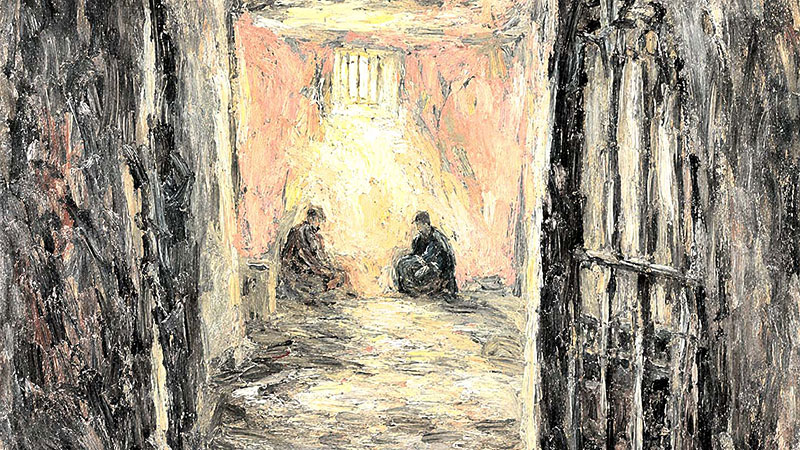
It is like the story of Rabbi Akiva and Pappas Ben Yehudah. Pappas asked Rabbi Akiva, who was teaching Torah against the edict of the Romans, how he could take such a risk? Later when Rabbi Akiva was caught and thrown into jail, he met Pappas there who was arrested for some petty crimes. They both wandered how they, who led such different lives, had ended up in the same cell. But their fate had been preordained. There was nothing they could do to avoid it. The only thing they could do was to work on themselves during their lifetimes so that by the time they met their fate, they would be worthy human beings. Rabbi Akiva arrived in the cell knowing he had led a meaningful life teaching Torah. Pappas arrived at the same place by breaking the law for his own enjoyment.