 October 23, 2026
 The Teshuvah of Elul: Returning the Hei


Our Sages teach that Elul, the month leading into the awesome days of Rosh Hashanah and Yom Kippur, is an acronym for a verse from Song of Songs: “Ani l’dodi v’dodi li” – I am to my Beloved as my Beloved is to me.
The King in the Field
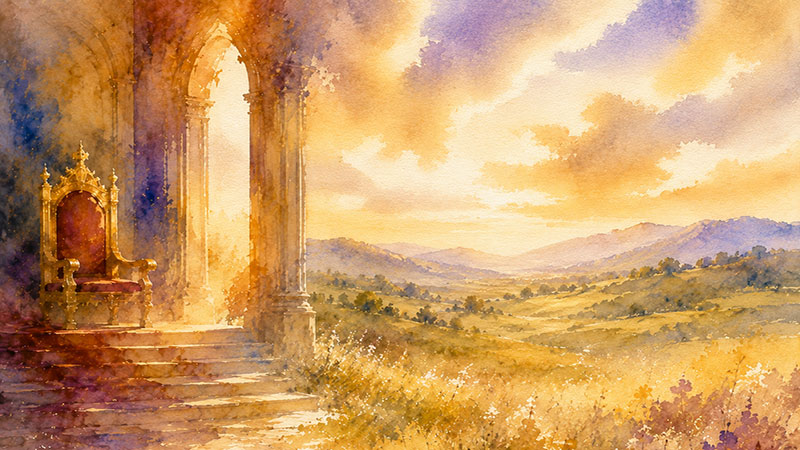
The early generations of chassidim teach that this is a month that “the King is in the field,” and is filled with immense joy and potential for closeness and renewal. The BaalHaTanya, Rebbe Schneur Zalman of Liadi, explains these days with a parable:
All year long, the king of a particular region remains in his castle, overseeing and ruling his nation from a distance. Once a year, however, he leaves his royal chambers and takes a stroll amid his people to interact with them more intimately.
Elul is a time to experience a connection with G-d that we may not feel is as accessible during the remainder of the year. For a brief period – a mere 30 days – the King of kings comes out to offer each of us a personal invitation to embark on a new journey together. We don’t have to ascend to the palace, or discard any of who or what we are; G-d comes to us, in our spaces, on our terms, just as we are.
We tend to incorrectly associate the month of Elul with feelings of trepidation, viewing it as a time for remorse over any wrongdoings we may have mistakenly committed during the past year. While there is indeed an element of this, it would be wrong to associate these days solely with strict judgment and regret. While we should undoubtedly consider Elul to be an exceptionally auspicious time for reviewing and mending our actions and priorities as we transition into the new year ahead, we cannot spend the totality of our time remaining fixated on what has already occurred. Elul reminds us that G-d created us to be human, not angels, and that the mistakes we might make as we develop are part of the journey we call life.
The Art of Teshuvah
Judaism’s revolutionary philosophy of teshuvah, often dangerously mistranslated as “repentance,” literally means “returning.” It’s a profoundly personal journey back to the point of potential within each of us before we became involved in any particular experience. Our Mystics explain that the word teshuvah is comprised of the Hebrew words “tashuv Hei,” the returning of the [Hebrew letter] hei, and that there are actually two different types of letter Hei: a symbolically lower Hei, representing intellect, and a symbolically higher Hei, representing action. G-d’s holiest name, Havaya, contains four Hebrew letters: Yud, Hei, Vav, and a second Hei, and the BaalHaTanya teaches that each of these letters signifies both how He manifests in the finite universe, and how we each interact with that reality as individuals.
The Yud represents G-d’s initial, impulsive desire to create a reality other than Himself, as well as our own moments of inspirational epiphanies that crop up in life. The Yud mirrors the Divine energy of chochma, wisdom, which is composed of the Hebrew words “koach mah” – the capacity of what – because wisdom is, essentially, only the raw potential for the greatness that we can achieve. The first Hei symbolizes the Divine energy of bina, the intellectual processing of how Creation would come to fruition – a necessary step because our wisdom can be dangerous if we don’t process our impulses and ensure that we are channeling them toward appropriate pursuits. The Vav acts as the connector, where Creation begins transitioning from abstraction into the tangible reality of the six lower, emotional Divine energies. Without these diverse channels, our ideas and ideals remain locked in our intellect; growth can only be lasting when we feel emotionally drawn toward that transformation.
And finally, the second Hei is G-d’s second planning phase – this time in more practical ways than when He first began conceiving His aspirations for Creation. This latter Hei helps us ensure that our emotional drives are suitable to support us in achieving the most righteous outcome. It’s in this Hei that we birth a new reality.
Our Mystics teach that Creation occurred through a process of contraction and concealment, known as tzimtzum, beginning with an idea and desire to see a finished product unfold. Veiling Himself within these many layers of concealment, G-d became able to give His initial desire width and depth until it became fully expanded as, and entangled in, the finite universe we know of today.
Somewhere in this evolving, downward chain of Creation, however, the final Hei in G-d’s name became disconnected from its preceding letters, and reality became fragmented. In an ideal state, we always feel and act wholesomely, and our minds, hearts, and actions are continually in sync and work harmoniously. Still, as we develop through life and engage with the finite universe and its host of temptations and distractions in our daily routines, we unavoidably make mistakes. The art of teshuvah is the journey of returning our actions (the “lower” Hei) to our thoughts (the “upper” Hei), and our thoughts to our soul – our innermost essence – bridging the gap between how we appear to behave externally and who we authentically are within. Teshuvah is when we fit the pieces (i.e., the disconnected Hei) back together.
Present Tense
Although our past, with its host of distractions and mistakes, has already transpired, we were, are, and always will be a timeless soul that G-d purposefully chose to send into this world during this stretch of time to fulfill a unique mission. For this reason, “Ani l’dodi v’dodi li” is written in the present tense. We can transform our here-and-now, and reveal – and (re)connect to – our genuine selves. We must be mindful of, and learn from our past, but real growth isn’t about fixating on what we did then as much about focusing on what we can do now; it’s not about who we were, but about who we can (and want to) become; it isn’t about remaining stuck in our yesterdays, or in our subconscious selves, but about actively pursuing the tomorrows we so desire.
As we prepare to enter the days of Rosh Hashanah and Yom Kippur that lie ahead, the month of Elul is indeed a time for teshuvah – to take stock of what was, to decide who we want to be, and to plan how we can return our missing Hei to its Source. But it can’t be about sadness or despair. Teshuvah exudes the power of becoming whole again and connecting the many facets of who we are that have become dislocated and scattered during the previous year. Teshuvah isn’t about returning to who we were prior to slipping, but rather, about returning to the wholesome state of existence that could have been had our Hei been in its ideal place.
It’s easy to get caught up in the “holiday rush” that Rosh Hashanah and Yom Kippur bring, but Elul offers us that oasis to be present and to reconnect with ourselves before that uplift takes place. The journey began long ago, but it’s up to each of us to decide how to actualize ourselves now and move forward.
But first, we make time to sit in the field with ourselves (and with our Maker).
May each of us be inscribed and sealed in the Book of Life for a year ahead filled with revealed blessings, sweetness, and goodness! K’siva v’chasima tova l’alter chaim tovim u’l’shalom!