 September 25, 2026
 Categories: Headline / Features
Helping Our Readers with Their Yiddish


Whenever I use Yiddish words or expressions in this column, I’m sure to hear from readers who complain that the translations aren’t a hundred percent accurate.
Please understand that this is what we learned – right or wrong. This was how we interpreted the words we heard Mama and Papa say.
In a sense, some of our relatives spoke Yinglish, a combination of Yiddish and English.
For example, the words ah bissel mean “a little.” People would say “Give me ah bissel soup.” Actually, it was said with Yiddish inflections as follows: “Gib mir ah bissel zoop.”
If you heard, “ah bisseleh zoop,” that would mean “very little soup.”
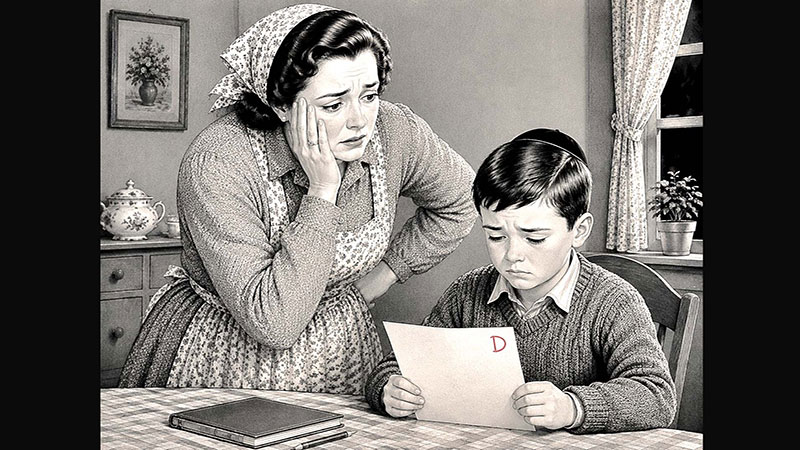
You have to master the ch sound for the next one. How often have you heard “ah broch”? That is similar to “a catastrophe.” It is usually said with an “oy” as in “Oy, ah broch!” When we were kids and did something wrong, Mama would say “Oy ah broch hut mir getrofen!” This happened whenever my little brother Berel would come home with his report card. All Berel’s marks were usually below water – you know, below “C” level.
I’ll never forget how Mama said “Ah broch tsu mir” and clapped her hands to her face when she saw my sister wearing lipstick for the first time. This really seemed like a catastrophe. Who knew where it would lead?
Here’s one that was used quite often around our house. “Ah deighe hob ich,” which means, “I couldn’t care less” or “why should I worry?” Mama would use that combination when my sisters would gang up on her and say, “Ma, we have to go to the movies this week – it’s a Bing Crosby picture!” Mama would say, “Ah deighe hob ich?” She couldn’t have cared less.
Here’s one I well remember: “Ah farshlepter krenk.” It literally means a chronic ailment, but it wasn’t only used for that. For example, when we would have to take the bus to the Catskill Mountains in the summer on the old Route 17, that was “Ah farshlepter krenk.” It could be interpreted as a pain in the neck or a drawn-out illness.
When my sisters would come home from school with an A in work and an A in conduct on a report card, Mama would kiss their foreheads lovingly and say, “Ah gezunt oif dein keppeleh,” which literally meant “Good health on your head.”
How about this one: “Ah glick hut mir getrufen.” That was actually used as a sarcastic remark that meant, “Oh, whoopee, I’m thrilled to pieces.” But since it was sarcastic, it could be interpreted as “forget about it!”
The following was probably the first Yiddish term we learned: “Ah klog tzu mir.” That meant, in its simplest interpretation, “Oh, my goodness gracious!” “Ah klog tzu meine sonim,” which literally meant “a curse on my enemies,” was used when a neighbor would come in to tell Mama the landlord was going to give everybody a 10 percent increase in the rent.
“Ah leben oif dir” was a blessing. It meant, “You should live and be well and have some more experiences like this one.” Mama usually cooed that combination of words to my little brother Berel whenever he passed an arithmetic test – which was quite seldom.
Here’s one phrase Mama and Papa practically wore out: “Ah nechtiger tog.” That meant literally: “A night-like day.” It was a sarcastic expression used to mean something absurd, or “That’s ridiculous!”
How about the word “halevai?” It means “It should only be.” When you hear of someone having good luck, like winning a raffle for a trip to Israel, you might say, “Halevai it should happen to me.”
“An alter bocher” is a single fellow, a bachelor. When a young girl falls in love with an older man, they might say, “Zee gait mit an alteh bocher.”
Here’s one: “An oomglick hut mir getrofen!” Mama would say it every time Berel came home with a note from his teacher asking Mama to make a personal appearance at his school. It means “A catastrophe has befallen me!”
Here’s one we all should use at least once a day: “Azoy!” That means “Really, you don’t say! You mean it?”
There are so many different interpretations for one word or combination of words in Yiddish, it’s difficult to break it down into simple classical sentences. For example, take the word “behaimeh,” meaning an animal. But it means more. For example, if you call someone “ah behaimeh” it means he is an uncouth, foolish person.
Here’s another great one: “billig.” That means cheap, inexpensive. I’m sure you’ve heard the expression “billig vi borscht – cheap as borscht.”
Here’s one you might use if someone comes into your place of business and says, “Someone just hit a car outside. Do you own a red sedan?” If you don’t own the red sedan you’d say, “Chas Vecholileh,” which means “Heaven forbid!”
When you want to describe the tumult that happens when all the relatives’ kids get together for the Seder, you might say “ah chamalyeh!” which means “the ultimate racket.” It’s another way of saying bang, boom, punch, slam, etc.