October 2, 2026
 Categories: Headline / Parsha / Torah
Here & There: Leining Disparitiesand Overlapping Occasions


Sh’mini Atzeret and Simchat Torah
Sh’mini Atzeret and Simchat Torah are observed as one day in Israel and as two separate days elsewhere. This year, the holidays are on Shabbat in Israel, Shabbat and Sunday in Chu”l (Chutz LaAretz).
I grew up in Brooklyn (Crown Heights, to be specific) and then lived in Forest Hills and Kew Gardens Hills, teaching at YCQ, until my aliya at age 33. That was back in 1981. When I came on aliya, I thought I’d miss the second Seder on Pesach. To my surprise, I didn’t. What I did miss – and still feel strange about, 45 years later – is combining Sh’mini Atzeret with T’filat Geshem, and Yizkor with Simchat Torah and its hakafot. A real mix of emotions for only one day. No regrets, of course, just a lingering strange feeling.
* * * * *
Let me share with you some ideas and observations in this shorter-than-usual column (due to limited space this issue).
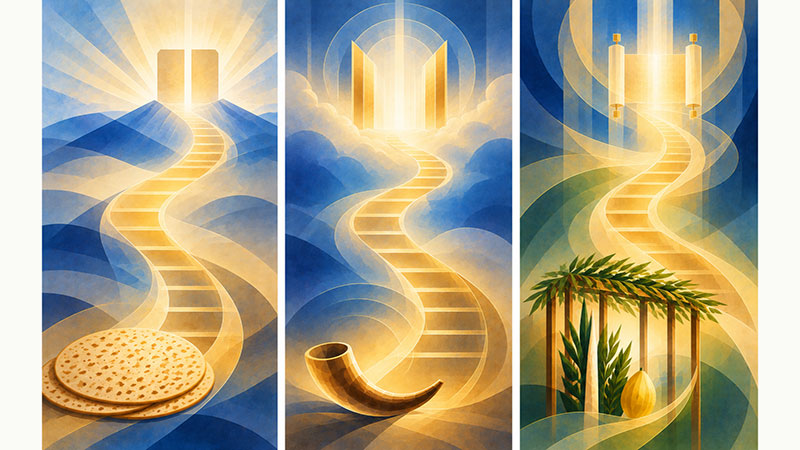
Take a look at pairs of “holydays.” First, Pesach and Shavuot: Pesach has a major mitzva as part of its celebration and observance – matza. Shavuot is on its own. Next, Rosh Hashanah and Yom Kippur: Rosh Hashanah has shofar as its main mitzva to help us focus on the Yom Tov itself. Yom Kippur is on its own. Now, Sukkot and Sh’mini Atzeret: Sukkot has sukka and the Arbaa Minim. Sh’mini Atzeret is on its own.
To clarify, Shavuot has a number of minhagim which help us properly celebrate the chag. Yom Kippur, with the mitzva to fast, certainly does have mitzvot. And Sh’mini Atzeret and Simchat Torah are not devoid of practices that are meaningful to the holiday. I was looking just at the biggies – matza, shofar, sukka, and the four minim. And I was contrasting those with the absence of any major mitzvot on the days that are, in essence, the culminations of their respective preceding holidays.
Shavuot, coming after Pesach, is also called Atzeret. Yom Kippur ends the Ten Days of T’shuva that began on Rosh Hashanah. Sh’mini Atzeret is both a chag on its own and the culmination of Sukkot. As such, may I suggest that when we begin these special sets of days – 51 days in the Pesach-Shavuot period, 10 days for Rosh Hashanah and Yom Kippur, and 8 (or 9) days for the Sukkot set – we have a special mitzva to help us focus and understand what the holidays mean. By the end of each period, we are hopefully completely involved and can finish off without the need for the focal point.
* * * * *
As mentioned in previous columns, Rosh Hashanah, Sukkot, and Sh’mini Atzeret fall on Shabbat in 28.57% of years. When this happens (as it does this year), we experience the impact that Shabbat has on the Yom Tov. We see it in the davening, in Kiddush, in the absence of shofar and lulav, and in the special combination of Kiddush for Yom Tov and Havdala for Shabbat, which are recited together over one cup of wine. We in Israel had our only YaKNeHaZ on the second night of Rosh Hashanah, whereas Jews in Chutz LaAretz have it again on the second night of Sukkot and on the eve of Simchat Torah.
An interesting difference between Israel and elsewhere this year is when we read the last sedra of the Torah, V’zot HaB’racha. Outside of Israel, it is never read on Shabbat – unlike all the other 53 sedras. So too in Israel – except in years like this one. We read that sedra on Shabbat-Sh’mini Atzeret (a.k.a. Simchat Torah). Because we read it on Shabbat, there are seven aliyot rather than the five aliyot of Yom Tov on a weekday. This becomes more noticeable because in many minyanim, the major portion of V’zot HaB’racha is read over and over again so that everyone can get an aliya. All of that is done before the portion read by the Chatan Torah to finish the sedra and the one read by the Chatan B’reishit to begin the Torah once again. And then comes the maftir, read from a third Sefer Torah.
And here’s a result of the difference between Israel and elsewhere: Outside of Israel, at Mincha on Shabbat-Sh’mini Atzeret, the first portion of V’zot HaB’racha is read, since that sedra will be read on the following morning, Simchat Torah. But in Israel, by Mincha-time on our Shabbat-Simchat Torah, we will have already read V’zot HaB’racha. So, we will read the first part of B’reishit, which is the sedra of the upcoming Shabbat.
This can become a riddle to ask your family and friends at lunch on Simchat Torah (or any other time you want to ask it). There are Shabbatot when there is a difference of one sedra between what is read in Israel as opposed to elsewhere. But there is one occasion (this one!) on which we read parts of the Torah which are as far apart as is possible.
* * * * *
Let me finish with a vort I read a long time ago, though it works only for those who daven Nusach Ashkenaz.
It goes something like this: We take the Torah out of the aron kodesh to read in public hundreds of times throughout the year. But it takes the experience of Rosh Hashanah, Yom Kippur, and all of Sukkot with their wonderful mitzvot to finally be able to say, on Simchat Torah, when we take out the Torah: “Ata hor-eita ladaat ki Hashem Elokim, ein od milvado” – You have been shown, in order to know, that Hashem is G-d; there is none else besides Him.
Reading Torah, learning Torah, studying Torah – even living Torah – is not the whole picture. It is the love of Hashem, who gave us the Torah and mitzvot, that completes the picture. That’s what the joy of Simchat Torah is meant to facilitate: Ahavat Hashem.
Shabbat Shalom and Chag Samei’ach!