October 2, 2026
 Categories: Torah
Hide-and-Seek Names & G-dly Garments


Parshat T’tzaveh, Parshat Zachor, and Purim
Parshat T’tzaveh is the 20th sedra of the Torah, the 8th of 11 in Sh’mot. It is written on 179.2 lines in a Sefer Torah, ranking 33rd in that respect. It drops to 35th with its 101 p’sukim and 1,412 words, but rises to 32nd place for letters.
There are seven mitzvot in T’tzaveh – four positives and three prohibitions. Additional mitzvot are found in the sedra, but are counted elsewhere in the Torah.
In the seven year-types of leap years (years with two Adars), T’tzaveh is read on its own. This accounts for 36.84% of all years. In plain (12-month) years, T’tzaveh is mostly paired with Zachor – accounting for 58.83% of all years. And in one year-type with a frequency of 4.33% of years, T’tzaveh is a hafsaka between Zachor and Para. That Shabbat in Yerushalayim is Purim, and T’tzaveh is joined by the 9-pasuk Torah reading of Purim, which is read in a second Torah as maftir. The rest of the Jewish world – in Israel and elsewhere – read only T’tzaveh on that Shabbat.
So, this year, with T’tzaveh and Zachor paired, is the most common situation, occurring in almost 60% of all years.
T’tzaveh is to the kohen’s garments as T’ruma was to the Mishkan. But T’tzaveh also contains elements of the Mishkan as a continuation of last week’s T’ruma.
The sedra starts with the mitzvah to tend to the Menorah in the Mishkan. Tending is done in the morning and includes cleaning out the oil cups whose lights have already gone out, putting in the fresh supply of olive oil and new wicks. Rambam says that the lighting of the Menorah each late afternoon is also part of this mitzvah in T’tzaveh. Other mitzvah-counters point to other p’sukim for the mitzvah of lighting, and say that this mitzvah here in T’tzaveh covers the setting up of the Menorah.
The sedra then continues with the mitzvah of making special garments for the Kohen Gadol and for the regular kohanim. Even though the garments are detailed extensively in the sedra, making the b’gadim (garments) is counted as one mitzvah. Two prohibitions related to the kohanic garments are counted as separate mitzvot – prohibitions – namely that the Choshen (Breastplate) may not be separated from the Eifod (decorative apron-like garment) and that it is forbidden to tear any of the garments, and therefore, certain susceptible parts of the garments have to be appropriately reinforced to prevent tearing.
Next, we have a good number of p’sukim about the seven-day inauguration that was to take place when the Mishkan was ready to operate. Many details about the bull and two rams offered during the seven days. None of this is counted among the Torah’s mitzvot, because it was all a one-shot thing. Only commands that continue day after day, year after year, are counted among the Torah’s Taryag mitzvot.
The above is followed by a description of the daily function of the Mishkan – specifically, the two lambs, one in the morning and one in the afternoon. This is a mitzvah, but it is counted from Parshat Pinchas rather than from T’tzaveh.
The sedra concludes with the making of the Mizbei’ach HaZahav, the Golden Altar, that was to join the Shulchan (Table) and Menorah in the Mishkan itself, the Aron being there too, but separated into the Holy of Holies by the parochet (curtain). The Golden Altar was to be used daily for the Incense Offering (K’toret). This is one mitzvah. And nothing else was to be brought on that Altar (except for the blood that was sprinkled on it on Yom Kippur). All other offerings were made on the external, larger Copper Altar that was commanded in last week’s sedra.
* * * * *
T’tzaveh is “famous” for the absence of Moshe’s name. It is not the only sedra without his name: Of course, the 12 sedras in B’reishit do not have his name. But from his birth in Parshat Sh’mot, he was the main personality for the rest of the Torah. However, in the Book of D’varim, there are several sedras without his name, because he was the main narrator of D’varim, and the Torah would say, “And G-d spoke to me,” rather than the common phrasing in Sh’mot, Vayikra, and Bamidbar of “And G-d spoke to Moshe...”To restate: T’tzaveh is the only sedra in the Books of Sh’mot, Vayikra, and Bamidbar in which Moshe’s name does not occur. “Ata,” the pronoun “you,” is used a number of times, referring to Moshe – but his name is conspicuously absent. (Interestingly, his name is mentioned in the first pasuk of T’ruma, and that’s it for last week’s sedra. So, the two sedras that consist of the majority of the details of the Mikdash and the priestly garments have the name Moshe only once.)
There are two reasons given for Moshe’s name not being in T’tzaveh.
In next week’s sedra, Ki Tisa, after the last pieces of the Mishkan topic are presented, we have the tragic event of Cheit HaEigel, the sin of the Golden Calf. When G-d expresses His “anger” (so to speak) and tells Moshe that He wants to wipe out Bnei Yisrael and start over with Moshe, Moshe passionately says to G-d that if He were to destroy the Jewish Nation, then He should wipe his (Moshe’s) name from the Book which He (G-d, addressed as “You”) wrote.
Even though Hashem “relents” (again, so to speak, which I write in order to recognize that we speak of G-d in human terms – which is not accurate, but is the only way we can relate to Him and hope to understand what’s going on) and does not and would not destroy the People, He basically says to Moshe that he should not have said what he did about erasing his name from the Torah.
We can look at the absence of Moshe’s name as a bit of rebuke to him. Why specifically is he not mentioned in T’tzaveh? Two reasons are suggested. The traditional date for Moshe’s birth and death is the 7th of Adar. T’tzaveh is the sedra that we read right after the 7th of Adar (or of Adar Alef). This adds irony to his name’s absence from this sedra.
The other reason given is that starting in Ki Tisa, when Moshe made his statement, G-d was “reluctant” (so to speak) to erase Moshe’s name, but had to. So, Moshe’s name wasn’t removed from Ki Tisa and the sedras after that, but rather from the final sedra in the following cycle before arriving back at Ki Tisa – which is T’tzaveh. Thus, that was the one from which Moshe’s name was erased.
But there is another reason Moshe’s name does not occur in T’tzaveh – a very nice reason. Vayikra (28:2), towards the beginning of T’tzaveh, contains the command to make the garments for the Kohen Gadol – for Aharon. “You shall make holy garments for your brother Aharon, for honor and glory.” For the sedra that focuses on the honor and glory of Aharon HaKohen (one way of looking at those words), Moshe, his brother, steps out of the picture so that Aharon can take center stage.
Let’s look at the relevant numbers (since that is the name of this column).
Moshe’s name occurs 647 times in the Torah and an additional 120 times in the rest of Tanach, with the Book of Yehoshua having almost half (58) of those occurrences. Moshe’s name occurs 290 times in the Book of Sh’mot, 86 times in Vayikra, 233 times in Bamidbar, and 38 times in D’varim. Ironically (or not), the sedra with the most “Moshe”s is Ki Tisa, the sedra in which he asked G-d to blot out his name if G-d would not forgive Bnei Yisrael for Cheit HaEigel. There are 49 “Moshe’s in Ki Tisa. This count is followed closely by 47 in Va’eira, 43 in B’haalot’cha, and 42 in B’shalach.
Aside from the Book of Yehoshua, Moshe’s name is also found in Divrei HaYamim (21), M’lachim (10), Ezra-Nechemiya (10), T’hilim (8), Shof’tim (4), twice each in Sh’muel, Yeshayahu, and Daniel, and once each in Yirmiyahu, Micha, and Malachi. That leaves no mention of Moshe’s name in Yechezkeil, the other 10 books of Trei Asar, Mishlei, Iyov, or the five Megillot.
* * * * *
Parshat Zachor is read on the Shabbat before Purim. In the Torah, the command to remember what Amalek did to Bnei Yisrael is not connected to any particular time of the year. Our Sages wanted to make the connection between Amalek and Haman – who not only descended from Amalek but behaved in the particular style of Amalek in his desire and efforts to wipe out “every man, woman, and child, the people of Mordechai.”Parshat Zachor is the last three p’sukim of Parshat Ki Teitzei in D’varim. It is written on six lines in a Sefer Torah, and consists of three p’sukim, 47 words, and 178 letters. It is the smallest of the special maftirs. However, it contains three mitzvot of the Taryag – two positives (to remember and to wipe out) and one prohibition (to never forget).
Parshat Zachor is the only Torah reading (some say, so is Para) that is the fulfillment of a Torah command. All other Torah readings throughout the year are Rabbinically mandated.
One point (of many) to focus on with Parshat Zachor: The wording in the Torah is to “Remember what Amalek did to you on the road when you left Egypt.” What this should include is remembering what we were lacking such that an Amalek could threaten us in the first place. And for that, we should note the passages that immediately precede the two Amalek portions in the Torah. “Vayavo Amalek,” at the end of B’shalach, tells of the original attack. Right before that, we read of the episode at Mei M’riva, when the people bitterly complain about the lack of water to drink and the very harsh words they use in their complaint. They seem to be asking, “Is G-d in our midst or not?”
Then, right before Parshat Zachor at the end of Ki Teitzei, we find the commands of having true weights and measures (and not cheating in business), about which the Torah says, “For whoever does these things, whoever perpetrates such injustice, is an abomination to Hashem, your G-d.”
Both portions that precede the Amalek portions point to lacks in bein Adam LaMakom and bein Adam l'chaveiro – serious defects in one’s relationship with G-d and with his fellows. That makes us vulnerable to Amalek.
* * * * *
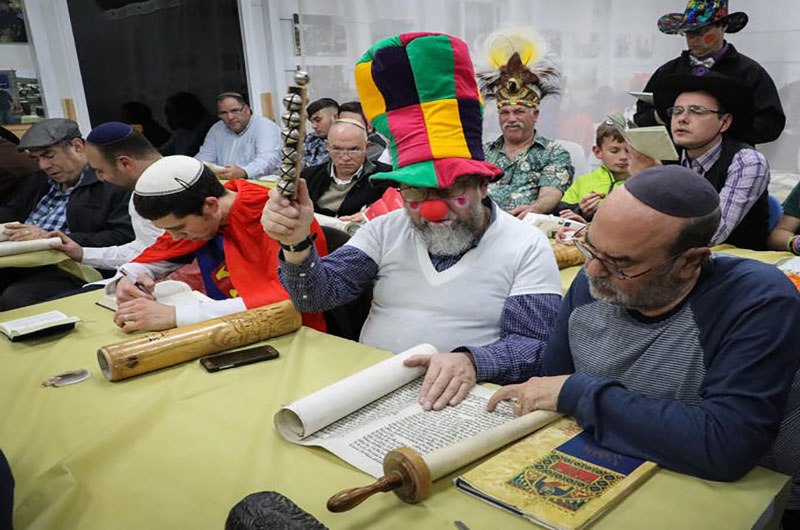
Speaking of Amalek, Purim is coming very soon – next Monday night-Tuesday in most of the world, Tuesday night-Wednesday in Jerusalem, and on both days in a number of locations in Israel that are considered to be in doubt as to Purim being on the 14th of Adar or the 15th. These question-mark places – based on whether they were walled from the time of Yehoshua or not, and whether they are the actual locations of those Biblical cities or not – will read Megila four times, the first two times with b’rachot and the second two without b’rachot.So much to write about Purim, but let me share some interesting numbers with you.
It is said that one should drink more wine than he usually does (without getting drunk, just mellow and happy) until he can’t tell the difference between “Arur Haman” (cursed is Haman) and “Baruch Mordechai” (blessed is Mordechai). Haman and Mordechai are obviously very different. We’re not going to forget that. But the difference between Arur Haman and Baruch Mordechai is much more subtle. They can even be seen as two sides of the same coin. Yet there is a difference in the way we look at things. The downfall of our enemy is necessary for our well-being. But it should not be the main focus of our intention. That we were spared disaster due to the actions of Mordechai and Esther is what should claim first place in our focus on Purim.
Now watch the numbers. Arur Haman = 1+200+6+200 (407) + 5+40+50 (95) = 502. Baruch Mordechai = 2+200+6+20 (228) + 40+200+4+20+10 (274) = 502!
Numerically, they are the same. There is no difference. But regular gimatriya is not all there is. Let’s calculate the AT-BASH gematria which reverses the Alef-Bet and assigns different values to each letter. Arur Haman = 400+3+80+3 (486) + 90+10+9 (109) = 595. Baruch Mordechai = 300+3+80+30 (413) + 10+3+100+30+40 (183) = 596! Just one off. That is a very subtle difference. This subtle difference in numbers echoes the subtle differences between “cursed is Haman” and “blessed is Mordechai.”
Furthermore, look at these numbers: Mordechai is mentioned in the Megillah 58 times. Haman is mentioned 54 times and his wife Zeresh is mentioned four times. Total: Also 58. Esther is mentioned 55 times. Add one more for Hadassah, her other name, and the two times she is referred to as “HaMalka,” the queen. Total: 58. Achashveirosh is mentioned 29 times – that’s half of 58. (One commentator suggested that this is so because he offered half his kingdom to Esther.) Hashem’s name is conspicuously missing from the Megillah, but the occurrence of the word HaMelech (without the name Achashveirosh) over 100 times is considered to be a remez (hint or allusion) to G-d – to Him being behind the scenes in the Purim story.
Two more numbers related to Megillah. The longest word in Tanach is “V’ha-achash-dar-p’nim” (11 letters). And the longest pasuk in Tanach is also in the Megillah – Esther 8:9, with 43 words.
Have a wonderful Shabbat – remember and don’t forget – and have a very Happy Purim. May we see Hashem’s smile upon us, His people, with the downfall of today’s Amalek-like enemies and victory for Am Yisrael.