 October 9, 2026
 How We Know a Sefer Was Owned By the Noda BeYehudah
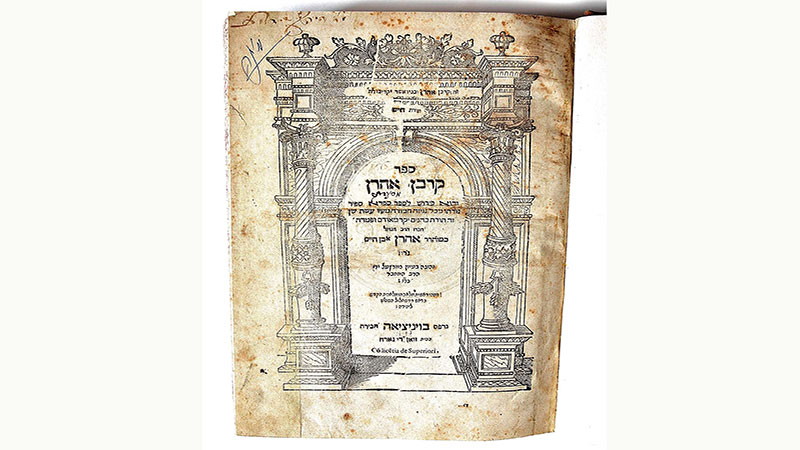


An exciting acquisition I made this week is an important and highly intriguing provenance copy of Rabbi Aaron ibn Hayyim’s monumental Korban Aharon on the Sifra, from the library of one of the greatest halachic authorities of the early modern period, Rabbi Yechezkel Landau, author of the celebrated Noda BeYehudah. The volume bears the Noda BeYehudah’s distinctive concealed signature, Misaadetecha, the name Yechezkel rendered, letter for letter, through the ancient cipher of Atbash, together with the ownership inscription of Rabbi Hirsch Shidlov. The use of ciphers and concealed names as signatures possesses a surprisingly ancient Jewish pedigree. Already in the period of the Genizah, Jewish scholars employed ingenious forms of letter substitution in personal signatures and ownership marks, including Atbash. Centuries later, this venerable practice found an especially elegant expression in the library of the Noda BeYehudah. The otherwise innocuous-looking word Misaadetecha – mem, samech, ayin, dalet, tav, chaf – when transformed through Atbash, becomes Yechezkel – yud, chet, zayin, kuf, aleph, lamed. What might appear at first glance to be an ordinary Hebrew word is therefore, in fact, the carefully concealed name of the great Prague posek himself.
The attribution, however, rests on far more than the appearance of the signature alone and the comparison of his handwriting. It is reinforced by a remarkable chain of documentary provenance connecting the present volume directly with other books known to have belonged to Rabbi Yechezkel Landau. A copy of Korban Netanel from the library of the Noda BeYehudah bears an explicit ownership inscription by his son, identifying the volume as belonging to his father. Immediately beneath that inscription appears Misaadetecha, accompanied by an autograph scholarly gloss in the hand of the Noda BeYehudah himself. A second documented Landau volume, Knesset HaGedolah, likewise bears the same distinctive Misaadetecha, together with inscriptions by his son and sons-in-law establishing his ownership. It is this second volume that provides the particularly compelling additional link to the present Korban Aharon. At the top of its title page appears the ownership inscription R. Hirsch Shidlov. The present copy bears the same striking combination: Misaadetecha, together with R. Hirsch Shidlov. The recurrence of this highly unusual pairing in two separate volumes is of enormous significance. One of these books is independently documented as having belonged to Rabbi Yechezkel Landau, while the present Korban Aharon preserves the identical combination of the concealed Landau signature and the Hirsch Shidlov ownership inscription. The convergence of these independent provenance marks makes the identification of the present volume as a book from the Noda BeYehudah’s library particularly compelling.
The cipher itself appears to have been a distinctive feature of the scholarly milieu surrounding the Landau family. Rabbi Yechezkel Panet, author of Mareh Yechezkel, who studied in Prague in the circle of the Noda BeYehudah’s son, Rabbi Shmuel Landau, also employed Misaadetecha as an ownership mark. The surviving examples attributed to Rabbi Panet, however, are written in a completely different hand from the inscription found in the present volume, an important distinction when evaluating the various examples of this unusual practice. There was, moreover, a broader family tradition of concealing names through literary and cryptographic devices. The Noda BeYehudah’s son, Rabbi Yisrael Landau, concealed his own name on the title page of Chok LeYisrael through initials and final letters, and again concealed the words HaKatan Yisrael HaLevi Landau MiPrag as an acrostic within his introductory poem. In this context, the Noda BeYehudah’s use of Atbash to conceal his own name is not merely a bibliographical curiosity but part of a fascinating tradition of sophisticated personal identification practiced within the Landau scholarly circle. The documented appearance of Misaadetecha in several books known to have belonged to the Noda BeYehudah, combined with the extraordinary recurrence of Hirsch Shidlov + Misaadetecha in both the present volume and the independently authenticated Landau copy, provides an unusually strong constellation of provenance evidence and powerfully reaffirms the attribution.
The book itself is worthy of its remarkable history. Rabbi Aaron ibn Hayyim (1545–1632), one of the leading Sages of Fez, travelled to Venice in order to bring his works to print. His Korban Aharon is the great early commentary on the Sifra, also known as Torat Kohanim, and constitutes one of the foundational commentaries on this important tannaitic work. It was preceded by his Middot Aharon, his extensive treatment of Rabbi Yishmael’s thirteen hermeneutical principles, which Heller described as possibly the most thorough early exposition devoted to the subject. The two works account for the separate foliation found within the volume, and together they represent the substantial contribution of one of the great North African rabbinic scholars to the literature of Torah interpretation and methodology.
An additional curiosity appears on the verso of the title page: a remarkable Venetian printer’s device depicting a partially nude crowned female figure standing above a seven-headed dragon, accompanied by the biblical verse Veyitav ha-melech yofyech, from Psalms 45:12. The same striking device had previously appeared in the celebrated Venice Rambam of 1574–1575, printed at the Bragadin press, and its appearance here is exceptionally rare. Thus, the very leaf which records the volume’s bibliographical identity preserves on its reverse one of the more unexpected images encountered in early rabbinic printing. The juxtaposition is extraordinary: on one side, the discreetly encrypted name of Rabbi Yechezkel Landau, concealed through an ancient Jewish cipher and preserved within the library of the great Prague posek; on the other, a distinctly Renaissance Venetian printer’s device, complete with crowned female figure and seven-headed dragon. Through the survival of this remarkable volume, these seemingly disparate worlds, sixteenth and seventeenth century Venetian printing, the scholarship of the Sages of Fez, and the private library of the Noda BeYehudah, come together in a single, exceptionally evocative copy.